
Why government buyers keep coming back to solar street lighting
A government solar street light supplier is rarely chosen on price alone. Public buyers are usually trying to solve a familiar set of problems at once: extend lighting into places where trenching is expensive, reduce electricity dependence, and keep roads, parks, and pedestrian routes safer after dark. In many projects, the decision is not simply “solar or not.” It is whether a solar lighting system can support a site with fewer civil works, less disruption, and manageable maintenance over time.
That is why the buying process is more demanding than it looks from the outside. A road authority, municipality, or public works team is not just purchasing a fixture. It is selecting a lighting package that has to survive weather, public use, and budget scrutiny. The right solar street light supplier for government work should be able to speak to field conditions, not just catalog pages. The wrong one may offer attractive photos and weak documentation, which is usually where trouble begins.
What government buyers are really trying to compare
For sourcing teams, the key question is not whether solar lighting works in principle. It does. The question is where it works well, what level of illumination is appropriate, and what kind of upkeep the authority can realistically support. In public projects, the decision often comes down to three trade-offs: installation cost versus long-term operating savings, lighting performance versus autonomy during poor weather, and simple hardware versus the flexibility of smarter controls.
That comparison matters because outdoor lighting is tied to public safety and public perception. A dim path can feel neglected. A well-lit walkway or road edge can make a site look more usable and easier to navigate. The same logic applies whether the project is a municipal street, a campus road, a park path, or a civic courtyard.
Where a solar lighting package can fit best
Solar street lighting is often strongest in locations where utility extension is difficult, expensive, or slow to approve. That includes peripheral roads, service lanes, pathways in new developments, park edges, and community circulation routes. It can also be useful where the goal is to light a space without opening pavement for cabling.
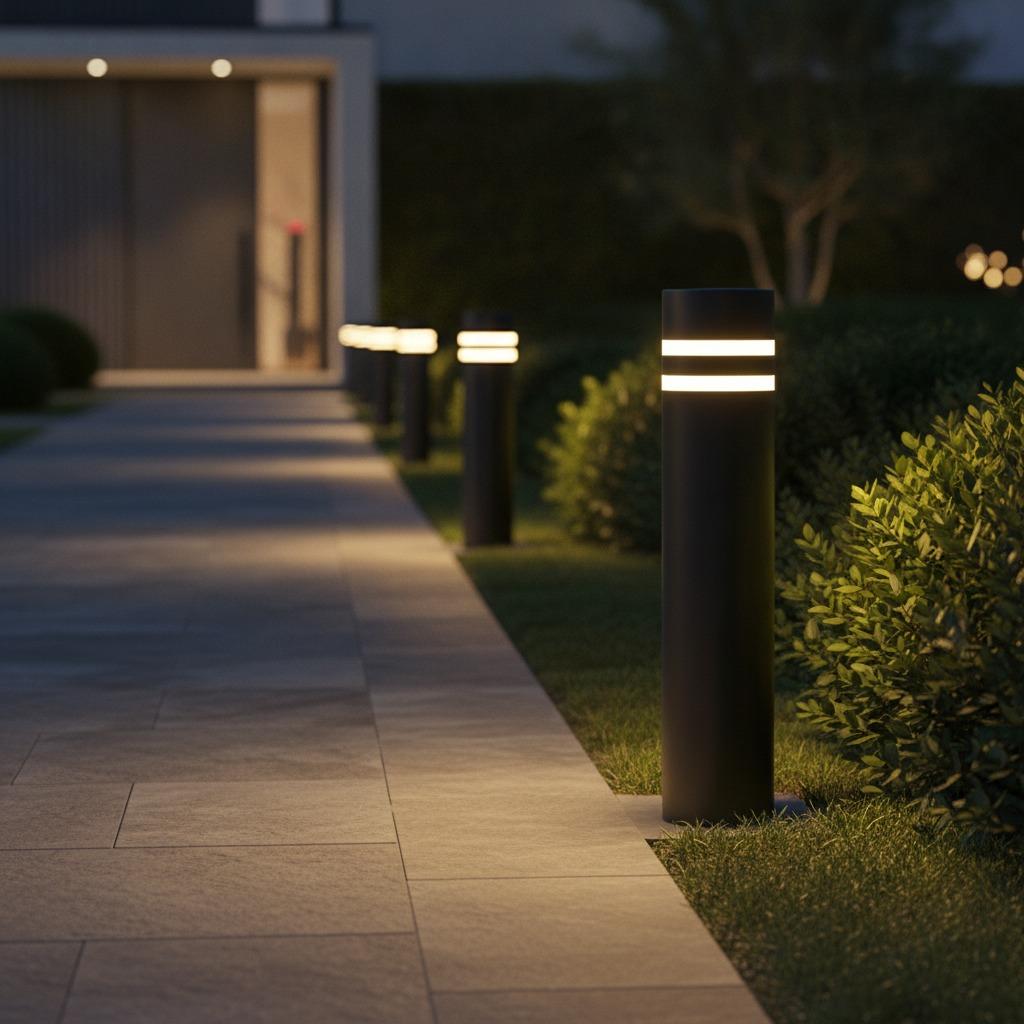
The product image provided here shows an outdoor bollard light, not a full-height street pole. Still, the same design logic is useful to understand: a low-mounted, sealed fixture with a dark cylindrical body, a grounded base plate, and two illuminated bands for visible wayfinding. In government settings, similar low-level lighting is often used around walkways, landscape borders, and courtyards where glare control and pedestrian guidance matter as much as brightness.
What to look for in a supplier, beyond the brochure
Documentation that matches the site
A public project needs more than a product image. Buyers should ask for clear technical documents, layout support, and a realistic explanation of system behavior in local conditions. If the supplier cannot explain battery autonomy, seasonal output changes, or maintenance access in plain language, that is a warning sign. A polished sales sheet does not help when the install team has to make decisions on site.
Build quality that suits outdoor duty
For outdoor lighting, the housing, finish, sealing, and mounting method matter. A metal body with a durable coated finish is a sensible starting point for many exterior applications, but the buyer still needs to confirm the actual construction and weather protection level before release. Government buyers should be careful not to assume a neat appearance means the fixture is ready for long-term public exposure.
Serviceability and replacement planning
Public lighting is easier to defend when maintenance is straightforward. That means accessible components, clear spare-part availability, and an installation method that does not create a special-case headache every time one unit fails. This is one of those unglamorous details that gets ignored until the first round of repairs.
Common mistakes in public solar lighting procurement
One common mistake is buying to a headline wattage or lumen figure without checking how that output is achieved and sustained. Another is treating every site as if it has the same solar exposure. Shaded roads, tree-lined paths, and winter conditions can change the outcome quickly. It is also easy to under-specify the mounting and foundation details, especially for projects that involve both street-scale and pedestrian-scale lighting.
Another practical issue is overpromising on aesthetics. A clean, minimalist fixture can look strong in renderings, but the real test is whether it stays readable, consistent, and safe after months of weather. For landscape and pathway applications, the kind of cylindrical bollard shown in the product information can work well as a visual guide, but only if the actual light distribution matches the route and spacing.
How to evaluate a manufacturer for public projects
A credible solar street light manufacturer should be able to support specification work, not just sales. In practice, that means helping the buyer compare site conditions, fixture layout, and maintenance assumptions. It also means being clear about what is known and what is not. If a supplier claims performance details that are not backed by documentation, that should slow the purchase process down, not speed it up.
For government work, a useful short list is simple: does the supplier understand public procurement, can they provide consistent product information, and do they have a realistic answer for long-term support? That last point matters more than many teams admit. A lighting project that looks inexpensive at award stage can become costly if replacement parts or technical support are hard to get later.
Buyer questions worth asking before award
Ask how the system performs after several cloudy days. Ask how the fixture is mounted and serviced. Ask what parts are replaceable and how failures are handled. Ask whether the proposed product is intended for roads, paths, courtyards, or landscape edges, because those are not interchangeable use cases. And if the supplier is offering a low-level bollard or pathway fixture rather than a true streetlight, make sure the application is still appropriate. That sounds obvious, but mismatches happen more often than people expect.
Choosing the right path forward
If your project is public-facing and the lighting decision has to balance safety, cost control, and speed of deployment, the safest approach is to build the specification around the site first and the product second. A government solar street light supplier should help you do that. Look for evidence of practical understanding, not just broad claims. For simpler pedestrian zones, a well-designed outdoor bollard light may be the right fit. For roads and larger circulation areas, the system requirements are different and should be reviewed carefully.
If you are comparing suppliers now, start with the site map, the maintenance plan, and the real lighting target. That sequence saves more projects than a last-minute price reduction ever will.