
Why a municipal solar street lighting supplier matters more than the fixture brochure
Choosing a municipal solar street lighting supplier is not just a lighting purchase; it is a public-infrastructure decision. For cities, townships, campuses, and industrial estates, the real question is whether the supplier can deliver a system that works outdoors every night, with limited maintenance and without turning the installation into a cabling project. That is especially relevant when the project sits on a long roadway, a new development, or a site where grid extension is slow or expensive.
The market often looks simple at first glance: a pole, a solar panel, an LED light head, and a battery somewhere in the assembly. In practice, the details decide whether the project becomes a dependable asset or a recurring complaint. A good municipal solar street light supplier should help the buyer think through layout, battery type, mounting, light distribution, and maintenance access before anyone starts placing orders.
1. Start with the use case, not the hardware
Solar street lighting for municipalities is rarely one-size-fits-all. A roadway wants consistent illumination and spacing. A park path may need lower mounting height and softer light. A campus or estate may care more about pedestrian comfort and low disturbance than long-range throw.
Look at the project first:
- Roads and streets: prioritize uniform coverage and reliable nighttime operation.
- Parking areas and walkways: prioritize visibility, safety, and glare control.
- Industrial parks and large estates: prioritize easier installation and reduced trenching.
- Public spaces and campuses: prioritize maintainability and a clean visual profile.
This sounds obvious, but it is where many projects drift. The wrong fixture spec can still look fine on paper and fail in the field.
2. Check how the supplier handles the system, not just the lamp
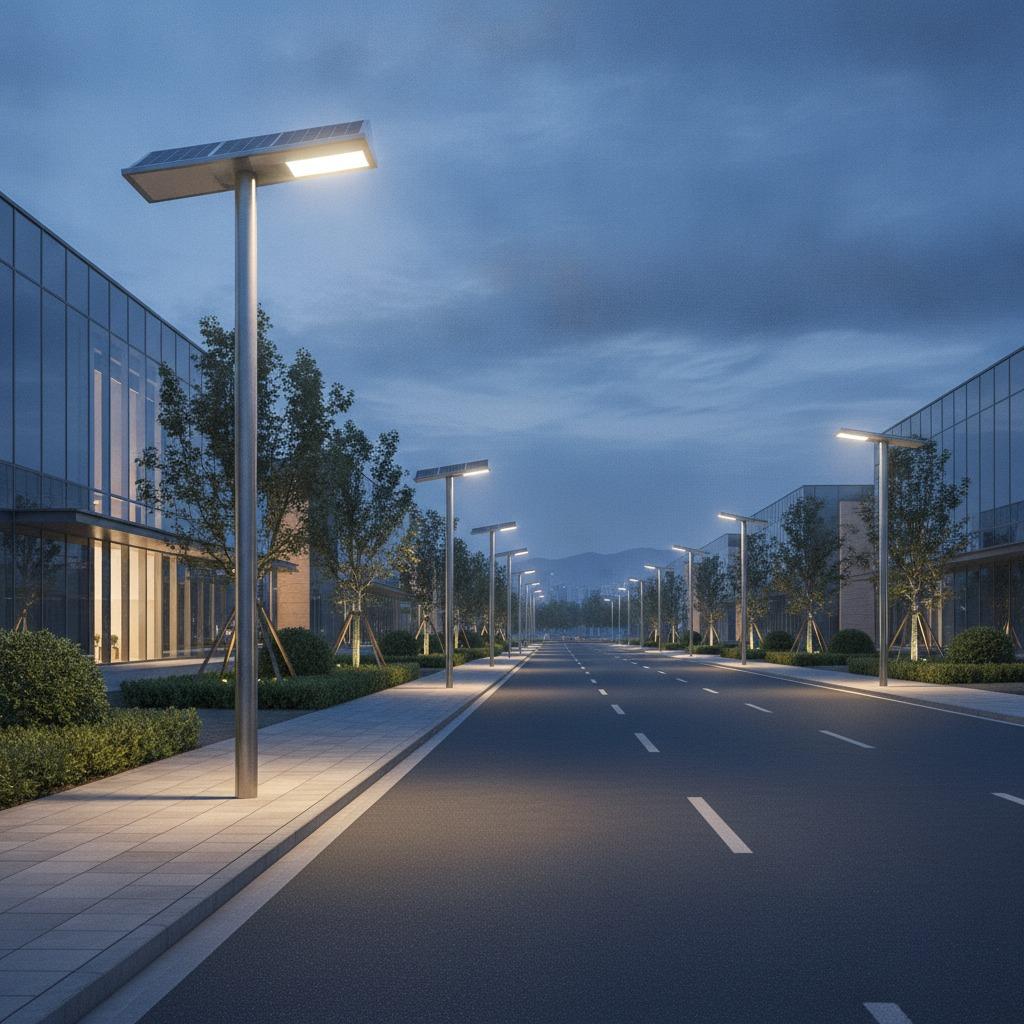
The image and product description point to a pole-mounted solar street light system with a photovoltaic panel, an LED luminaire, and a dark-coated metal pole and arm. That is the visible part. The real performance depends on what is not visible: battery integration, controller logic, charging behavior, and the quality of the assembly.
Ask whether the supplier provides a complete outdoor lighting system or only partial components. Municipal buyers usually need more than a light head. They need a coordinated package that can be installed repeatedly along a roadway without every pole becoming a custom job.
If the supplier mentions LiFePO4, treat that as a useful sign, but still ask how the battery is integrated and serviced. Lithium iron phosphate is commonly selected in outdoor solar lighting for cycle life and thermal stability, yet the buyer still needs clarity on replacement access and enclosure design. The battery may be internal or split-type; do not assume from a picture alone.
3. Compare the structural details that affect field durability
Municipal lighting lives outdoors, so the pole, arm, and light housing matter almost as much as the electronics. A straight cylindrical pole and angled arm are common for solar street lighting because they are straightforward to manufacture and install. But buyers should still look closely at finishing and joint quality.
- Coating: dark gray or black finishes can look clean and weather well, but confirm the coating process and corrosion protection approach.
- Arm geometry: a stable angle helps position the panel for sun exposure and the luminaire for roadway coverage.
- Housing design: the LED module should be practical to service, not just sleek in photos.
- Panel placement: the panel should be angled for local sun conditions, not merely attached wherever it fits.
One practical caution: if a supplier cannot explain how the unit handles rain, heat, dust, and long daily cycling, that is a warning sign even if the brochure looks polished.
4. Ask for deployment logic, not vague “project support”
Municipal projects are about repeatability. A supplier that can furnish one sample may not necessarily support a long roadway of identical units. Good sourcing teams look for help with spacing assumptions, pole placement, and the logic behind consistent lighting across a site.
For a municipal solar street lighting supplier, the value is often in making the rollout easier. That may include advising on where solar street lighting for municipalities works best, how to arrange the poles, and how to balance cost with night-time performance. It is less glamorous than a product render, but it is the part that saves field rework.
5. Do not ignore maintenance and replacement planning
Solar lighting gets sold as low-maintenance, which is mostly true compared with wired infrastructure. Still, public buyers should plan for cleaning, inspection, and eventual battery or component replacement. A supplier should be able to explain how the system is maintained without making the process unnecessarily disruptive.
Key questions include:
- How is the battery accessed if replacement is needed?
- Can the LED luminaire be serviced without replacing the entire pole assembly?
- What inspection routine is realistic for municipal crews?
- Are spare parts standardized across the project?
That last point matters more than many teams expect. Standardization is not flashy, but it keeps the asset manageable years later.
6. Watch for overspecification and underspecification
There are two common mistakes in municipal procurement. The first is buying a system that is more complicated than the site needs. The second is buying something so lightly specified that it cannot meet real-world conditions. Both can happen when the buyer focuses only on headline features.
Be careful with claims that are not backed by project context. Exact wattage, autonomy days, lumen output, pole height, and panel size should be discussed as part of the actual site plan, not guessed from a catalog page. If a supplier offers those numbers too casually without asking about the location, lighting class, or usage pattern, that is worth pausing over.
7. Use a shortlist that respects both engineering and procurement
A practical shortlist for municipal buyers is simple:
- Can the supplier explain the whole system, not just the lamp head?
- Do they understand roadside, campus, parking, and walkway applications?
- Can they discuss battery integration carefully, including LiFePO4 where relevant?
- Do they show consistent manufacturing details in the pole, arm, panel mount, and luminaire?
- Can they support repeated deployment across a long roadway or large site?
If the answer is yes to most of those points, you are probably dealing with a supplier that understands municipal work, not just outdoor decor lighting.
FAQ: common buyer questions before placing an order
Is solar street lighting only for off-grid sites?
No. It is often chosen for off-grid locations, but it is also useful where trenching, cabling, or utility connection is expensive or inconvenient.
Are all solar street lights the same?
Not really. The panel, battery strategy, pole design, controller behavior, and serviceability can vary a lot from supplier to supplier.
What should I request from a supplier first?
Start with a site-specific proposal and a clear explanation of how the system is assembled, maintained, and scaled across multiple poles.
Next step: ask for a project-level quotation, not a generic catalog reply
If you are sourcing a municipal solar street lighting supplier, ask for a proposal tied to your roadway, campus, park, or estate rather than a one-line product pitch. The best suppliers will talk through the application, the system layout, and the practical trade-offs before they talk price. That is usually the difference between a lighting purchase that looks good in procurement and one that works year after year in the field.