
A streetscape project where lighting had to do two jobs at once
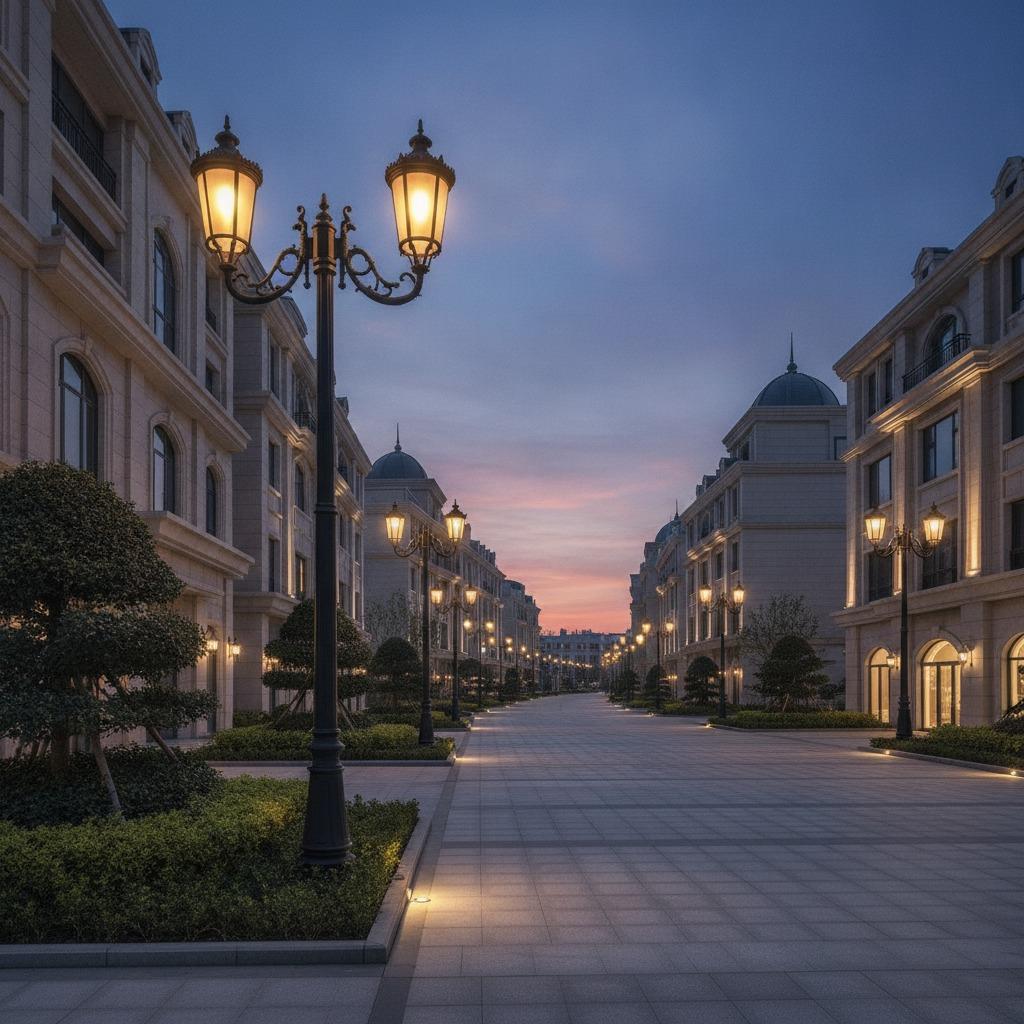
A decorative street light manufacturer is usually brought into a project when the brief stops being just “add light” and becomes “shape the place.” That was the situation in a recent streetscape-style installation built around long, linear rows of pole-mounted lanterns. The visual cue was clear: tall metal poles, ornate dual-arm brackets, and paired lantern heads creating a repeated rhythm along the walkway. The practical goal was equally clear: provide usable area illumination without turning the avenue, plaza, or promenade into a plain utility corridor.
That is the real buying question behind this product category. Engineers and sourcing managers are not only comparing fixtures; they are comparing how a lighting system will change the reading of a space after dark, how much maintenance it may demand, and whether the look will still feel credible five years later. Decorative lighting can improve a district noticeably, but only if the geometry, finish, and installation approach make sense for the site.
What the installation shows at a glance
This style of outdoor luminaire is built around a tall pole with scroll-like metal work and a symmetrical lantern arrangement. In the example here, each pole carries two suspended lantern heads on curved arms. The dark bronze or black finish helps the fixtures blend into landscaped and urban settings without disappearing entirely, which is often the point. The light output appears warm, giving the walkways a softer night-time character than a harsh white utility lamp would.
For buyers, that combination matters because it tells you the product is doing two jobs: lighting the area and contributing to the identity of the street. A decorative street lights manufacturer has to solve both at once. If either side is weak, the project tends to show it quickly. A beautiful pole with poor spacing looks underlit. A bright luminaire with clumsy ornament looks out of place.
Why decorative lighting is often specified for public-facing spaces
Municipal streets, residential compounds, commercial promenades, parks, hotel grounds, and campus pathways all benefit from lighting that feels intentional. In those environments, the pole is not hidden; it is part of the public furniture. That means buyers must think beyond electrical performance and ask whether the fixture supports the architecture and the pedestrian experience.
There is also a maintenance angle that gets overlooked during early design meetings. Ornamental scrollwork, finials, and lantern housings can create visual richness, but they also add surfaces that need durable coating and careful fabrication. On a project with many poles installed in sequence, small inconsistencies become visible fast. If a decorative street light manufacturer cannot repeat the same proportions and finish across a long run, the whole avenue starts to look uneven.
What to check before you commit to a supplier
1. Match the fixture style to the site
Heritage districts, hospitality projects, and landscaped public spaces often call for different visual language than a modern transit corridor. The lantern form, arm sweep, and pole profile should fit the architectural context. Buyers sometimes focus on the head design and forget the pole base and bracket proportion, which are just as visible at street level.
2. Ask how the decorative parts are made
The product shown here appears to use painted or coated metal components, likely combining fabricated pole sections with decorative scrollwork and lantern assemblies. That is common in this category. The practical issue is consistency: weld quality, alignment, coating coverage, and assembly accuracy affect both appearance and service life. Exact material grades and corrosion systems should always be confirmed in the technical submittal, not assumed from photographs.
3. Look closely at the optical outcome
Decorative fixtures are sometimes selected first for appearance and only later tested for glare control and spacing. That is a mistake. A streetscape can look attractive in the daytime and still feel patchy at night if the beam distribution is wrong. Warm light may suit the mood, but it still needs to reach the walking surface properly.
Common buyer mistakes on projects like this
One common mistake is treating all decorative street light manufacturer options as interchangeable. They are not. Some suppliers are stronger on casting and ornamentation; others are better at structural fabrication or luminaire integration. Another mistake is ordering from a catalog photo alone. A product may look balanced in an image yet differ materially in arm dimensions, housing depth, or finish quality when installed at scale.
A smaller but practical warning: do not over-ornament a site that already has strong architectural detail. The lighting should support the scene, not compete with it. That sounds obvious, but procurement teams still get pulled toward the most elaborate option when a restrained design would age better.
How sourcing teams can evaluate offers more effectively
When comparing a street light decorative manufacturer or any decorative street lights manufacturer, ask for the information that helps you judge repeatability and fit: construction method, coating specification, lamp type compatibility, mounting details, and the way the lantern assembly is serviced. If the project is municipal or public-facing, it is also worth confirming the maintenance approach early, because decorative products can be harder to service than plain poles.
A useful internal test is simple: can the supplier explain why the product looks the way it does, not just what it is made of? Good manufacturers can connect design choices to streetscape use. That usually tells you more than a polished brochure.
FAQ for buyers
Are decorative street lights only for aesthetic projects?
No. They are often chosen for real functional lighting in public spaces where appearance also matters.
Can one design work for both municipal and private projects?
Sometimes, but the mounting, spacing, and finish requirements may differ. Private compounds may prioritize visual continuity; municipal projects may lean harder on durability and maintenance access.
What should be verified before ordering?
Confirm the technical details that are not obvious from the image: pole height, output performance, protection rating, structural capacity, and installation method.
A practical next step
If you are evaluating a decorative street light manufacturer for a streetscape or promenade project, start with a sample drawing, a finish reference, and a discussion of the site conditions. That will tell you quickly whether the supplier understands both the decorative and the engineering side of the job. The right partner should be able to balance appearance, repeatability, and long-term serviceability without making the lighting feel overdesigned.