
How a Port Operator Evaluated a High Mast LED Flood Light Supplier for a Night Shift Upgrade
When a logistics yard starts running later into the evening, lighting stops being a comfort item and becomes part of the operating system. Forklifts need clear sightlines, container handlers need depth perception, and security teams need to see what is happening at the edge of the property. That is usually when buyers begin searching for a high mast LED flood light supplier, not because they want a prettier yard, but because the old fixtures are no longer doing the job.
A recent yard upgrade case is a good way to frame the decision. The site was broad, paved, and open, with traffic moving across long distances. The existing lighting created pockets of brightness and dead zones between poles. From a buyer’s point of view, the issue was not simply lamp replacement. It was coverage, mounting height, beam distribution, and how many poles would be needed to light the space without overcomplicating maintenance.
What the buyer was actually solving
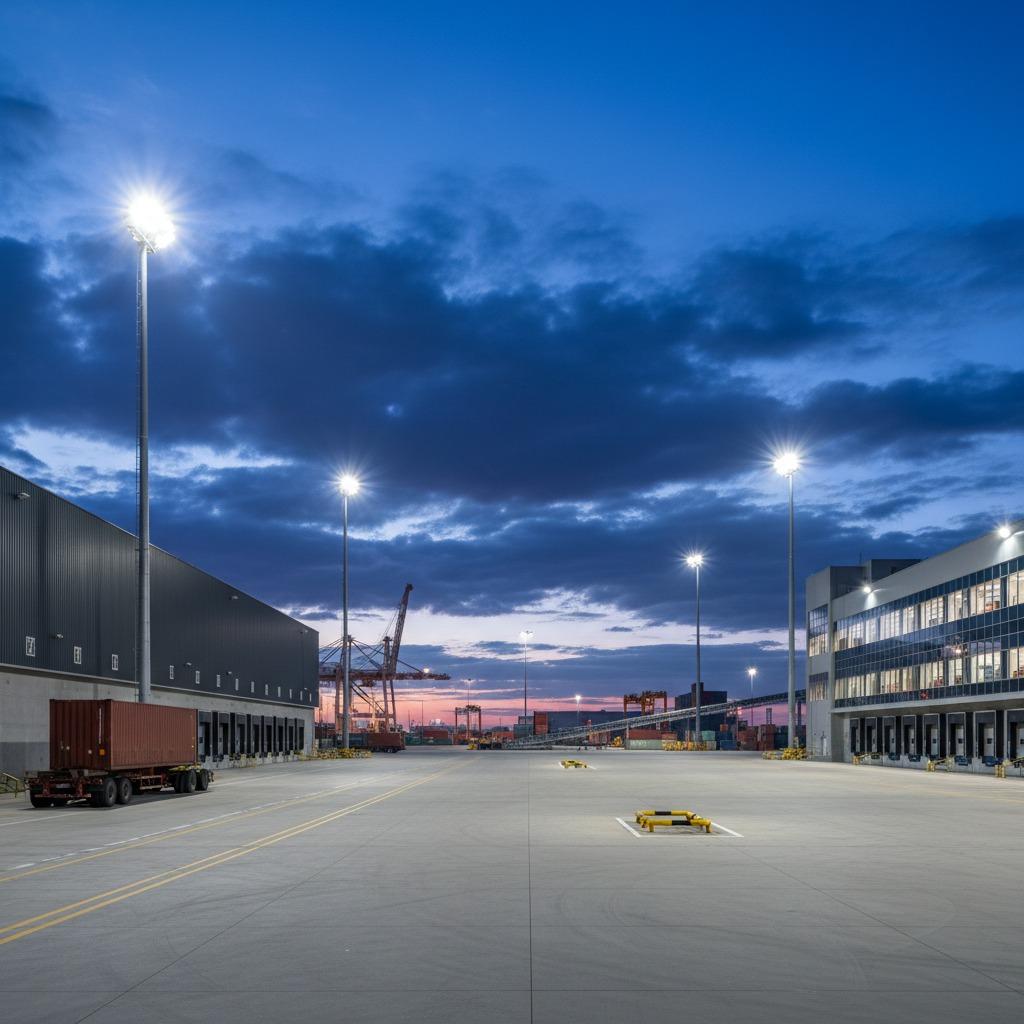
Large outdoor sites such as container yards, freight terminals, depots, and industrial parks have a different lighting problem from a warehouse aisle. The target is not close-up task light; it is uniform visibility across a wide area. High mast LED floodlight systems are built for that kind of work. They use tall metallic poles, often steel or aluminum in appearance, with clustered LED light heads mounted high above the ground. From there, the fixtures throw bright white light across a broad footprint.
In this case, the buyer wanted fewer dark lanes between work zones and a more reliable nighttime environment for operators and security staff. That is a common pattern. People often start by asking for more watts, when what they actually need is better placement and a more coherent lighting layout.
Supplier evaluation: what mattered more than the brochure
The strongest suppliers in this category do not just sell fixtures. They help match the lighting concept to the site. For a high mast lighting supplier, the useful conversation usually starts with pole height, spacing, yard dimensions, and the type of movement taking place after dark. A port, for example, has different glare concerns than a parking area. A freight terminal also has different maintenance expectations than a remote industrial yard.
The buyer in this case looked closely at three practical questions:
First, would the elevated luminaire arrangement actually cover the open area evenly, or just create bright islands? Second, were the fixtures designed for outdoor exposure and weather, at least in general terms of rugged industrial use? Third, how would maintenance be handled if a light head failed at height? That last question is often overlooked during early sourcing, then becomes expensive later.
Why the geometry of the system matters
High mast lighting is a system, not a single product. The pole height, the number of LED heads, and the distribution around the yard all affect performance. A high mast LED floodlight manufacturer may offer multiple configurations, but the buyer still needs to think in terms of coverage patterns rather than catalog models.
In the yard case, several poles were distributed around a wide paved area to achieve uniform illumination. That is a sensible approach for sites with open lanes and moving equipment. The bright white output also helped improve visibility for markings, vehicles, and edge lines, although actual performance depends on the final lighting design and site conditions.
Common mistake: choosing by fixture count alone
A common buyer error is to compare only the number of luminaires on each pole. More heads do not automatically mean better lighting. If the optics, aiming, or pole placement are wrong, the yard can still feel patchy. That is why experienced sourcing teams ask for a layout concept, not just a product sheet.
What the case suggests for sourcing teams
If your site looks anything like a container yard, depot, warehouse apron, or industrial park, the supplier choice should be based on fit to application. The best high mast LED flood light supplier is usually the one that can explain how the system will be arranged for your specific footprint, not the one with the brightest headline claims.
A cautious buyer should also confirm what is included and what is not. The visible product information suggests outdoor industrial lighting equipment with clustered LED heads on tall metal poles, but it does not verify electrical specifications, control systems, pole construction details, or service scope. Those points should be clarified before any purchase order is issued.
Buyer checklist before you request a quote
Ask for a site-based lighting approach, not a generic recommendation.
Confirm pole height, spacing, and how many masts are proposed.
Check whether the fixtures are intended for weather-exposed industrial use.
Ask how the supplier handles installation support, maintenance access, and replacement planning.
If the project is safety-critical or runs around the clock, ask for a layout that reduces glare and dark zones rather than simply increasing total output.
Where this usually leads
For large open sites, the right lighting partner can change how the yard functions after dark. Operators move with more confidence, security patrols see farther, and loading activity tends to feel less improvised. If you are comparing options now, use your site dimensions, working hours, and maintenance constraints as the starting point. Then talk to a supplier that understands high mast outdoor illumination as a system, not just a fixture sale.
That is usually the fastest path to a result that holds up after installation, which is where the real test begins.