
When a Port Yard Needs More Than “Brighter Lights”
Choosing a high mast LED flood light supplier is rarely about buying a lamp. In ports, logistics terminals, rail yards, and large industrial lots, the real issue is coverage: how to light a broad, open area without leaving dark pockets, glare, or maintenance headaches. That is why many buyers end up comparing tall mast systems rather than smaller perimeter fixtures. A high mast LED flood lighting system is built for distance and spread, with multiple luminaires mounted near the top of each pole to wash light across container rows, apron zones, parking areas, and other wide spaces.
For sourcing teams, the decision is practical. You are not just selecting a product; you are choosing how the site will operate after dark, how safely vehicles move, and how often maintenance crews will need to return to the top of a mast. That last point matters more than many first-time buyers expect.
A Real-World Use Case: Wide-Area Lighting With Fewer Poles
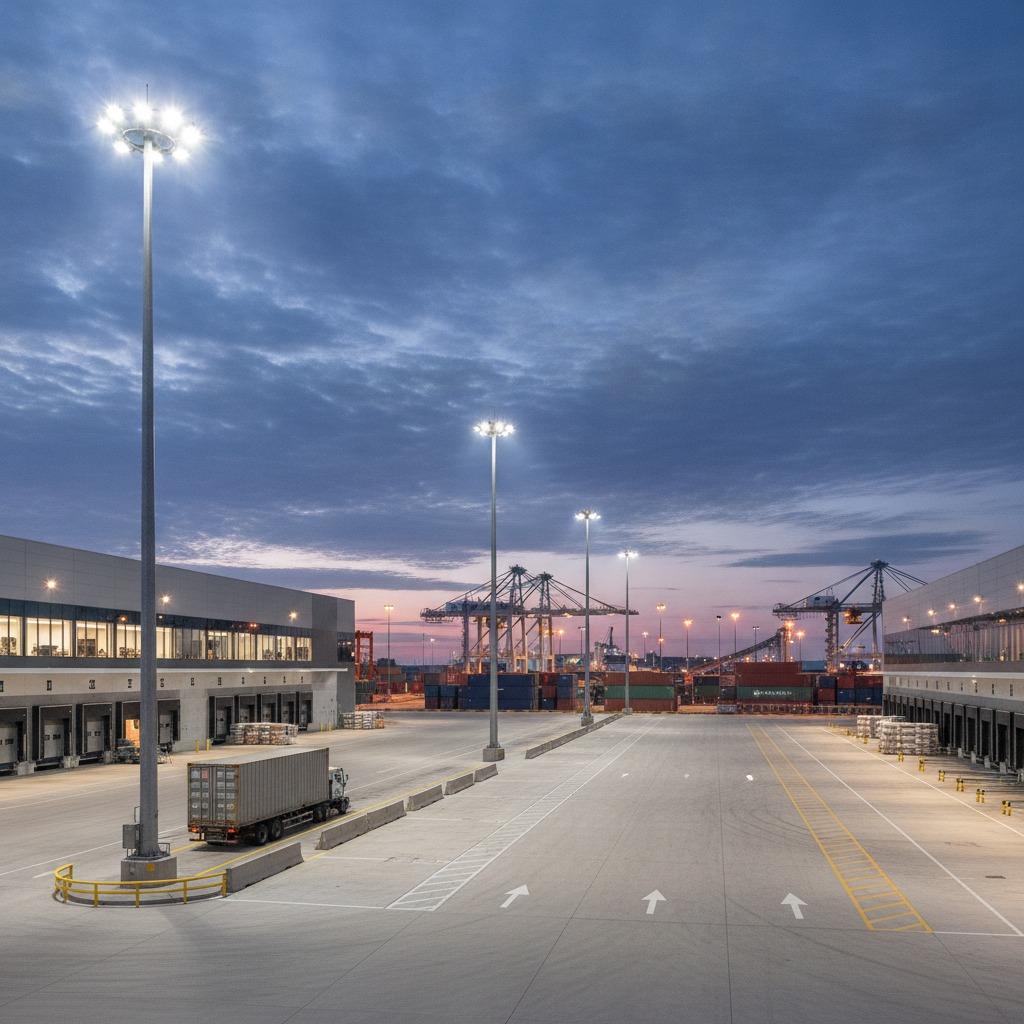
In one typical application scenario, a port or freight operator needs to illuminate an open yard where trucks, forklifts, and container handlers move in several directions at once. Standard wall packs or low poles usually create overlap in some areas and shadows in others. A high mast arrangement solves that by lifting the light source high above the activity zone. The result is more even coverage over a large footprint, especially when the site is full of tall equipment and stacked cargo.
The visible structure of this system is straightforward: slim cylindrical poles, metallic finishes, and clusters of LED heads arranged at the mast top. That configuration is common in outdoor industrial lighting because it supports broad distribution and keeps the light source above obstructions. The housings in the image appear metallic in white or silver tones, though exact materials and internal specifications are not confirmed. Buyers should treat that as a cue to ask for fabrication details rather than assume them.
What Buyers Usually Compare First
When sourcing from a high mast LED floodlight manufacturer, the first comparison points are often not electrical data alone. They are practical questions tied to site conditions.
Coverage pattern
How many heads are mounted on each mast, and how are they aimed? For wide-area jobs, beam arrangement matters as much as raw brightness. A good layout reduces hot spots and makes the yard easier to work in during night shifts.
Pole fabrication and finish
Outdoor mast poles are typically fabricated from metal and finished for weather exposure. In the absence of confirmed material data, ask whether the pole is galvanized, painted, or otherwise protected for the site environment. Coastal yards, for example, tend to demand more caution than inland warehouses.
Maintenance access
High mast systems are attractive precisely because they reach so far, but they also sit far from the ground. Buyers should ask how the luminaires are serviced, whether lowering systems are available, and what routine maintenance looks like. It is not a glamorous question, but it saves trouble later.
Why Supplier Selection Matters More Than the Fixture Photo
Many listings look similar at first glance. Tall poles, multiple heads, white light, outdoor use. The difference is usually hidden in the details a sales photo cannot show: structural fabrication quality, sealing approach, wiring discipline, thermal design, and how consistently the system performs in wind, dust, heat, and rain. That is why the role of a high mast lighting supplier is broader than selling hardware. A reliable supplier should be able to discuss site layout, mounting configuration, and the intended application in a way that matches the engineering reality of the project.
If you are buying for a port, airport apron, or rail yard, the question is not whether the light turns on. It is whether the system will still be serviceable and appropriate after the site changes, traffic grows, or the operations team asks for a different lighting pattern. That is where supplier experience starts to matter.
Common Buyer Mistakes in High Mast Projects
The most common mistake is over-focusing on a single headline number and ignoring the system as a whole. Another is failing to match the lighting layout to the site geometry. A container yard with narrow lanes does not behave like a parking lot, even if both are outdoors and open. It is also easy to underestimate wind loading, corrosion exposure, or access for service. Those are not side issues; they are part of the product choice.
One practical caution: do not assume every tall LED flood system is suitable for every industrial site just because it looks robust. Ask for the actual configuration and the intended use case. If the supplier cannot explain the application clearly, that is a warning sign.
What a Good Supplier Conversation Should Cover
A serious buyer discussion usually covers pole height, luminaire cluster layout, finish options, and the lighting area that needs to be covered. It should also touch on manufacturing method, installation approach, and any site-specific concerns such as corrosion or access restrictions. If you are comparing a high mast LED flood light supplier with a high mast LED floodlight manufacturer, the useful distinction is often depth. The manufacturer may offer more clarity on fabrication and assembly, while the supplier may be stronger on project coordination and delivery. In practice, the best partners can speak both languages.
Next Step for Engineers and Sourcing Teams
Before requesting quotes, sketch the site, mark the work zones, and note the obstacles that could block light or service access. Then ask each supplier to respond to the same set of questions: mast configuration, head arrangement, weather protection approach, and maintenance method. That keeps comparisons honest and prevents a polished brochure from driving the decision.
If you are planning an outdoor industrial or transport lighting project, start with the site map, not the product photo. The right high mast system is usually the one that fits the yard cleanly and can be maintained without drama. That is the kind of detail a good supplier should help you verify early.