
Solar Street Light for Rural Roads: What It Solves, and What It Does Not
A solar street light for rural roads is usually chosen for one simple reason: the road needs reliable night lighting, but the grid is weak, far away, or expensive to extend. That is the search intent behind most buyer questions, and it matters because rural roadway lighting is never just about visibility. It is about vehicle safety, pedestrian comfort, and whether a project can be built without dragging in trenching, transformers, and a long utility schedule.
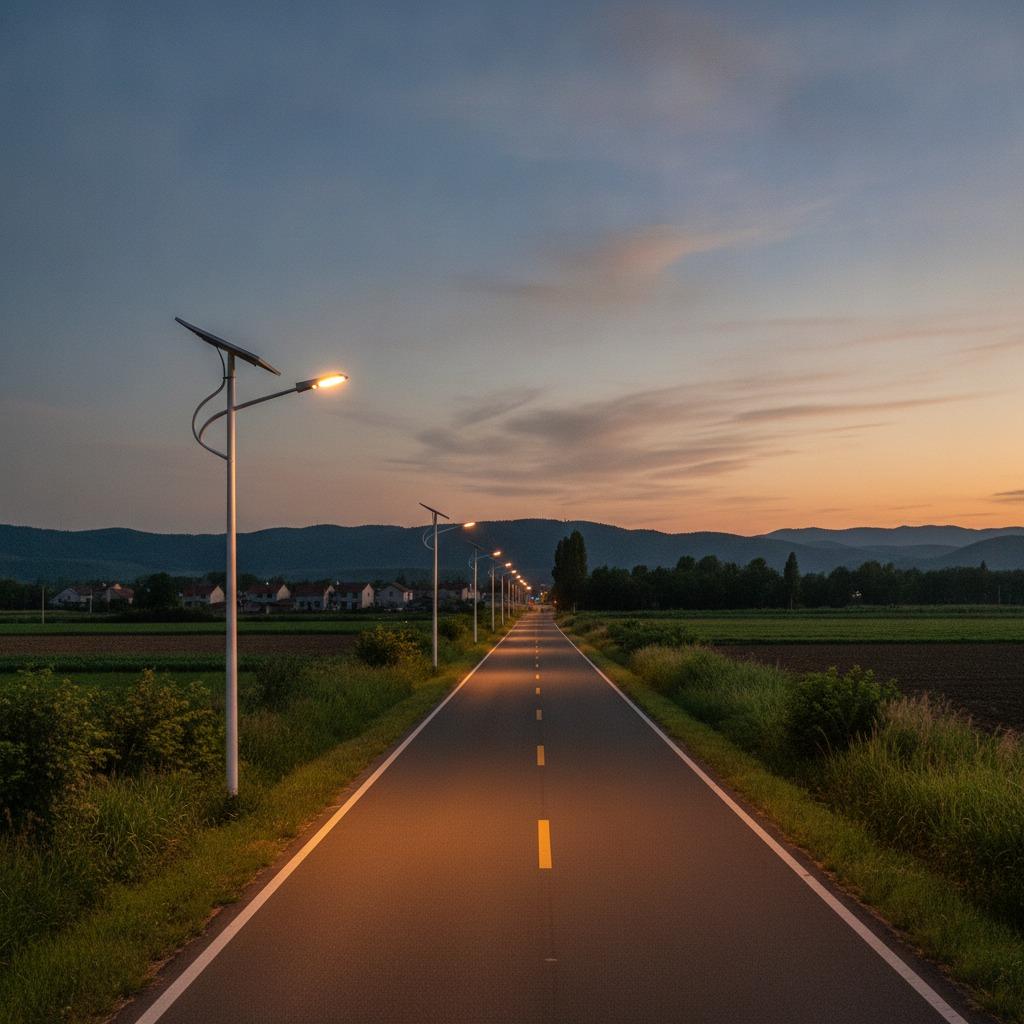
The installation seen in the field image is a good example of the category. Tall poles line both sides of the road, each with a cantilever arm, an integrated LED-style luminaire, and a rectangular panel mounted near the top. It is a practical off grid solar road lighting layout, and it is easy to understand why municipalities, contractors, and developers keep returning to it for village streets, farm access roads, and remote road segments.
Solar vs. Grid-Powered Lighting: The Real Trade-Off
The most useful comparison is not between one brand and another. It is between solar and conventional powered lighting. Grid-connected poles can be straightforward where utility service already exists. They often make sense for dense urban roads, intersections, and areas where maintenance crews can access every component quickly. But once a project moves into a rural setting, the cost and delay of extending utility lines can outweigh the cost of the lights themselves.
That is where off grid solar road lighting changes the equation. The system captures sunlight during the day and powers the light at night, so the road is not tied to a utility route. For low-traffic or dispersed road networks, that independence is often the deciding factor. The caution, of course, is that solar lighting must be matched to the site. Shade, weather patterns, pole spacing, and expected operating hours all affect performance. A buyer who treats it like a standard streetlight with a panel bolted on top is usually setting up disappointment.
What the Visible System Layout Suggests
The visible hardware tells an important story. The poles appear slender and likely made from steel or aluminum with a corrosion-resistant finish. That is a sensible choice for outdoor use, especially where moisture, dust, or road splash can shorten the life of untreated metal. The single-arm layout keeps the fixture over the roadway without making the structure look heavy or crowded.
The rectangular solar panel mounted near the pole top suggests a coordinated design rather than an afterthought. That matters in rural projects because the panel angle, mounting rigidity, and cable management are often what separate a dependable installation from one that rattles loose after the first rough season. The compact LED-style head also fits the current market direction: lower energy demand, better directional control, and less wasted light spilling into fields or adjacent property.
Quick Comparison: Where Solar Wins and Where It Can Be Limited
For buyers comparing lighting options, the decision usually comes down to a few practical questions rather than a technical brochure.
-
Solar street lighting works well where trenching is difficult, grid access is uncertain, or the road length makes utility extension expensive.
-
Grid-powered lighting can be better where continuous high-output lighting is needed and the electrical infrastructure already exists.
-
Solar systems reduce dependence on utility power, but they need enough sun exposure and proper system sizing.
-
Conventional systems may be simpler in some maintenance workflows, but they create recurring electricity costs and infrastructure dependency.
That last point is often overlooked. A rural road solar lighting supplier may talk first about panel wattage or battery autonomy, but the project only succeeds if the full site context is respected. Road width, traffic speed, seasonal cloud cover, and the availability of maintenance access all shape the final result.
Selection Criteria Buyers Should Not Skip
When evaluating a solar street light for rural roads, start with the road itself. How wide is it? Is the traffic mostly vehicles, pedestrians, or both? Is there any nearby shading from trees, buildings, or embankments? A clean-looking lighting plan on paper can fail if one side of the road gets blocked by canopy growth for half the year.
Next, look at the system integration, not just the lamp head. The image shows the pole, arm, panel, and luminaire as a coordinated package, which is usually preferable to a mixed collection of parts. In real projects, the unseen items matter just as much: battery enclosure, controller logic, mounting hardware, cable routing, and sealing. Those details are not always visible in a sales rendering, so buyers should ask direct questions before approving a layout.
Also consider the maintenance model. Rural installations often live far from the nearest service team. That makes modular replacement, accessible battery compartments, and robust brackets more valuable than flashy controls. If a system includes motion sensing or dimming, that can help energy management, but only if it is reliable and easy to service in the field.
Common Mistakes in Rural Road Projects
The most common mistake is overspecifying the lights while underspecifying the site. Another is ignoring spacing. The repeated pole layout in the image shows that these systems are meant to work as a sequence, not as isolated fixtures. If pole intervals are too wide, the road develops dark gaps. If they are too tight, the budget climbs without much practical benefit.
A second mistake is choosing a system based only on daytime appearance. Solar roadway products often look straightforward in daylight, but their real test is dusk, after cloud-heavy days, and during the months when the weather turns less predictable. In other words, the design should be judged on operating conditions, not just on how neat it looks standing in a row.
Buyer Advice: What to Ask a Supplier
If you are speaking with a rural road solar lighting supplier, ask for the full system picture rather than isolated component claims. You want to know how the pole, panel, luminaire, controller, and battery are intended to work together. Ask how the system handles site shading, what installation assumptions were made, and whether the layout was planned for roadway coverage or only for decorative effect.
It is also fair to ask what information is still uncertain. Reputable suppliers should be able to explain what is standard and what must be confirmed by project conditions. That is especially important for rural roads, where a small change in terrain or exposure can affect the entire result.
FAQ
Is a solar street light for rural roads only for remote areas?
No. It is also used on access roads, village streets, low-traffic residential projects, and municipal upgrades where utility work would be inconvenient or costly.
Does solar always mean fully off-grid?
Not necessarily. The visible setup strongly suggests a self-powered system, but whether a project includes any grid backup depends on the final design.
What makes this style of lighting practical?
The elevated pole-mounted design gives road coverage, the panel supports daytime charging, and the LED-style head keeps the lighting package compact. That combination suits long roadside runs better than scattered fixtures.
What a Good Next Step Looks Like
For a rural road project, the next step is not to chase the cheapest pole or the brightest lamp. It is to confirm site conditions, define the lighting purpose, and compare layouts that fit the road rather than forcing the road to fit the product. If you are reviewing options now, start with the road width, the available sunlight, and the service expectations. Then compare proposals side by side. The differences usually become obvious once the real operating environment is on the table.