

1. Start with the job the light has to do
Choosing a municipal solar street lighting supplier is not really about buying a lamp. It is about deciding whether a street, path, or parking area will be usable after dark without creating a maintenance problem for the next five years. That is why the first question is not the panel size or the battery chemistry, but the application: roadway, walkway, campus road, industrial park, landscaped development, or a true off-grid municipal street.
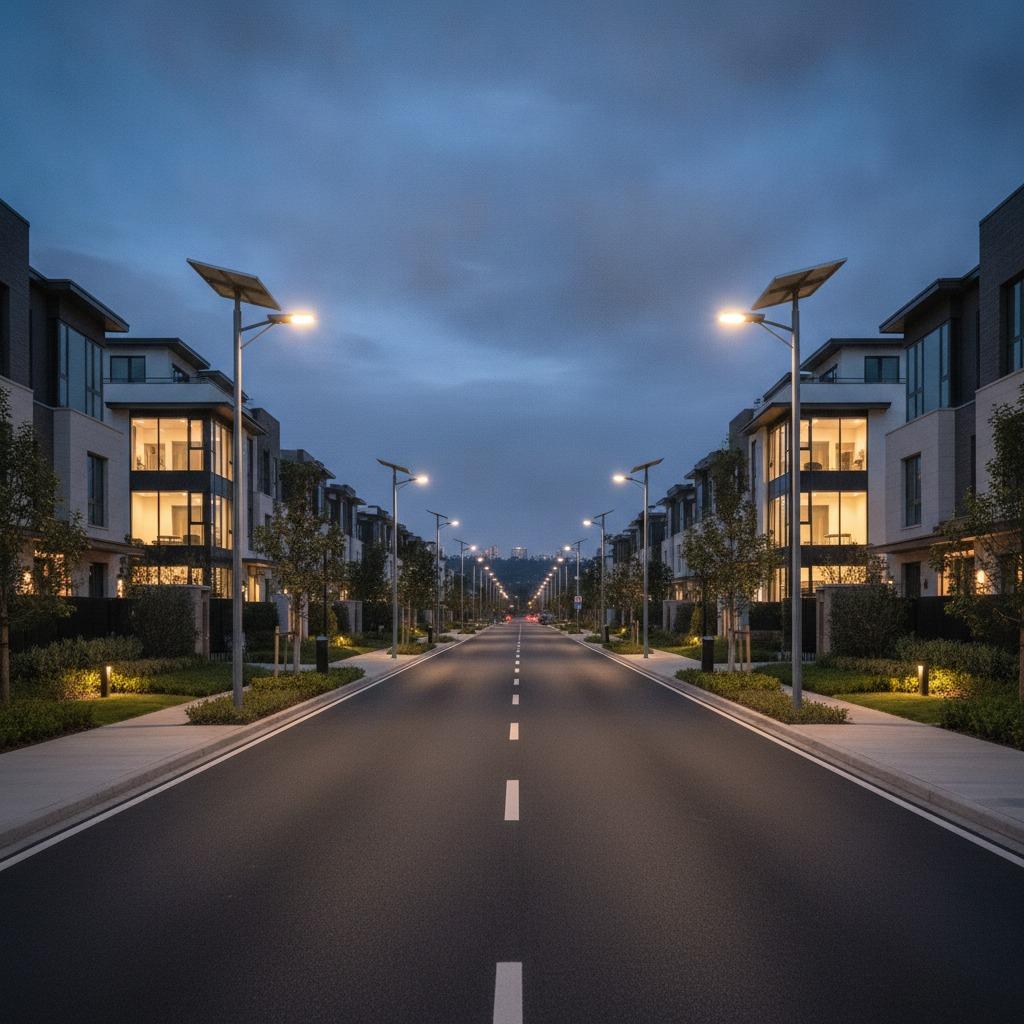
The product type shown in the provided information is an integrated solar street light with a pole-mounted photovoltaic panel and LED head. That layout is common for solar street lighting for municipalities because it reduces trenching and cabling work. It also makes deployment easier when a city or contractor needs to scale up quickly across multiple blocks or site zones. Still, buyers should remember that “solar” is not one-size-fits-all. A quiet pedestrian lane and a busier road do not ask for the same lighting behavior.
2. Check whether the supplier understands municipal realities
A municipal solar street light supplier should be able to talk about more than illumination. Public projects bring along access constraints, vandalism concerns, permit coordination, wind exposure, and the need for predictable upkeep. If a supplier only speaks in generic product language, that is a warning sign.
Look for practical answers to questions such as: How is the pole mounted and protected? What kind of maintenance access is required? How does the system behave after several cloudy days? Can the design be repeated across a long street without looking patched together? Those are the details that separate a product seller from a real municipal solar street lighting supplier.
3. Review the visible system architecture before you talk price
The image and notes describe a tall metal pole, a side arm, a rectangular solar panel mounted above or behind the fixture, and a slim LED luminaire in a dark utility finish. That is an integrated all-in-one style, and it has a few clear buyer-facing advantages. It keeps the installation compact, avoids overhead wiring, and is easy to replicate in rows along roads or site perimeters.
For municipal buyers, the visible geometry matters because it affects both performance and public acceptance. A panel angle that captures sun effectively is useful, but so is a clean silhouette that fits the streetscape. In some locations, the integrated style is ideal. In others, especially where poles face high wind or the city wants separate component access, a different configuration may be easier to support. The supplier should explain the trade-off instead of pretending every site wants the same setup.
4. Compare the power-storage story carefully
The preparation data mentions LiFePO4 as a possible battery type, but it is not confirmed by the image, so that should be treated as an inferred spec rather than a verified one. That caution matters. Battery type, capacity, placement, and replacement strategy can change the long-term cost of ownership more than the fixture shell itself.
Municipal buyers should ask how the energy storage is protected, how it is accessed for service, and what happens when performance declines over time. Solar street lighting is attractive partly because it reduces grid dependence, but that benefit only holds if the storage system is sized and maintained with some discipline. A good supplier will not dodge the battery question. A weaker one will try to keep the conversation on the aluminum housing and stop there.
5. Use a short comparison checklist before you shortlist suppliers
When procurement teams compare suppliers, the evaluation often gets messy because everyone is quoting a different configuration. A cleaner approach is to compare the same set of practical points across each bidder.
- Does the supplier offer an integrated solar street light suitable for the site type?
- Can the design support municipal streets, walkways, or parking areas without major redesign?
- Is the pole and fixture construction appropriate for outdoor public use?
- Does the supplier explain solar charging and storage in plain terms?
- Can the product be deployed in multiple units with consistent appearance and output philosophy?
- Does the company provide service guidance, not just a sales quote?
This kind of list sounds basic, but it saves time. It also helps prevent the common mistake of selecting a low-cost offer that looks fine on paper and becomes awkward once the first section is installed.
6. Watch for the common buying mistakes
The most common mistake is treating solar street lights like decorative fixtures. They are outdoor energy systems first, lighting products second. If the supplier cannot discuss real-world operating conditions, the project may struggle later.
Another mistake is overfocusing on the visible pole and ignoring the hidden parts of the system. The battery, controller, and wiring details matter even when they are not obvious in product photos. Municipal projects also suffer when buyers select a product based only on a single sample unit, then discover that site conditions are harsher than expected. Wind, shade, pollution, and seasonal weather all affect performance.
A smaller but still important caution: do not assume every solar street lighting for municipalities project needs the same brightness level or runtime target. Overbuilding can be just as wasteful as underbuilding. The right supplier should ask enough questions to avoid both mistakes.
7. Ask for evidence that the supplier can support a real project
Even when exact certifications, warranties, or test results are not available in the material you have, the supplier should still be able to provide project-ready documentation during the buying process. Municipal teams usually need drawings, configuration notes, maintenance guidance, and shipping or installation coordination. The best suppliers are organized enough to provide these without drama.
For a buyer, this is where the relationship starts to feel different. A credible municipal solar street lighting supplier does not just push hardware; it helps the city or contractor avoid field confusion. That may include discussing pole placement, consistent orientation for the photovoltaic panel, or how multiple units will be sequenced along a road or site boundary.
8. Make the final decision on lifecycle value, not just unit cost
Public lighting projects can be deceptive. The cheapest line item is not always the lowest total cost once installation labor, trenching, maintenance access, and replacement cycles are considered. Solar systems are often chosen because they reduce wiring work and suit off-grid or energy-saving outdoor lighting goals, which is exactly why lifecycle value should guide the award decision.
If a supplier can show that its integrated solar street light is suitable for repeatable municipal deployment, uses a durable outdoor construction approach, and gives straightforward guidance on storage and service, that is usually worth more than a slightly lower quote from a less responsive vendor. Buyers rarely regret choosing the supplier who explained the real-world details clearly.
Quick buyer takeaway
For municipalities, campuses, and public-space developers, the best supplier is the one that can align product design, maintenance reality, and site conditions. The right municipal solar street light supplier will discuss the whole system: pole, panel, LED head, energy storage, installation context, and long-term service. If any of those parts feels vague, pause and ask again.
FAQ: what municipal buyers usually ask
Is an integrated solar street light always the best choice?
No. It is often convenient for organized developments and repeat installations, but the site should decide the product, not the other way around.
Why does battery discussion matter so much?
Because battery behavior influences runtime, maintenance, and replacement planning. In solar lighting, that is not a side issue.
What should a buyer request first?
Start with the application, then ask for a proposed configuration, site assumptions, and service guidance. Price comes after that.
Next step
If you are comparing vendors now, build your shortlist around project fit, support quality, and repeatable deployment, not brochure claims. A solid municipal solar street lighting supplier should be able to explain how the product fits your street, your site, and your maintenance plan without overselling what the fixture can do.