
Choosing a commercial LED lighting supplier for office projects
If you are sourcing an office fit-out, a refurbishment, or a multi-site rollout, the choice of commercial LED lighting supplier affects more than the purchase order. It changes how easy the project is to design, coordinate, install, and maintain once the ceiling is closed and the desks are in place. That matters because office lighting is rarely just about brightness. It has to support workstations, circulation paths, meeting rooms, and the look of the space itself.
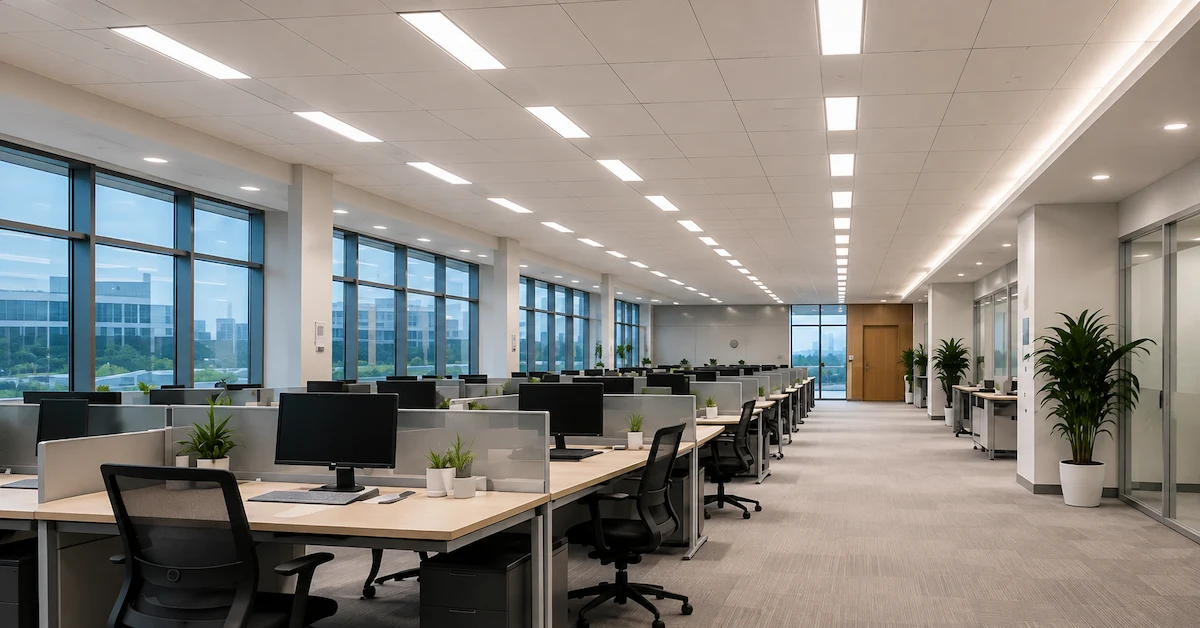
A modern open-plan office often uses a layered lighting approach: recessed square ceiling panels for broad ambient illumination, plus slim linear black fixtures for visual definition and sometimes task support. That combination, seen in many contemporary interiors, is tidy and flexible, but it also asks more of the supplier. The right partner should help you balance appearance, comfort, and consistency rather than simply quoting a catalog line.

What buyers are really trying to solve
Most sourcing teams are not just buying commercial LED lights. They are trying to reduce project risk. A lighting package can look straightforward on paper and still become awkward if the supplier cannot confirm product availability, coordinate fixture families, or support the design intent across different zones.
For engineers and product teams, the real question is usually this: who can supply the fixtures needed for a clean office ceiling layout and do it with enough consistency that the finished space looks deliberate? In that sense, a supplier is part product source, part project enabler. The best ones understand how recessed panels, linear luminaires, and suspended or mounted ceiling fixtures work together in a commercial interior.
Supplier, wholesaler, distributor, or manufacturer?
These labels are often used loosely, and that can muddy procurement decisions.
Commercial LED lights manufacturer
A commercial LED lights manufacturer is usually the best fit when you need control over product configuration, private label options, or a repeatable spec for multiple projects. That does not automatically mean faster service, but it can help when your team needs a stable fixture family across several sites.
LED lighting wholesaler
An LED lighting wholesaler may be the better route for mixed orders, project staging, or faster access to a broader stock range. The trade-off is that customization may be limited, and the product mix can vary more from batch to batch.
LED lighting distributor
An LED lighting distributor often sits between the two, especially where local support, channel access, and delivery coordination matter. For buyers working to a tight install schedule, that local touch can be valuable. Still, it is worth checking how much technical detail the distributor can actually provide before you commit.
What to look for in office lighting supply
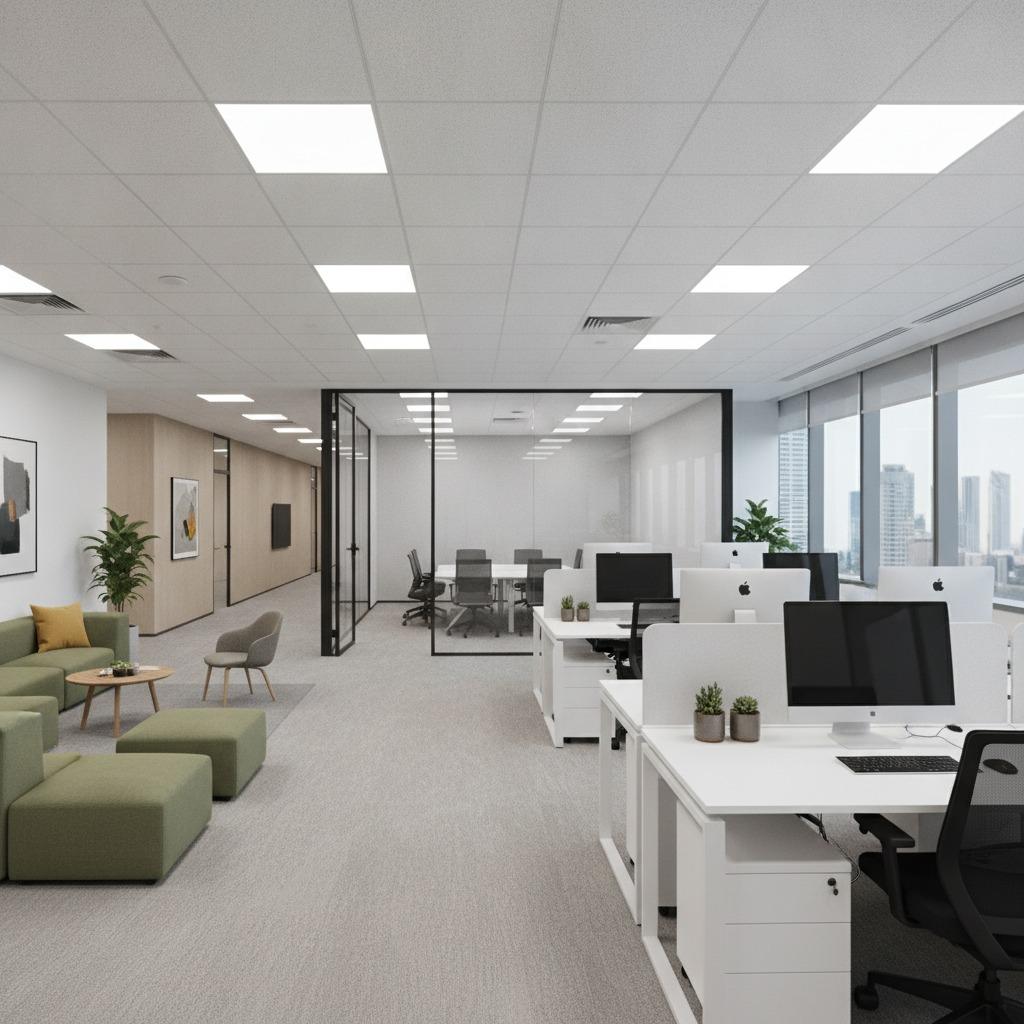
Office lighting has a practical side that gets overlooked when procurement becomes too price-driven. A ceiling with flush square panels and slim black linear fixtures may look simple, but the final result depends on the supplier’s ability to support layout consistency, finish matching, and the right mix of fixture types for each area.
Look for a partner that can speak clearly about product families rather than isolated SKUs. For open-plan offices, continuity matters. If the recessed panels differ in trim detail from one batch to another, or if the linear fixtures have a slightly different finish than expected, the ceiling can start to look patched together. That is the kind of detail occupants notice even if they cannot name it.
You should also ask how the supplier handles documentation. Even when exact wattage, output, or control options are not yet fixed, the project team usually needs coherent submittals, dimensional information, and a clear understanding of what is standard versus optional. A commercial LED lighting supplier that leaves those gaps until late in the job can create avoidable delays.
Why layered office lighting is so common
Modern offices rarely rely on a single fixture type. The image of recessed ceiling panels paired with linear black luminaires reflects a pattern used in many commercial interiors because it solves two different problems at once. The panels provide even ambient light across desks and shared space. The linear fixtures add architectural rhythm, can support circulation routes, and help break up a large ceiling visually.
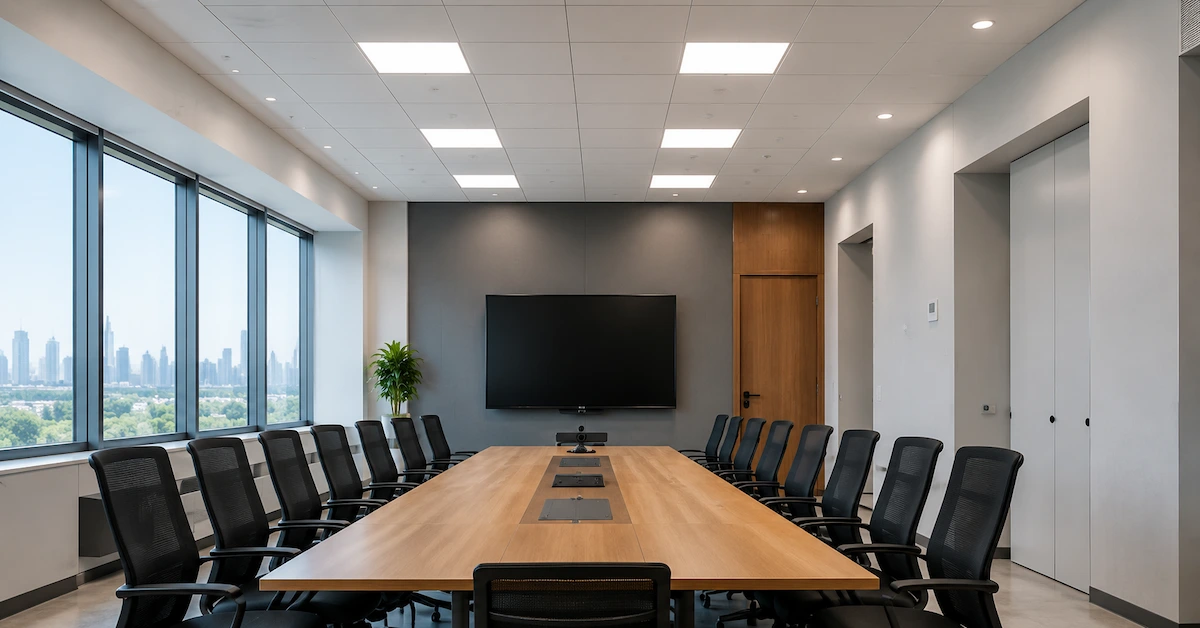
This matters especially in open-plan layouts with glass partitions and mixed-use zones. A reception area may need a stronger visual identity than a workstation row. A meeting room may need a different feel from a corridor. Suppliers who understand that layering can be more useful than those who only talk about lamp count.
Common mistakes buyers make
One frequent mistake is treating commercial LED lighting as a commodity. It is easy to compare only price and lead time, but office projects usually fail on coordination, not on the invoice. Another common issue is buying fixture types separately and discovering too late that their proportions, finishes, or ceiling integration do not match well.
A second mistake is assuming every supplier can support the same level of project detail. Some can quote quickly but struggle with technical follow-through. Others are strong on documentation but slower when the order needs adjusting. If your project is phased, that difference can become painful.
There is also a design-side risk: choosing the wrong balance between recessed panels and linear fixtures. Too much emphasis on decorative linear elements can leave desks underlit. Too much dependence on flat panel lighting can make the space feel bland. A sensible supplier should be able to talk through that tension without overselling one approach.
Buyer-facing questions worth asking early
Before placing an order, ask whether the supplier can support the same fixture family across multiple spaces, not just a single room. Check whether the product line is suitable for open-plan offices, meeting rooms, reception areas, and circulation zones if you need a consistent visual language. If your project has a mix of recessed and suspended or surface-mounted elements, ask how those products are coordinated in size and finish.
It is also sensible to ask how the supplier manages replacements and add-ons. Offices change. Teams expand, tenant layouts shift, and that extra meeting room appears later than expected. A supplier that can support follow-on orders without forcing a redesign is often more valuable than a slightly cheaper one at the start.
Practical signs you are talking to the right partner
A capable LED commercial lighting supplier will usually ask about ceiling type, room function, and the look you are trying to achieve. That is a good sign. It means they are thinking beyond the lamp itself. The stronger suppliers also understand that low-profile installations and a clean ceiling appearance are often as important as light output on paper.
If a supplier can explain when to use recessed square panels versus linear fixtures, and when a mixed system makes more sense than a uniform grid, you are probably dealing with someone who understands commercial interiors. That kind of guidance is useful whether you are sourcing for a new office fit-out or updating an older space that needs a more modern ceiling language.
Where a commercial LED lighting supplier adds value
The best suppliers do not just ship fixtures. They help reduce uncertainty. They support consistency across a project, offer realistic product guidance, and make it easier for the design intent to survive procurement and installation. For an office with layered ambient and architectural lighting, that is not a small detail.
If you are comparing a LED lighting wholesaler, an LED lighting distributor, and a commercial LED lights manufacturer, start with the project outcome you need. If the priority is repeatability and a defined product family, go closer to the manufacturer. If the priority is speed, breadth, or local support, a distributor or wholesaler may be the more practical route. The right answer depends on whether you are buying a single floor, a full workplace, or a series of sites.
Next step for sourcing teams
When you shortlist suppliers, bring a simple room plan, the ceiling type, and a note on the spaces you need to light: workstations, conference rooms, reception, or circulation areas. That gives the supplier enough context to recommend a commercial LED lighting package that fits the project instead of forcing the project to fit the fixtures.
For office interiors, the cleanest results usually come from suppliers who understand both product and layout. That is the difference between a ceiling full of lights and a lighting scheme that actually supports the way people work.