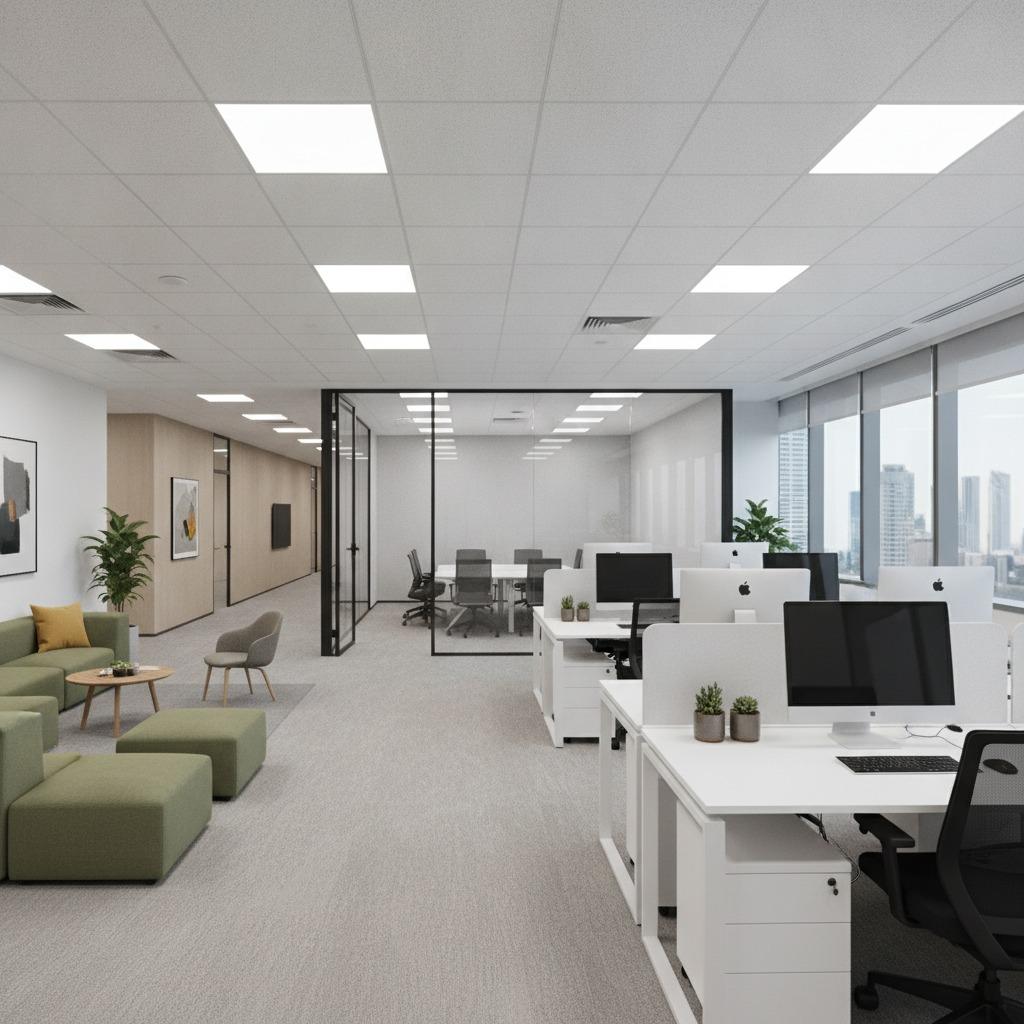

What Should Buyers Expect From a Low Glare LED Lighting Manufacturer?
For an office, classroom, meeting room, or commercial interior, simply increasing light output does not necessarily create a better lighting environment.
The fixture needs to put light where people need it while limiting uncomfortable brightness in the field of view.
That is why buyers looking for a low glare LED lighting manufacturer should evaluate the complete lighting system rather than selecting a fixture from wattage or lumen output alone.
The practical questions are:
- How is glare controlled?
- What optical system is used?
- Is UGR data available?
- Does the fixture suit computer-based work?
- Can the supplier provide photometric files?
- Can the product work with DALI or 0-10V controls?
- Can the manufacturer adapt the fixture for a specific project?
- Can the supplier support lighting calculations?
These questions are especially relevant for B2B buyers because a lighting specification is normally approved before hundreds or thousands of fixtures are ordered.
CDZM's current commercial lighting offering includes panel and troffer solutions with UGR<19, high-efficiency options, and DALI/0-10V control configurations for professional applications.
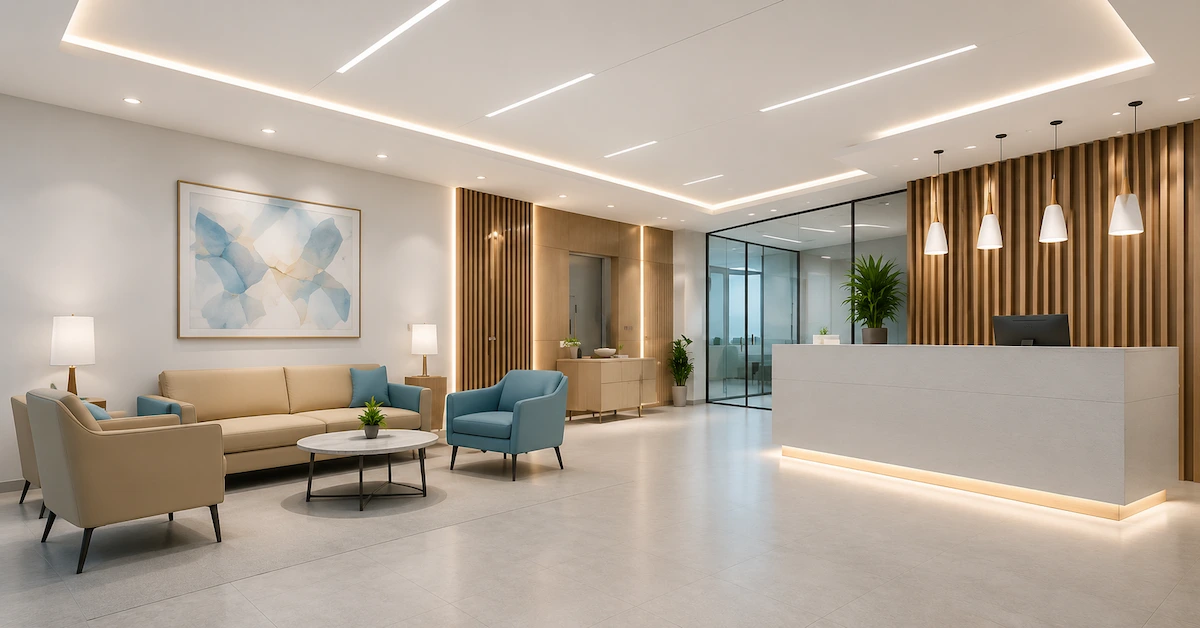
What Does Low Glare LED Lighting Mean?
Low glare LED lighting refers to a lighting solution designed to limit uncomfortable or excessive brightness perceived by occupants.
Glare can come from:
- The visible luminous surface of a fixture
- Poor optical distribution
- Excessive luminance
- Incorrect fixture positioning
- High contrast between the fixture and surrounding surfaces
- Poorly planned lighting layouts
A low-glare fixture therefore involves more than adding a diffuser.
The LED source, optical system, diffuser, reflector, fixture dimensions, installation height, spacing, room surfaces, and viewing direction all contribute to the final result.
For this reason, a product can have excellent lumen output and still perform poorly in a glare-sensitive office.
What Is UGR and Why Does It Matter?
UGR stands for Unified Glare Rating.
It is used to evaluate discomfort glare from lighting installations.
For commercial lighting buyers, UGR is useful because it moves the discussion away from a vague statement such as “comfortable lighting” toward a measurable lighting-design consideration.
However, UGR is not simply a property of the LED fixture.
The final value depends on the lighting installation and room conditions.
Relevant factors include:
- Luminaire luminance
- Fixture position
- Fixture spacing
- Room dimensions
- Ceiling height
- Wall and ceiling reflectance
- Observer position
- Viewing direction
This means a supplier should be cautious about presenting “UGR<19” as a guarantee for every installation.
CDZM's current commercial solution lists UGR<19 as a characteristic for its panel/troffer lighting offering. For a project with strict glare requirements, buyers should still request photometric data and evaluate the product within the actual room layout.
Why UGR19 Is Commonly Requested for Office Lighting
Office workers often spend several hours looking at monitors, documents, or other visual tasks.
A fixture positioned directly within the viewing field can become distracting if its luminous surface is too bright.
This is why UGR19 office lighting supplier is a commercially relevant search term for designers and project buyers.
The important point is that UGR19 should be treated as a design target, not simply a product marketing label.
A serious office lighting specification should combine:
- UGR requirement
- Illuminance target
- Uniformity
- Fixture spacing
- CCT
- CRI
- Optical distribution
- Ceiling height
- Workstation orientation
The same fixture may produce different glare conditions in two rooms because the installation geometry is different.
What Makes a Low Glare LED Fixture Different?
A well-designed low-glare fixture usually pays close attention to the relationship between the LED source and the observer.
Optical Distribution
The optic determines how light leaves the fixture.
Poorly controlled light can create:
- Bright spots
- Excessive high-angle luminance
- Uneven illumination
Better optical control distributes light toward the working area while reducing unnecessary light entering high-angle viewing directions.
Diffuser Design
A diffuser can spread light and soften the appearance of the LED source.
But the diffuser also affects efficiency.
A very aggressive diffusion layer may reduce optical efficiency, while an overly transparent material may expose bright LED points.
The supplier therefore needs to balance:
glare control + light transmission + uniformity + efficiency
LED Arrangement
The position and density of LED modules influence the visible brightness pattern.
Different panel and troffer constructions may use:
- Edge-lit LED modules
- Back-lit LED modules
- Direct-lit configurations
- Specialized optical lenses
The appropriate structure depends on the fixture design and project requirements.
Low Glare LED Lighting vs Standard Commercial LED Lighting
Not every commercial LED fixture is designed around the same visual priorities.
| Factor | Standard LED Lighting | Low Glare LED Lighting |
|---|---|---|
| Main priority | General illumination | Illumination + visual comfort |
| Optical design | Basic distribution | Controlled distribution |
| Glare consideration | May be secondary | Key design factor |
| UGR data | May not be emphasized | Usually important |
| Office application | Possible | Strong fit |
| Computer work | Depends on fixture | More suitable when properly specified |
| Lighting simulation | Project-dependent | Highly recommended |
| Procurement focus | Price + output | Performance + comfort + lifecycle value |
The distinction does not mean standard LED lighting is unsuitable.
It means buyers should match the fixture's optical design to the environment.
How to Select Low Glare Office Lighting
For low glare office lighting, start with the space rather than the product catalogue.
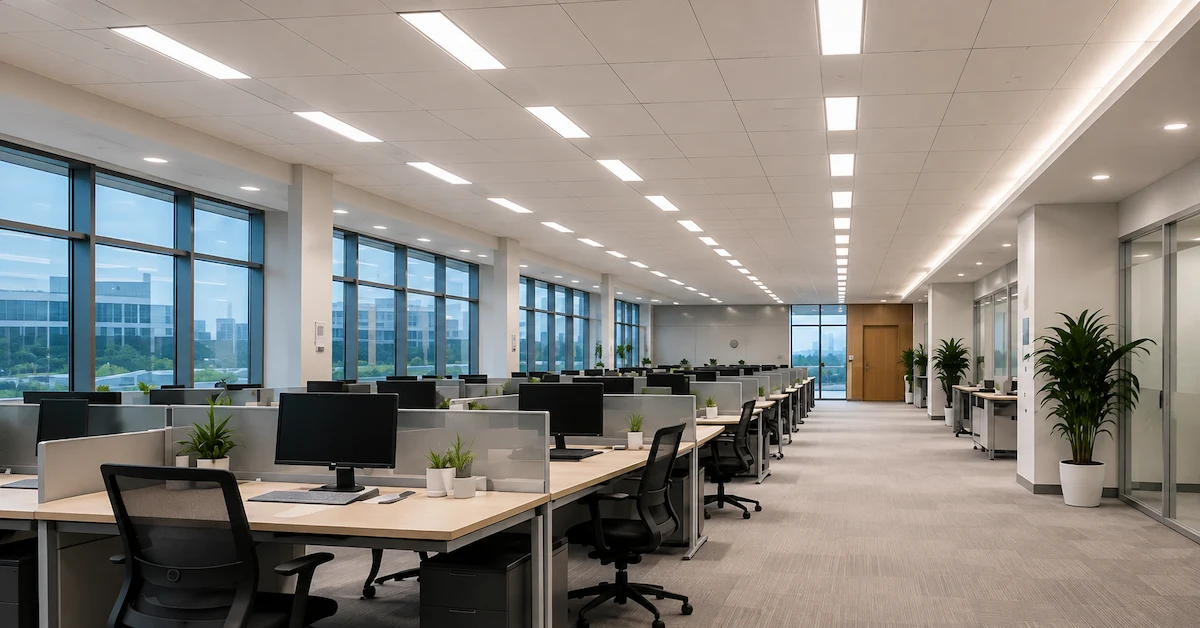
Open-Plan Offices
Open offices typically contain:
- Multiple workstations
- Computer monitors
- Long sightlines
- Large ceiling areas
- Significant daylight from windows
The lighting layout needs to avoid creating bright fixtures directly within common viewing directions.
Panel lights, troffers, and linear systems can all be considered depending on the ceiling and architectural design.
Private Offices
Private offices may have fewer fixtures, but desk position becomes more important.
A fixture that looks comfortable from one desk can appear brighter from another viewing direction.
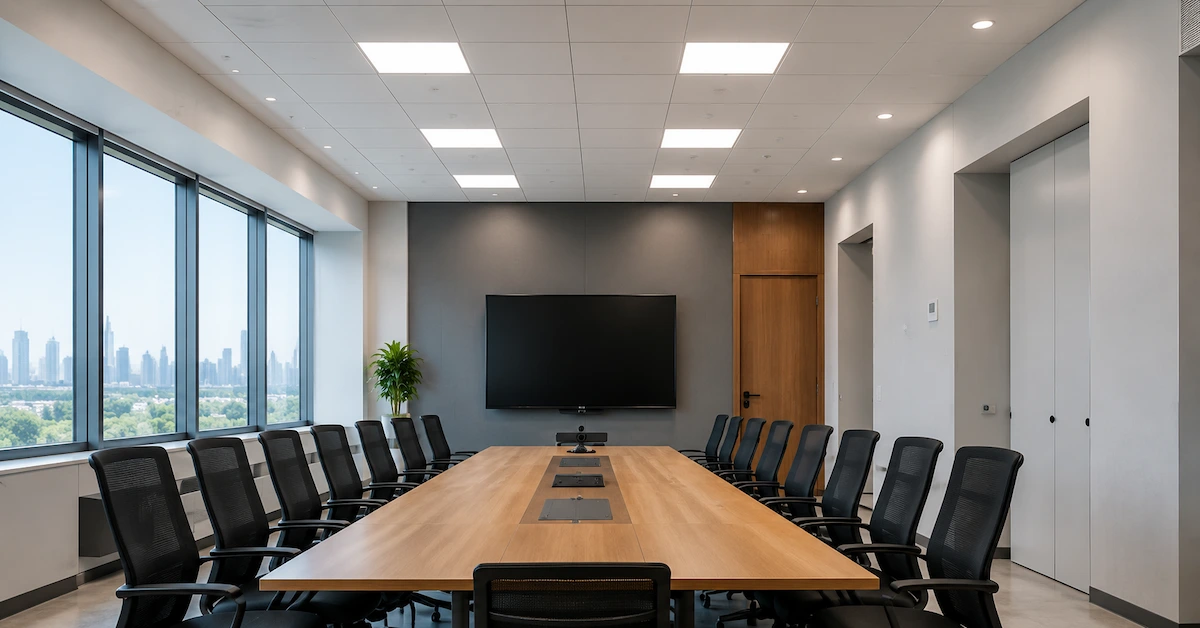
Meeting Rooms
Meeting rooms need flexibility.
The same space may be used for:
- Presentations
- Video conferences
- Discussions
- Training
Dimming can allow the lighting level to change without completely switching off the room lighting.
Reception Areas
Reception lighting has both functional and visual requirements.
The designer may combine general illumination with:
- Decorative fixtures
- Accent lighting
- Linear lighting
The goal is not necessarily to use the lowest possible glare rating everywhere, but to provide an appropriate visual environment.
Why Fixture Layout Matters as Much as the Fixture
One of the easiest mistakes in office lighting procurement is assuming that a low-glare fixture automatically produces a low-glare room.
It does not.
Consider a simple example.
A panel may perform well when installed at the recommended spacing and ceiling height. If the same panels are installed too close together, too far apart, or directly above certain viewing positions, the visual result can change.
That is why CDZM's office lighting guidance recommends evaluating room dimensions, ceiling height, workplane height, workstation arrangement, daylight, fixture spacing, and control requirements before finalizing a specification.
For larger projects, a DIALux simulation can reveal these problems before installation.
What Technical Data Should a Low Glare LED Lighting Supplier Provide?
When comparing a low glare LED lighting supplier, request technical information that can actually be used by the project team.
Photometric Data
Request:
- IES files
- LDT files
- Lumen output
- Light distribution
- Photometric curves
These files allow designers to model the fixture in lighting software.
Glare Information
Depending on the product and project, request:
- UGR information
- Applicable calculation conditions
- Optical configuration
- Recommended mounting conditions
Avoid relying only on a product page saying “low glare.”
Electrical Specifications
Check:
- Input voltage
- Rated power
- Power factor
- THD
- Driver model
- Dimming method
Color Specifications
Check:
- CCT
- CRI
- Color consistency
Retail, healthcare, education, and office applications may have different priorities.
Mechanical Information
Confirm:
- Fixture dimensions
- Fixture thickness
- Recessed installation
- Surface mounting
- Suspension options
- Ceiling compatibility
A technically excellent fixture is still unsuitable if it does not fit the project ceiling.
What Is the Difference Between UGR19 LED Lighting and Low Glare Lighting?
The two terms are related but should not be treated as identical.
UGR19 LED lighting refers to lighting specified around a particular UGR performance target.
Low glare LED lighting is broader. It describes the overall design objective of limiting uncomfortable glare.
A low-glare product may involve:
- Optical control
- Diffusion
- Luminance management
- Fixture placement
- Room design
Therefore, buyers should avoid choosing products based solely on a label.
Ask for the actual technical evidence behind the claim.
How Do Lighting Controls Improve Low Glare Applications?
Lighting controls do not replace optical glare control, but they can improve the way a space is operated.
0-10V Dimming
0-10V can provide adjustable output when the fixture uses a compatible driver.
For example, an office may operate at a lower lighting level when sufficient daylight is available.
ANSI C137.1-2022 specifies a 0-10V control interface method and performance requirements for dimmable LED drivers, fluorescent ballasts, and dimming control units.The standard covers applications including commercial, industrial, residential, roadway, area, and hospitality lighting.
DALI Control
DALI provides a digital control architecture that can support more advanced lighting-management functions.
CDZM currently lists both DALI and 0-10V options in its commercial lighting offering.
Daylight Control
In an office with large windows, natural daylight can vary considerably during the day.
A control system can reduce artificial light output when daylight is sufficient.
Occupancy Control
Lighting can also respond to whether a space is occupied.
This is particularly useful in:
- Meeting rooms
- Corridors
- Training rooms
- Shared offices
The energy benefit depends on the actual operating pattern, sensor configuration, and control strategy.
Where Is Low Glare Commercial Lighting Most Useful?
Low glare commercial lighting is particularly relevant in spaces where people perform visual tasks or spend long periods indoors.
Offices
Primary concerns:
- Computer screens
- Employee comfort
- Uniform illumination
- Flexible control
Schools
Primary concerns:
- Classroom visibility
- Student comfort
- Teacher visibility
- Long operating hours
Universities
Applications include:
- Classrooms
- Libraries
- Study areas
- Offices
- Laboratories
Healthcare Facilities
Lighting requirements can vary significantly by room.
Designers may need to consider:
- Visual comfort
- Color rendering
- Cleaning requirements
- Operating schedules
Retail
Retail projects often balance general lighting with display and accent lighting.
The appropriate glare level depends on the store layout and fixture type.
Public Buildings
Government and public facilities may prioritize:
- Reliability
- Energy efficiency
- Easy maintenance
- Comfortable general illumination
How to Evaluate a Low Glare LED Lighting Manufacturer
Manufacturing Capability
Ask where the key stages of production take place and how product consistency is controlled.
Useful questions include:
- Who controls product engineering?
- How are LED components checked?
- How are drivers selected?
- What testing is performed?
- How are approved specifications controlled?
CDZM describes itself as an LED lighting manufacturer with more than 16 years of manufacturing experience and OEM/ODM services. Its website also states that it exports to more than 50 countries.
Engineering Support
For a project-oriented buyer, engineering support can be more valuable than a large catalogue.
CDZM states that its engineering team provides:
- DIALux simulation
- Lux calculation
- 3D visual rendering
- Structural design
- Energy-saving analysis
- Cost optimization
This type of support allows buyers to evaluate a lighting concept before committing to mass production.
Quality Control
Ask how the manufacturer controls:
- Incoming materials
- Assembly
- Driver integration
- Electrical performance
- Aging
- Final inspection
CDZM states that its manufacturing system includes automated production and testing processes.
For an actual project, request the relevant test and certification documents for the exact model being quoted.
OEM and ODM for Low Glare LED Lighting
Distributors and lighting brands may need something different from the manufacturer's standard configuration.
Possible customization areas include:
| Item | Possible Requirement |
|---|---|
| Power | Project-specific wattage |
| Lumens | Target output |
| CCT | Market/application preference |
| CRI | Application requirement |
| Optics | Distribution and glare control |
| Driver | DALI / 0-10V |
| Dimensions | Ceiling compatibility |
| Housing | Appearance and finish |
| Branding | Private-label requirements |
| Packaging | Distributor requirements |
The key is to test the final configuration.
Changing the driver, diffuser, LED arrangement, or optic can change the optical result.
A sample approved by the buyer should become the reference configuration for mass production.
How to Request a Low Glare LED Lighting Quote
If you are contacting a low glare LED lighting manufacturer, avoid sending only:
“Please quote 40W LED panel light.”
That request leaves too many variables open.
Instead,provide:
Project Information
- Application
- Country
- Building type
- Quantity
- Room dimensions
- Ceiling height
Lighting Requirements
- Target illuminance
- Fixture size
- Lumens
- CCT
- CRI
- Glare requirement
Control Requirements
- DALI
- 0-10V
- Occupancy sensor
- Daylight sensor
- Other building controls
Commercial Requirements
- Sample requirement
- Estimated order volume
- Certification requirements
- OEM/ODM needs
- Target delivery schedule
For larger projects, add the floor plan.
This allows the supplier to evaluate the actual application instead of guessing the fixture specification.
A Practical Supplier Comparison Checklist
Before choosing between suppliers, use a simple comparison sheet.
| Evaluation Area | Questions to Ask |
|---|---|
| Glare | Is UGR data available? |
| Photometry | Are IES/LDT files provided? |
| Efficiency | What is the complete luminaire efficacy? |
| Color | What CCT and CRI options are available? |
| Driver | Which driver is used? |
| Dimming | Does it support 0-10V or DALI? |
| Ceiling | Does the size fit the project? |
| Engineering | Can the supplier run DIALux calculations? |
| Customization | Can optics and driver configurations be customized? |
| QC | What tests are performed? |
| Compliance | Which certifications apply to the exact model? |
| Production | Can the supplier meet the required volume? |
| Support | Who handles technical questions after delivery? |
The supplier with the lowest quotation is not automatically the best choice.
For a large office project, a slightly higher fixture cost may be justified if the product requires fewer fixtures, delivers better visual comfort, integrates with the existing control system, and reduces future maintenance work.
Common Mistakes When Buying Low Glare LED Lighting
Choosing a Product Because It Says “UGR19”
The label alone is not enough.
Ask for the photometric information and understand the conditions behind the stated value.
Comparing Only Lumens
More lumens can mean more light, but not necessarily better lighting.
The target is appropriate illumination—not maximum brightness.
Ignoring the Ceiling
A fixture needs to fit the actual ceiling grid or mounting structure.
Confirm dimensions before sampling.
Selecting the Driver Too Late
The driver affects:
- Dimming
- Flicker
- Electrical performance
- Control compatibility
It should be specified together with the luminaire.
Treating Every Room the Same
An open office, conference room, classroom, corridor, and reception area have different lighting requirements.
One fixture may not be the best answer for all of them.
Skipping Lighting Simulation
For larger projects, a simulation can identify fixture quantity, spacing, and glare-related issues before installation.
FAQ About Low Glare LED Lighting Manufacturers
1.What is a low glare LED lighting manufacturer?
A low glare LED lighting manufacturer develops or produces LED luminaires designed with optical and mechanical features intended to reduce uncomfortable glare in applications such as offices, schools, and commercial interiors.
2. What is UGR19 LED lighting?
UGR19 LED lighting generally refers to a lighting design or fixture configuration targeting a UGR value of 19 under specified installation conditions. The actual UGR of an installation depends on the room, fixture position, viewing direction, and other parameters.
3. Is UGR19 enough for office lighting?
Not by itself. Buyers should also evaluate illuminance, uniformity, CCT, CRI, fixture placement, optical distribution, and the actual room geometry.
4. How do I find a reliable UGR19 office lighting supplier?
Ask for photometric files, UGR information, product specifications, driver details, testing documents, and lighting-design support. For larger projects, request a DIALux calculation based on the actual room layout.
5. What is the difference between low glare LED lighting and standard LED lighting?
Low glare lighting places greater emphasis on optical control and visual comfort.Standard LED lighting may focus primarily on illumination, efficiency, price, or general application requirements.
6. Can low glare LED lighting be dimmed?
Yes, if the fixture uses a compatible dimmable driver. Depending on the product, control options can include 0-10V or DALI.
7. Can a low glare LED lighting supplier customize products?
Depending on the manufacturer's capabilities, customization can include optics, dimensions, power, CCT, CRI, drivers, dimming systems, housing, branding, and packaging.
8. What information should I provide when requesting a quotation?
Provide the application, quantity, room dimensions, ceiling height, fixture size, target illuminance, CCT, CRI, glare requirements, control system, certification requirements, and delivery schedule.
9. Does CDZM offer low glare LED lighting?
CDZM's current commercial lighting offering includes panel and troffer lighting with UGR<19 options, along with DALI and 0-10V control configurations. Buyers should confirm the exact model, driver, test data, and certification for their project.
10.Can CDZM help with a commercial lighting project?
CDZM states that its engineering team supports DIALux simulation, lux calculations, 3D visual rendering, energy-saving analysis, structural design, and project optimization.
For a project quotation, buyers can provide the floor plan, ceiling height, application, quantity, target illuminance, fixture requirements, control system, and destination market.
Conclusion
Choosing a low glare LED lighting manufacturer should start with the lighting requirement, not with a catalogue price.
For office, education, healthcare, retail, and other commercial projects, buyers should look at the entire system:
- Optical design
- UGR performance
- Delivered lumens
- Efficacy
- CRI
- CCT
- Fixture layout
- Driver quality
- Dimming compatibility
- Photometric data
- Ceiling compatibility
- Quality control
- Engineering support
The most important distinction is that low glare is not created by a single number.
A UGR19 claim can be useful, but the final visual result depends on how the fixture performs within the actual room.
For this reason, project buyers should request photometric files, confirm the driver and control configuration, and use lighting calculations where appropriate.
CDZM currently offers commercial panel and troffer lighting with UGR<19 options and DALI/0-10V control configurations, while its engineering team provides DIALux and project-design support.
If you are sourcing low glare LED lighting for an office, school, commercial building, or other project, send CDZM the floor plan, ceiling height, quantity, target illuminance, fixture dimensions, CCT/CRI requirements, glare target, control protocol, and destination market.
That information gives the manufacturer a much clearer basis for recommending the right configuration and preparing a project quotation.