
What Should a Hotel Outdoor Lighting Supplier Deliver?
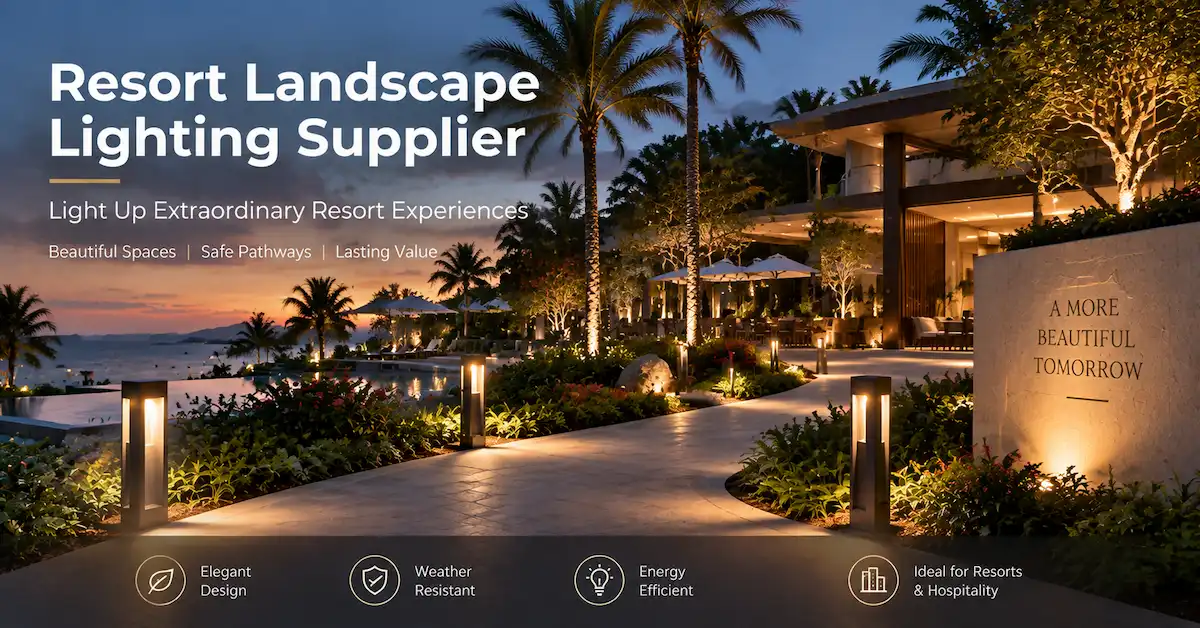
A hotel outdoor lighting supplier should help the project team build a coordinated lighting package for entrances, pathways, courtyards, gardens, building façades, parking areas and other guest-facing outdoor spaces rather than simply selling individual lamps. For hotel developers and contractors, the important purchasing questions are whether the fixtures suit each lighting task, whether the specifications match the installation conditions, whether the approved appearance can be reproduced across a large project and whether replacement products can be supplied later. CDZM currently organizes relevant outdoor products across courtyard lights, lawn and bollard lights and outdoor wall lamps, allowing hotel buyers to evaluate several fixture families instead of forcing one lamp type into every area.
The supplier should also help the buyer move from an architectural or landscape concept to a controlled specification. That means identifying the fixture model and version, power supply, optical requirement, material, dimensions, installation interface, finish, control method and project quantity before mass production. CDZM states that its engineering services include DIALux lighting simulation, structural design and rapid prototyping, which can be relevant when a hotel project needs both product supply and lighting-layout support.
Who Needs a Hotel Outdoor Lighting Supplier—and Who Needs Additional Specialist Design?
Typical buyers include hotel developers, resort owners, hospitality groups, landscape architects, lighting designers, MEP contractors, purchasing companies, outdoor-lighting distributors and companies responsible for hotel renovation projects. Their priorities are not identical. A hotel owner may focus on guest experience and long-term maintenance, a designer may focus on fixture appearance and nighttime composition, a contractor may prioritize installation interfaces and delivery timing, while procurement teams need comparable quotations and controlled product specifications.
A hotel outdoor lighting supplier is most useful when the requirement involves repeatable outdoor luminaires and project-level supply. It should not automatically be treated as the sole designer for emergency egress lighting, specialist sports lighting, underwater lighting, aviation-related lighting or other applications subject to separate technical requirements. Those areas should be evaluated against the applicable project standard and specialist design scope. Keeping these boundaries clear prevents a decorative hospitality lighting package from being incorrectly extended to applications for which it was not specified.
Plan Hotel Outdoor Lighting by Guest Journey and Application
Hotel exterior lighting works best when purchasing begins with zones rather than with a list of lamp wattages. Guests move from the arrival road to the entrance, reception approach, courtyard, paths, restaurants, gardens, recreational areas and parking zones, and each part of that journey has a different lighting purpose. A hotel landscape lighting supplier should therefore help the buyer separate orientation lighting, decorative lighting, architectural emphasis and practical circulation lighting.
Hotel Entrance and Arrival Areas
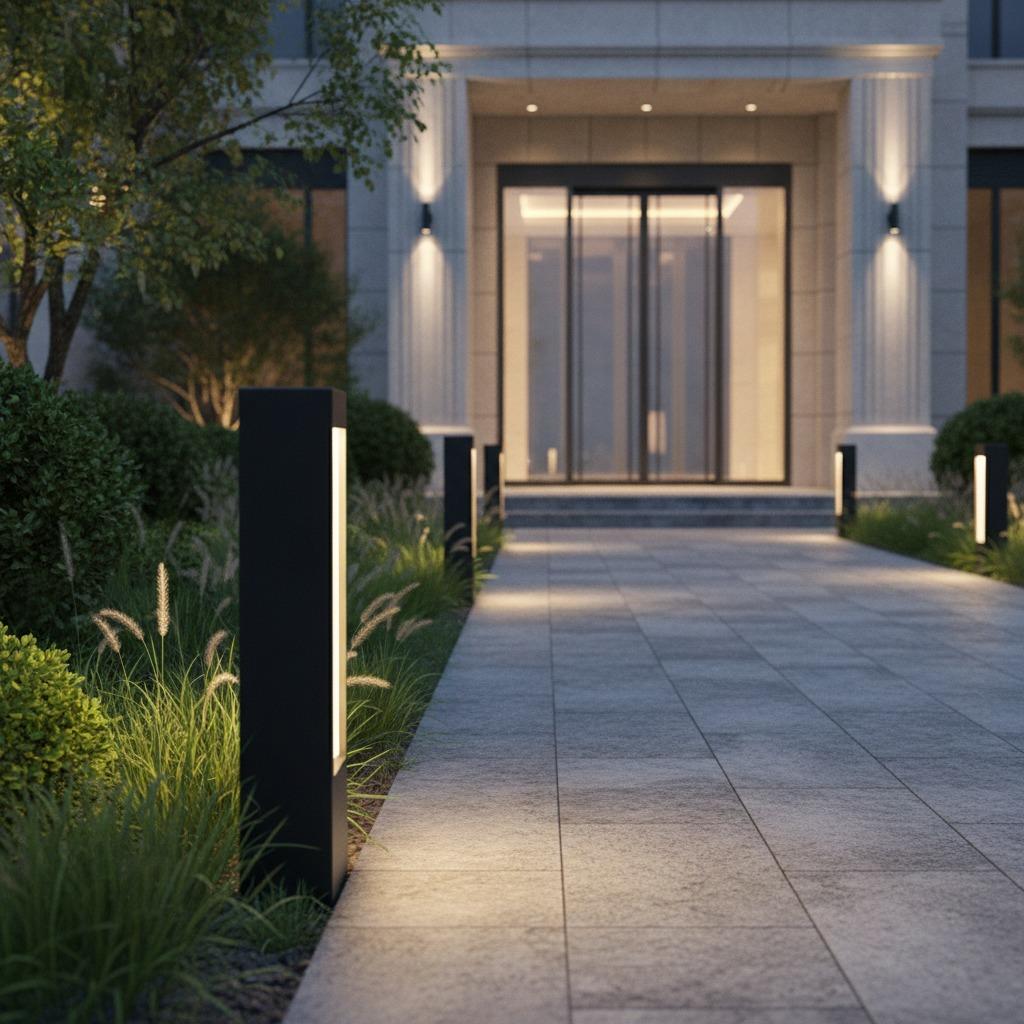
The arrival area establishes the first nighttime impression of the property. Courtyard or post lights may support broader circulation lighting, while wall-mounted or architectural fixtures can reinforce the entrance façade. The goal is not simply to make the entrance as bright as possible; the lighting package should allow guests to recognize the route, building entrance and pedestrian areas without creating distracting brightness contrasts.
Courtyards and Resort Gardens
Courtyards often combine landscaping, seating, planting and guest circulation, so fixture appearance matters during both day and night. CDZM's courtyard light collection includes several garden and post-light designs that can be evaluated for hotel courtyards, landscaped gardens and resort outdoor spaces. The appropriate choice depends on mounting height, light distribution, architecture, pathway position and maintenance access rather than on appearance alone.
Hotel Pathways and Landscape Walkways
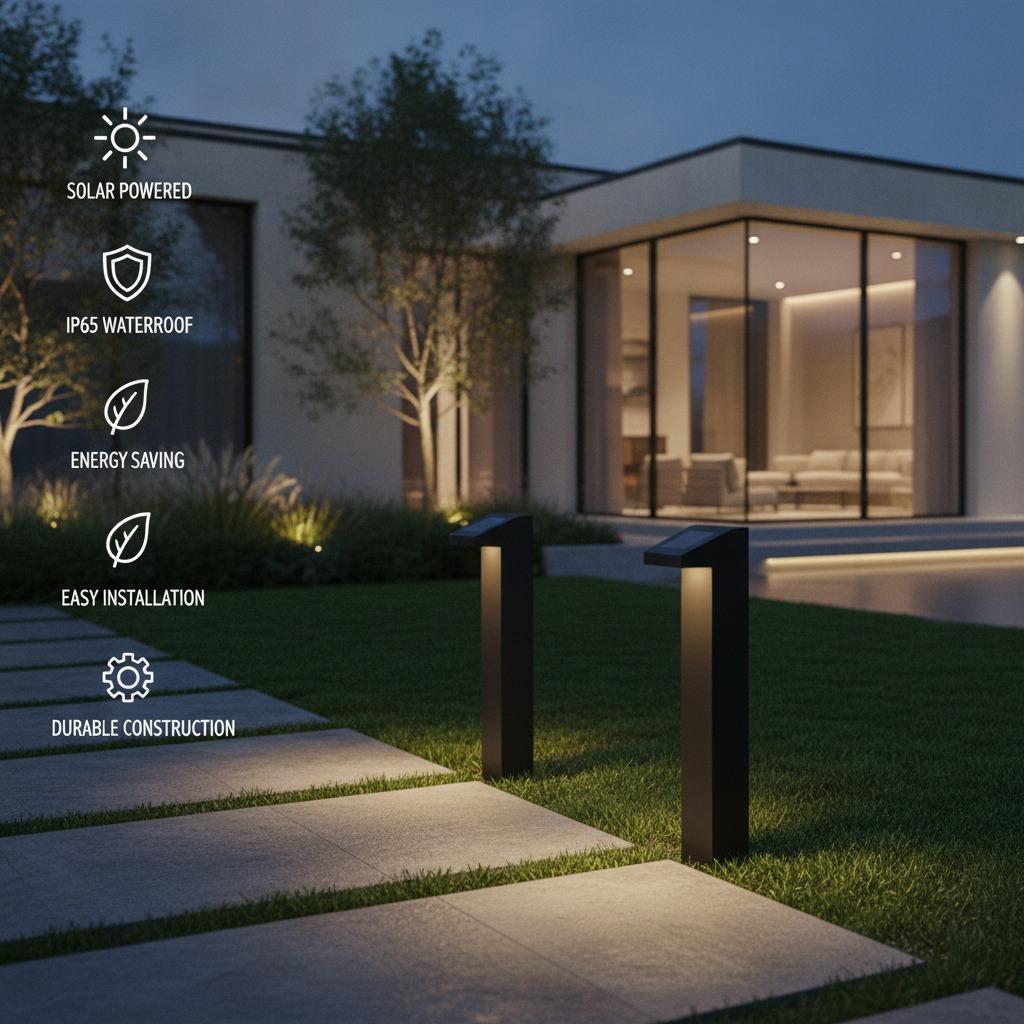
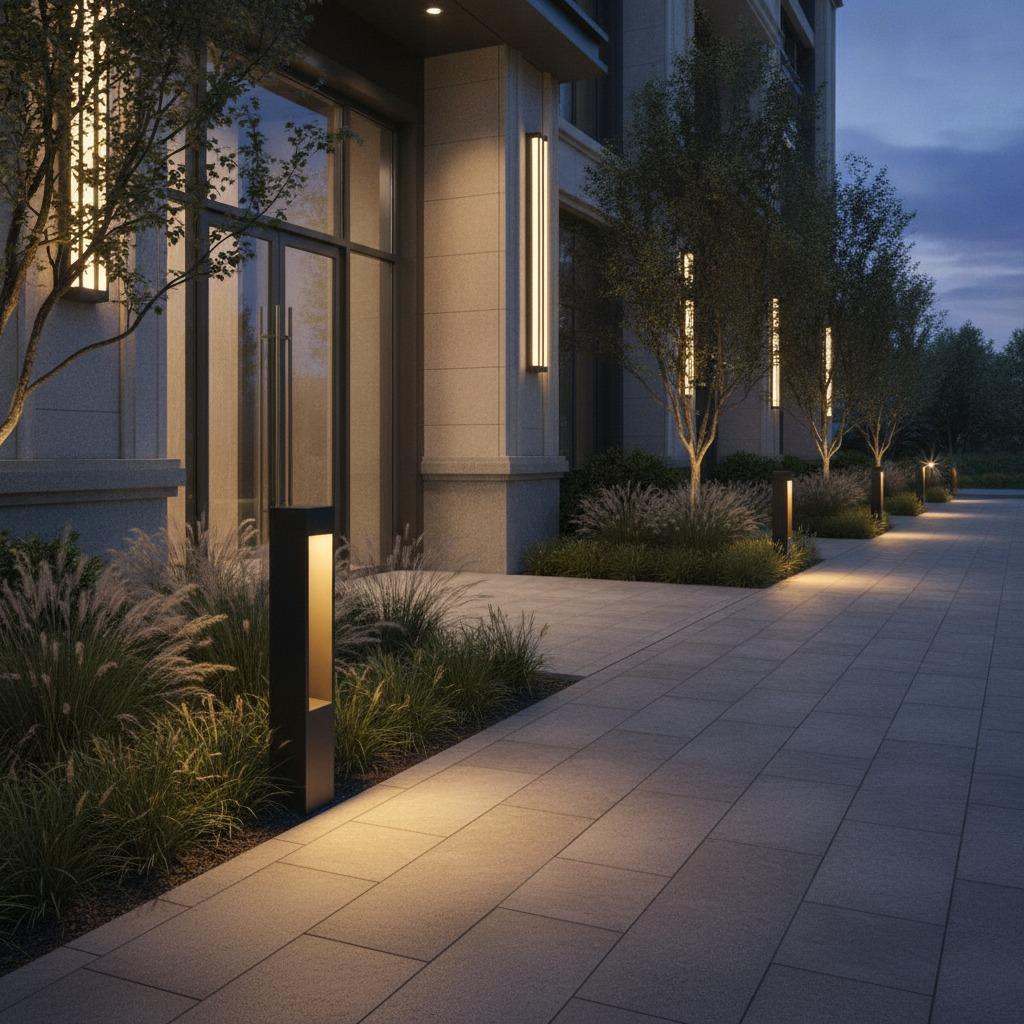
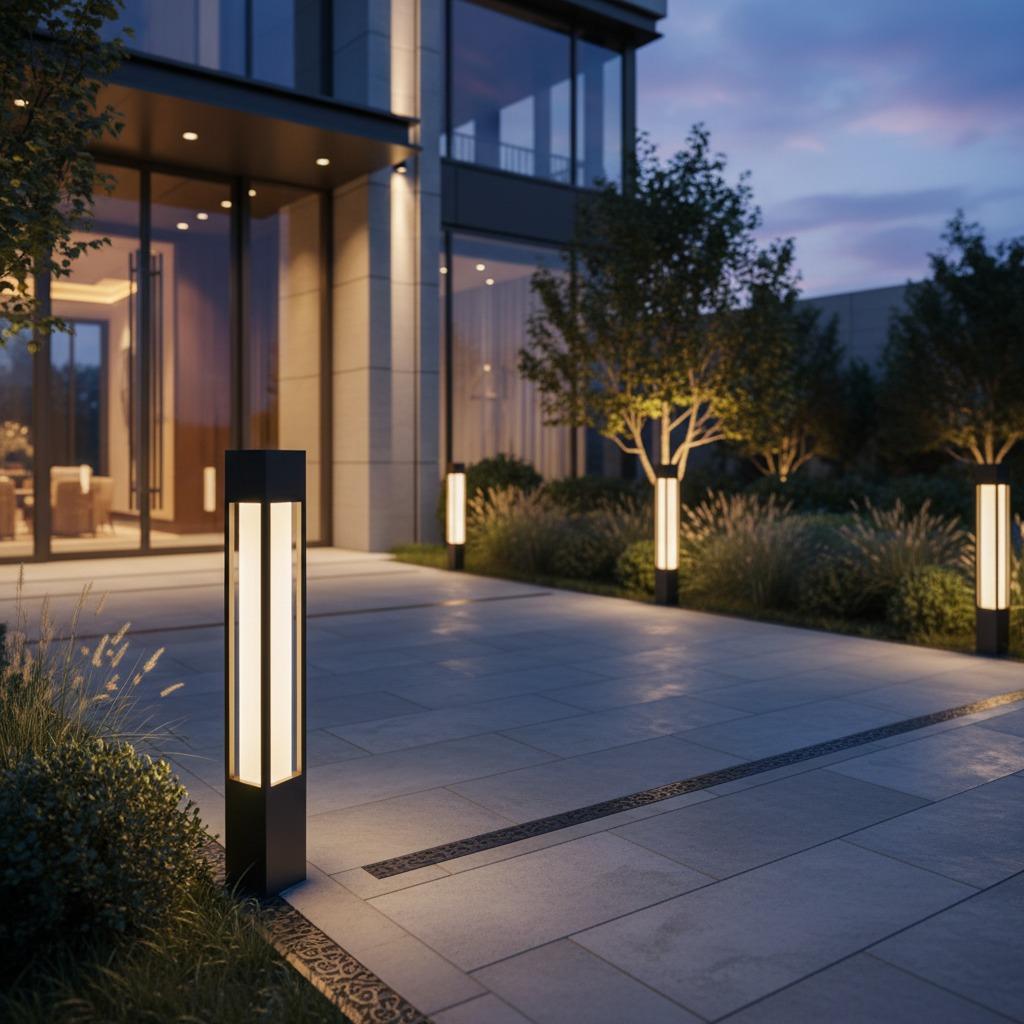
Lower bollard or lawn lights are useful candidates where the project needs pedestrian-scale lighting and a less dominant daytime fixture. CDZM's lawn-light category includes decorative, slim, recessed and cylindrical bollard designs, as well as solar and low-voltage options. One listed product is specifically described as a 5W/7W 12V outdoor bollard lawn light for hotel and home decoration, showing why supply voltage and installation design should be checked at the individual model level.
Hotel Walls, Villa Units and Guest-Room Exteriors
Wall lamps can provide another visual layer around villas, guestrooms, courtyard walls and entrance structures. CDZM's wall-lamp range currently includes YUANZUAN, YUANYUE, GUANGLIFANG and FANGZUAN designs, together with a solar floodlight category. Several wall-light pages identify hotel exteriors, hotel pathways or courtyards among their intended applications.
Resort Plazas and Large Outdoor Areas
Large plazas and expansive resort grounds may require a very different lighting scale from intimate garden paths. CDZM's engineering cases include a high-mast floodlighting project for a resort complex, where the published project description emphasizes broad illumination, guest navigation and coordination between mast appearance and surrounding architecture. This is a useful reminder that resort lighting should be designed by zone rather than by choosing one fixture family for the whole property.
Build a Hotel Outdoor Lighting Specification Before Requesting Prices
A reliable quotation requires more than a product image and target quantity. Give each shortlisted hotel outdoor lighting supplier the same technical brief so the proposals can be compared on equivalent assumptions. The exact requirements should be confirmed by the project designer, but the procurement schedule below provides a practical starting point.
| Specification Item | What the Buyer Should Confirm | Why It Matters for Hotels |
|---|---|---|
| Application zone | Entrance, courtyard, pathway, façade, garden, parking or plaza | Different areas require different lighting tasks |
| Fixture model/version | Exact supplier model and product revision | Prevents sample and mass-production mismatch |
| Power supply | AC, low-voltage DC or solar | Affects wiring, installation and maintenance |
| Rated power | Model-specific input power | Needed for electrical planning and comparison |
| Light output | Whole-luminaire lumen data where available | Helps compare actual output rather than wattage alone |
| Light distribution | Beam or photometric information | Determines where the light reaches |
| Color specification | Required color temperature and consistency | Supports a coordinated nighttime environment |
| Material | Housing, shade and relevant hardware | Affects appearance and environmental suitability |
| IP rating | Rating for the exact model | Helps assess enclosure protection requirements |
| Mounting interface | Wall mounting, ground mounting or pole/spigot dimensions | Reduces installation mismatch |
| Controls | Fixed output, dimming, timer or solar control where applicable | Defines actual operating behavior |
| Documentation | Drawings, reports, instructions and certification scope | Supports project review and handover |
| Spare strategy | Drivers, modules or replacement fixtures where relevant | Important for long-term hotel maintenance |
Do not assume that a specification shown on one product can be applied to the full CDZM range. Hotel buyers should freeze the actual model and version in the purchase documentation after sample and technical approval.
Compare Materials, Optical Design and Installation Structure
Materials matter because hotel outdoor fixtures remain visible even when the lights are off. Housing finish, proportions, fasteners, shade material and installation details all influence the architectural appearance. CDZM's published outdoor products include die-cast aluminum housings and combinations of PC or tempered-glass covers, but the construction varies by model. For example, the CDZM-9032 courtyard light is listed with a high-pressure die-cast aluminum housing and tempered-glass lampshade, while the YUANZUAN wall lamp uses a die-cast aluminum body with a PC shade.
Optical and installation details should be reviewed at the same time. The CDZM-9032 product page lists 30W/60W rated power, IP65 protection and 60/76mm installation spigot options. These details can be useful for a courtyard or commercial landscape project, but the buyer should still verify the intended mounting height and project layout before approval.
For guest-facing spaces, excessive visible brightness can undermine the atmosphere even when the measured light level appears adequate. Ask the supplier or lighting designer to review where guests will see the luminaire from seating areas, balconies, paths and building entrances. A product should be assessed as part of the installed composition rather than from a catalog photograph alone.
Evaluate Solar, AC and Low-Voltage Options by Site Conditions
Hotel projects may combine more than one electrical approach. Grid-powered courtyard or wall lights can suit locations with planned electrical infrastructure, while low-voltage landscape lighting may fit certain garden zones. Solar lighting can be considered for suitable areas where trenching or electrical access is difficult, but the decision should be based on site solar conditions, energy storage, actual operating mode and maintenance strategy.
CDZM's solar lighting solution presents solar street, split-system and floodlighting options, while individual wall-lamp pages also show solar configurations. However, system-level marketing figures should not automatically be applied to every solar product. Hotel buyers should request the panel rating, battery chemistry and capacity, actual fixture power, operating program and model-specific autonomy before accepting a runtime claim.
The YUANZUAN GT-BD3002 page, for example, lists a 5W solar version, a 5V/4.5W monocrystalline panel, an 8Ah/3.2V lithium battery and a separate mains-powered version. This illustrates why “solar wall light” and “mains wall light” should be recorded as distinct configurations rather than treated as one interchangeable specification.
Review Workmanship and Batch Consistency Before Mass Production
Hotels rarely purchase one outdoor lamp. A project may involve many fixtures installed across a site, so visual and electrical consistency becomes commercially important. A strong sample is useful only if the production batch follows the approved specification. Buyers should therefore record the approved housing finish, dimensions, optical configuration, electrical version, labels and accessories before releasing mass production.
CDZM's About Us page displays production stages including SMT assembly, PCB soldering, wire assembly, housing assembly, LED module mounting, heat-sink processing, final assembly and inspection. It also describes a 50,000 m² facility, while the homepage states that the company operates 20+ production lines. These are company-level published capabilities; the production route applicable to the selected hotel fixture should still be confirmed for the actual order.
For a hotel project, a useful pre-production approval can include the fixture sample, finish sample, packing method, installation accessories and a controlled technical specification. If the property will open in phases, the buyer should also consider how color and appearance will be maintained across later batches.
Check Quality Testing and Certification at Model Level
CDZM states that its internal testing includes integrating-sphere testing, electrical safety testing, high-temperature aging, waterproof testing, impact-resistance testing and environmental-stress testing. The company page also states that more than 30 tests are conducted before a product is released and that essential safety and performance parameters receive 100% testing during mass production. Hotel procurement teams should use these claims as the basis for requesting model-specific evidence rather than assuming that every displayed test applies identically to every fixture.
The same principle applies to certification. CDZM displays ISO 9001, CE and other qualification information on its website and states that full certification details are available on request. For a hotel project, verify whether the document covers the exact model, electrical version and destination market required by the order. A company-level certificate and a product-specific compliance document serve different purposes.
Confirm Capacity and Lead Time Around the Hotel Opening Schedule
A hotel outdoor lighting supplier should understand that a late lighting package can affect landscape completion, electrical commissioning and the opening schedule. Instead of asking only “What is the lead time?”, divide the timeline into technical confirmation, sample approval, customization, material preparation, production, inspection, packing and shipment. The supplier should identify which steps depend on buyer approval and what date starts the production lead time.
CDZM publishes company-level production capacity information through its manufacturing pages, including multiple automated production lines, but the available capacity for a particular hotel order must still be confirmed based on quantity, model mix and customization requirements.
For large resorts, it can be useful to organize the order by zones—entrance, guestrooms, gardens, pathways and parking areas—while keeping one controlled fixture schedule. This helps the contractor identify which fixtures are required first and reduces the risk of receiving decorative products before the necessary installation interfaces have been approved.
Compare CDZM Fixture Types for Hotel Outdoor Areas
The following table uses currently published CDZM product families as a procurement starting point. “Best for” describes a reasonable hotel application to evaluate; it is not a guarantee that the product fits every project.
| CDZM Product / Range | Published Characteristics | Hotel Area to Evaluate | Key Point to Confirm |
|---|---|---|---|
| CDZM-9032 Courtyard Light | 30W/60W, die-cast aluminum, tempered glass, IP65, 60/76mm spigot | Courtyards, landscaped circulation, larger garden zones | Mounting height, photometrics, exact color specification |
| YUANZUAN GT-BD3002 Wall Lamp | Solar and mains versions, die-cast aluminum + PC, IP65, 390 lm listed for solar version | Hotel exterior walls, villa units, courtyard walls | Solar vs. mains configuration and runtime mode |
| YUANYUE GT-BD3202 | Round decorative wall design, solar/mains versions, 380 lm listed for solar version | Guest-villa entrances, walls, intimate courtyard areas | Finish, mounting location and power version |
| GUANGLIFANG GT-BD4003 | Square geometric wall-light design, die-cast aluminum + PC, IP65 | Modern hotel façades and pathways | Exact model output and installation conditions |
| CDZM Lawn & Bollard Lights | Decorative, slim, recessed, cylindrical, low-voltage and solar options | Garden paths, landscape walkways, planting edges | Height, glare, supply voltage and spacing |
| Solar Lighting Solutions | Solar street and floodlighting configurations | Remote access roads, selected parking or off-grid areas | Model-specific energy balance and sunlight conditions |
Calculate Total Project Cost Instead of Comparing Lamp Price Alone
Unit price matters, but a hotel outdoor lighting supplier should also help the buyer understand the costs surrounding the fixture. The installed project cost may include poles, foundations, cables, underground conduit, trenching, drivers, controllers, mounting accessories, installation labor, commissioning, shipping, spare parts and later maintenance. A cheaper lamp may not create a cheaper project if it requires additional installation work or frequent replacement.
Solar and mains-powered products should also be compared using the full installation scenario. Solar lighting may reduce the need for certain cable routes in suitable locations, but it introduces requirements for panel exposure, battery condition and energy management. Mains lighting can simplify some operating considerations but may involve trenching and electrical infrastructure. The appropriate choice depends on the actual hotel site.
Maintenance access is another cost factor. Before approving a fixture, ask how the lamp or driver is accessed, which parts can be replaced and whether a matching replacement can be ordered later. Hotels operate continuously, so replacing a failed fixture without disturbing guest areas can be as important as the original purchase price.
Use OEM/ODM Customization to Coordinate the Hotel Design
Hotels and resorts often need outdoor fixtures to match a defined architectural language. CDZM states that it supports OEM/ODM services and engineering work including structural design and rapid prototyping. This can be relevant when a buyer needs a specific finish, dimensional adjustment, mounting solution, branded packaging or other agreed modifications.
Customization should start with a controlled request rather than “make this lamp look more luxurious.” Define the target appearance, dimensions, installation interface, finish sample, electrical configuration, quantity and approval process. If a requested change affects the optical, electrical, thermal or structural design, ask whether another prototype or technical review is necessary.
For hotel groups operating several properties, the greatest value may come from building a repeatable fixture package rather than developing a completely different lamp for every project. A consistent family of courtyard, bollard and wall lights can simplify specification, replacement planning and future procurement while still allowing different zones to use different lighting functions.
What Should You Send a Hotel Outdoor Lighting Supplier for a Quote?
A useful hotel lighting inquiry should include the project country, hotel or resort type, site plan, landscape plan where available, photographs or renderings, lighting zones, approximate quantities, installation heights, existing electrical conditions, required power system, preferred appearance, target delivery date and any project documentation requirements. If the lighting designer has already prepared target illuminance, photometric criteria or fixture schedules, include those documents rather than asking the supplier to infer them from photographs.
CDZM offers commercial and outdoor lighting products together with project-design support. Buyers can review the company's commercial lighting solutions and engineering cases before preparing the fixture schedule. For a project-specific quotation, send the required zones, products, quantities and technical information through the CDZM contact page.
Frequently Asked Questions About Hotel Outdoor Lighting Suppliers
1. What products should a hotel outdoor lighting supplier provide?
A hotel project may require courtyard lights, bollard or lawn lights, decorative wall lamps, floodlighting and selected solar products. The exact combination should follow the site layout and lighting tasks rather than a fixed package. CDZM currently publishes courtyard, lawn/bollard and wall-lamp categories that can be evaluated for these applications.
2. What should buyers check before choosing hotel pathway lights?
Confirm fixture height, optical distribution, visible glare, spacing, supply voltage, material, IP rating, installation method and maintenance access. Review the fixture from the actual guest walking direction instead of judging it only from a product photograph.
3. Are solar lights suitable for hotel and resort projects?
They can be evaluated for suitable locations, especially where grid access or trenching is difficult. The buyer should still check model-specific solar-panel power, battery capacity, operating mode, shading conditions and expected nighttime duty before approving a solar configuration.
4. What color temperature should be used for hotel outdoor lighting?
There is no single value suitable for every hotel. Architecture, landscape materials, brand atmosphere and functional requirements should guide the selection. Keep the selected specification consistent across related fixtures and review real samples before bulk production.
5. Is IP65 enough for every hotel outdoor location?
No single IP rating should be treated as proof of suitability for every environment. Confirm the actual exposure, mounting position and additional project requirements, especially for coastal, flood-prone, high-temperature or unusually harsh locations.
6. Should a hotel use the same fixture everywhere?
Usually not. Entrances, pathways, gardens, walls, parking areas and plazas perform different functions. A coordinated product family can create visual consistency, but the optical and installation requirements should still be selected by zone.
7. How should buyers approve outdoor lighting samples?
Record the exact model, power version, finish, material, color specification, mounting configuration and accessories. Where possible, install the sample in a representative area and review its appearance and lighting effect from normal guest positions.
8. Can CDZM customize hotel outdoor lighting?
CDZM states that it provides OEM/ODM design services, structural design and rapid prototyping. The exact customization scope, sample requirement, cost and production implications should be confirmed for the requested fixture and project.
9. What should be checked when reviewing certificates and test reports?
Confirm the model number, product version, applicable standard or test scope, issuing information and destination-market relevance. Do not assume a certificate displayed at company level automatically covers every product configuration.
10. How can a hotel reduce long-term outdoor lighting maintenance risk?
Use controlled product specifications, approve actual samples, document installation interfaces, keep records of drivers and electrical versions, plan spare fixtures or components where appropriate and require review before supplier substitutions. A consistent repeat-order specification is more useful than relying on a product name alone.
Conclusion
Selecting a hotel outdoor lighting supplier is a project decision that combines guest experience, landscape design, product reliability, installation and long-term maintenance. Hotel developers and contractors should define every outdoor zone first, then compare courtyard lights, bollard lights, wall lamps and solar options using model-specific specifications rather than relying only on style, wattage or price. CDZM offers outdoor product categories, OEM/ODM support, lighting-design services and published resort project experience that can provide a starting point for hospitality lighting procurement. Review the relevant CDZM outdoor lighting products and submit your site plan, project zones, quantities, installation conditions and target schedule through Contact Us to evaluate a hotel-specific outdoor lighting package.