
What Should a Landscape LED Lighting Manufacturer Deliver?
Choose a landscape LED lighting manufacturer that can connect the quotation, approved sample, production specification and delivered product. An attractive sample is only the starting point: buyers also need an agreed electrical configuration, installation dimensions, inspection criteria and replacement strategy. CDZM’s product range includes lawn and bollard lights, courtyard lights and outdoor wall lamps, providing several fixture families for landscape projects. The purchasing task is to select the appropriate configuration from those families and define what must remain consistent when the order moves into production.
Which Buyers Benefit From a Manufacturing-Focused Approach?
For distributors, make the repeat-order specification and product documentation part of supplier evaluation. For lighting brands, define the customization scope, approved components and packaging requirements. For contractors, prioritize installation interfaces, delivery sequence and technical approval. Developers and property operators should involve the maintenance team before selecting fixtures that will remain on site for years. A manufacturing-focused purchase is particularly useful when multiple units, phased deliveries or future replenishment must match. For a small replacement order, first check whether a standard product meets the requirement. Keep underwater, emergency-egress and other specialist applications outside the landscape package until the responsible designer has confirmed the necessary product and installation requirements.
Match Each Fixture Family to an Application
Pathways, Residential Communities and Commercial Gardens
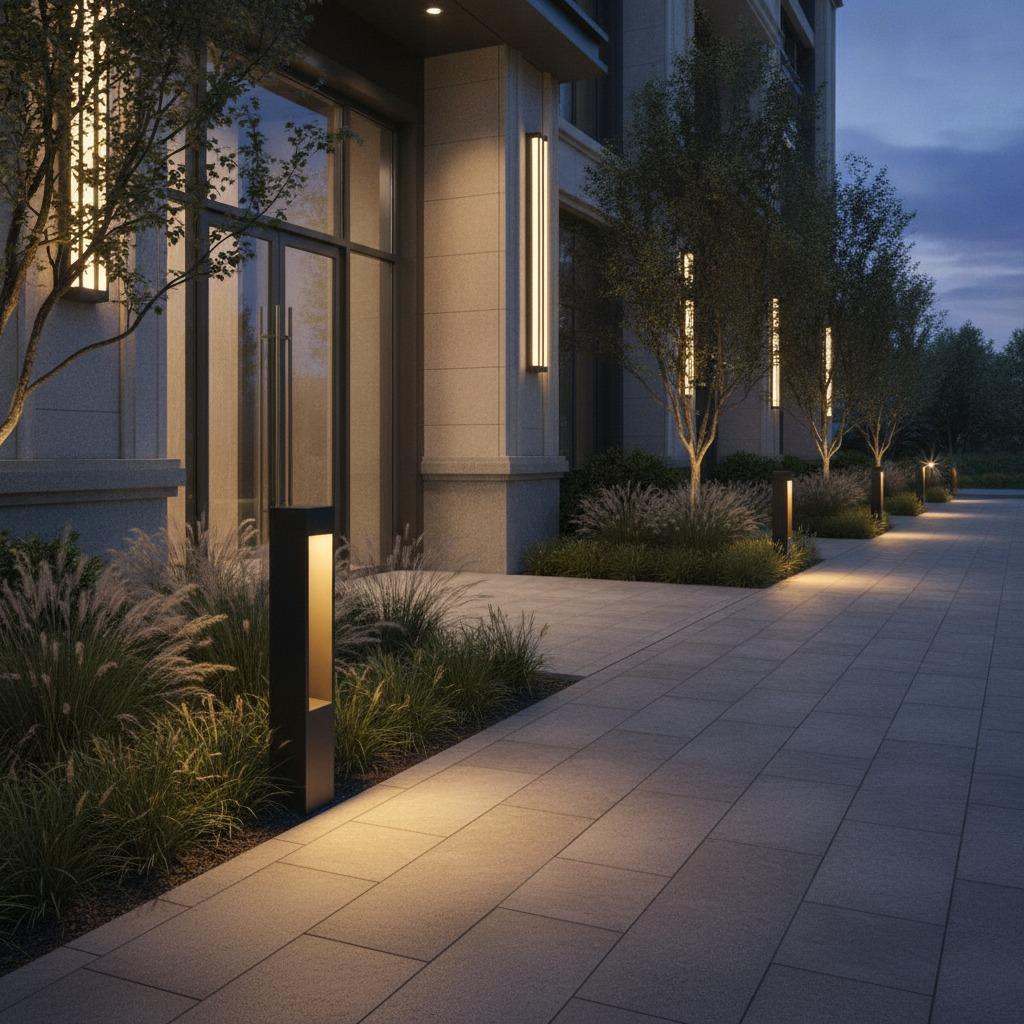
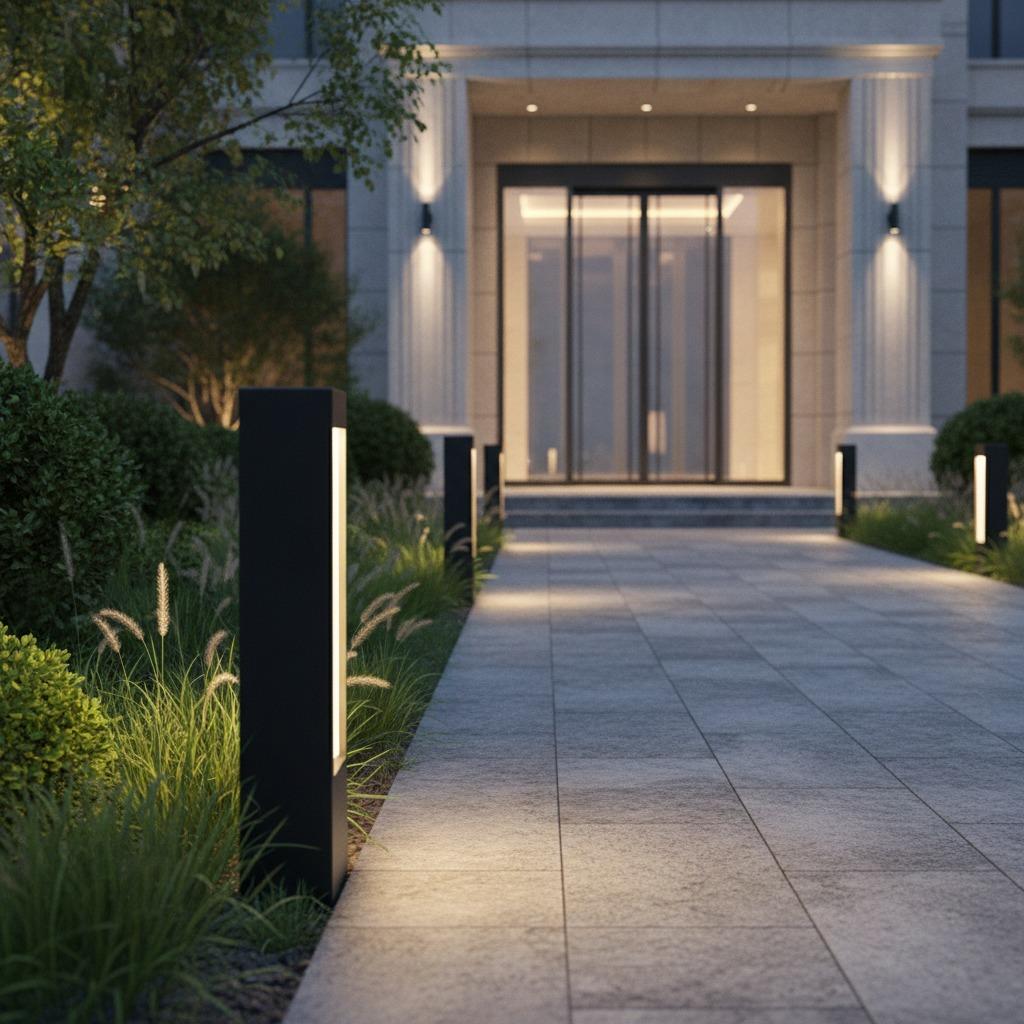
For pedestrian routes, ask the designer to identify path widths, proposed mounting heights, viewing directions and nearby seating or windows. Evaluate the fixture’s daytime appearance alongside its nighttime effect. In the CDZM bollard range, recessed, rectangular and cylindrical designs provide different options to investigate; do not assume that similar power ratings produce an interchangeable result. Record the selected height and optical arrangement before approving foundations or cable positions.
Courtyards, Entrances and Larger Landscaped Areas
For larger outdoor spaces, review post-mounted garden lights separately from low-level pathway fixtures. Require the proposal to identify mounting height, pole compatibility, light distribution and maintenance access. A courtyard-light quotation should make clear whether it includes only the luminaire or also poles, brackets, foundations, wiring accessories and installation support.
Building Edges, Villa Entrances and Garden Walls
For wall-mounted lighting, include wall construction, mounting position, cable entry and the required visual effect in the brief. Review solar and mains-powered versions separately. A coordinated appearance across a property is a design goal, but it should not conceal differences in electrical supply, operating controls or replacement parts.
Prepare a Technical Specification Before Comparing Prices
Before asking a landscape LED lighting manufacturer for its best price, issue a specification that every quotation must address. Separate the buyer’s requirement, the supplier’s proposed value and the final approved value. The following schedule is a recommended purchasing framework—not a claim that every feature is standard on every CDZM product.
| Specification Item | Information to Define | Evidence or Approval Record |
|---|---|---|
| Model and revision | Exact fixture reference and configuration | Approved specification |
| Dimensions | Body size, selected height and mounting interface | Dimensioned drawing |
| Electrical supply | AC, low-voltage DC or solar version | Product label and electrical data |
| Input power | Rated power for the selected version | Model-specific specification |
| Light output | Whole-luminaire lumens and distribution | Photometric data or relevant report |
| Color quality | Color temperature, rendering and consistency requirements | Agreed data and sample review |
| Housing and finish | Material, finish, color and texture | Construction details and finish sample |
| Environmental suitability | Exposure, temperature and protection requirements | Applicable product evidence |
| Controls | Fixed output, dimming, timing or sensing requirements | Driver and controller details |
| Serviceability | Access method and replaceable components | Maintenance instructions |
| Documentation | Required reports and installation information | Documents matching the configuration |
| Packaging and accessories | Included parts, labels and protective packaging | Approved packing specification |
Keep AC, DC and Solar Versions Separate
The CDZM-9001 garden-light page distinguishes CDZM-9001A as the electric version and CDZM-9001B as the solar version. This is a choice between configurations, not evidence of automatic switching between two power sources. For a solar proposal, request panel rating, battery voltage and capacity, operating program and the conditions behind any runtime claim. For a low-voltage proposal, specify the required supply and installation arrangement rather than writing only “12V landscape lighting.” Keep these details attached to the individual model throughout quotation, sample approval and production.
Review Materials and Components Beyond the Exterior Finish
Ask the landscape LED lighting manufacturer to identify the housing construction, optical cover, driver, LED module, cable entries and mounting hardware. Approve the visible finish with a physical reference, but review component specifications separately: matching paint does not establish an identical electrical configuration. For exposed sites, include coastal conditions, irrigation, possible standing water and cleaning methods in the requirement rather than treating an IP65 entry as the complete environmental brief. Request the relevant supporting evidence for each condition. Where maintenance matters, ask to see how the fixture is opened, which parts can be replaced and what must be checked during reassembly. Treat these as approval questions, not assumptions based on a product photograph.
Turn the Approved Sample Into a Production Reference
CDZM’s manufacturing overview presents processes including SMT assembly, PCB soldering, wire assembly, housing assembly, LED-module mounting, inspection and packaging. Ask which operations apply to the selected product, which are performed in-house and how purchased components are checked. Before releasing production, create a signed sample record identifying the model, drawing revision, height, finish, optical arrangement, driver, labels and accessories. For example, a hypothetical order for a 600 mm bollard should record that height explicitly rather than retain the catalog’s broader selectable-height range. Agree how production units will be compared with the reference and which substitutions require approval. For repeat orders, retain the specification as well as the sample; a model name alone is not a complete purchasing record.
Check Quality Testing and Certification at Model Level
Separate Product Validation From Production Inspection
CDZM lists integrating-sphere, electrical-safety, high-temperature-aging, waterproof, impact-resistance and environmental-stress testing among its activities. Use this information to request an order-specific inspection plan. Ask which characteristics receive full inspection, which are sampled and which rely on product-validation reports. Identify acceptance limits, record retention and the handling of nonconforming units. Where the project needs output data, request results for the complete quoted luminaire rather than accepting an LED-component description as the only evidence.
Match Documents to the Supplied Configuration
The company page displays certification information and states that full details are available on request. Have the project’s technical reviewer check document scope, model references, electrical ratings and applicable market requirements. Record any gaps before production approval. When changing a driver, optical assembly, housing or other specified component, ask whether the change requires renewed testing or documentation review. Do not transfer a report from one configuration to another without establishing its applicability.
Confirm Capacity, MOQ and Lead Time for the Actual Order
Ask the landscape LED lighting manufacturer for a schedule covering the selected model mix, not just a headline production capacity. The CP201813 product FAQ gives reference timings of 7–12 working days for samples and 15–25 working days for general customized orders, while stating that timing depends on design and quantity; it also describes a flexible MOQ rather than a universal quantity. Confirm what starts the clock and whether the quotation includes approval time, inspection, packing and transport. For phased projects, allocate quantities by installation zone and delivery milestone. Agree when long-lead components must be ordered, how changes affect the schedule and whether later batches will follow the same approved specification.
Compare CDZM Models Using Published Specifications
The following comparison uses CDZM’s published product data, not independent measurements. Applications are suggested areas for evaluation. Obtain project-specific photometric information and quotations before ranking the models; the public pages do not provide a consistent price basis for assigning “low,” “medium” or “high” cost levels.
| Model | Published Specifications | Design Feature to Evaluate | Application to Evaluate | Cost and Approval Variables |
|---|---|---|---|---|
| CP20191 recessed bollard | 5W COB; 3000K; AC100–265V; 110 × 65 × H300–800 mm; IP65 | Recessed light source with downward illumination | Paths where source visibility and a discreet profile are priorities | Selected height, finish, driver and accessories. |
| CP201813 rectangular bollard | 10W COB; 3000K; AC100–265V; 160 × 55 × H300–800 mm; IP65 | Rectangular frame with the light source in its upper section | Modern residential and commercial landscapes | Height, finish, optical requirements and order quantity. |
| CP20194 cylindrical bollard | 7W COB; 3000K; AC100–265V; Ø65/90/108 × H300–800 mm; IP65 | Cylindrical body with a translucent upper diffuser | Gardens and pathways requiring a rounded fixture profile | Selected diameter and height, finish and installation parts. |
| CDZM-9032 courtyard light | 30W/60W; AC85–265V; die-cast aluminum housing; tempered-glass cover; IP65; 60/76 mm spigot options | Post-mounted courtyard-light construction | Courtyards and larger landscaped circulation areas | Power version, mounting interface, pole scope and lighting calculation. |
Use this table to establish a shortlist, not a wattage ranking. Request a representative installation review at the intended height and position, including the ground surface, nearby planting and normal viewing directions. For further application questions, CDZM’s path and bollard lighting guide provides additional purchasing context. Keep the final selection tied to the approved layout and sample, not to whichever product looks brightest in an isolated demonstration.
Compare Total Purchase Cost, Including Missing Items
Normalize quotations from each landscape LED lighting manufacturer before negotiating unit price. Specify whether drivers, mounting kits, poles, connectors, packaging, testing documents and spare parts are included. As an illustrative calculation—not CDZM pricing, consider two otherwise equivalent offers for 200 fixtures: an offer priced $6 lower per unit appears to save $1,200. If omitted mounting kits add $4 per fixture and additional installation work adds $600, the extra costs total $1,400; the apparently cheaper offer costs $200 more overall. Use the same approach for customization, freight and maintenance provisions. Separate confirmed costs from estimates, and avoid assigning a financial value to longer life or lower failure rates without supporting evidence.
Define OEM/ODM Scope Before Development Starts
CDZM describes OEM/ODM design services, DIALux lighting simulation, structural design and rapid prototyping in its engineering service overview. Start by comparing the requirement with an existing model. When changes are necessary, ask the manufacturer to distinguish finish or branding requests from changes to dimensions, mounting, optics or electrical components. Record feasibility, development charges, sample rounds, tooling responsibilities and any additional verification before authorizing work. For private-label landscape lighting, also agree label content, packaging artwork and product identification. For an original design, clarify design and tooling ownership in the commercial agreement. The objective is a configuration that can be reproduced and reordered—not simply a customized first sample.
What Should You Send a Landscape LED Lighting Manufacturer?
Prepare a request for quotation with the destination market, buyer type, project application, quantities by model, drawings or site plans, mounting dimensions, supply requirements, preferred finish, required documentation and target delivery date. Include the expected repeat-order volume where available, but distinguish forecasts from committed orders. For solar configurations, add the location, shading conditions and operating requirements; for modifications, provide marked drawings or a reference sample. Submit the brief through the CDZM contact page and request a response identifying the proposed models, included accessories, unresolved technical points, sample plan, MOQ and delivery assumptions. Resolve those points before comparing final prices.
Frequently Asked Questions
1. How can I evaluate whether a manufacturer controls production?
Request the production route for the selected model, identify in-house and subcontracted operations, and review how incoming components and finished products are inspected. Where appropriate, arrange a factory visit or remote review focused on your product rather than general promotional footage.
2. Should I begin with a standard model or an OEM/ODM project?
Compare the requirement with an existing product first. Use customization where there is a defined need that the standard configuration cannot meet. Ask for the development scope, sample requirements and production implications before committing to a modified design.
3. Does a higher wattage make a landscape light the better choice?
Do not use wattage as the sole ranking criterion. Request whole-luminaire output, distribution and a layout assessment for the intended mounting conditions. Approve the resulting illumination and visual effect before comparing energy or purchase costs.
4. What should a buyer check before selecting bollard height?
Provide path width, planting height, proposed positions, nearby seating and the desired appearance. Ask the designer to assess the selected fixture at that height. Ensure the order records a specific approved dimension rather than the entire catalog range.
5. How should color consistency be managed across deliveries?
Agree the color-temperature specification and acceptable variation before production. Review samples together under the same conditions and retain their identification. Ask how later batches and replacement units will be checked against the approved requirement.
6. What additional information is needed for coastal or exposed sites?
Describe salt exposure, wind-driven rain, temperature, cleaning methods and possible flooding separately. Request relevant material, finish and test information for the exact configuration. Do not approve the site requirement solely from an “outdoor” product label.
7. What should be included in a pre-production sample approval?
Record the fixture reference, dimensions, finish, optical arrangement, driver, power version, labels, mounting parts and packaging. Document open issues and the approval date. Keep any changed sample clearly separated from earlier versions.
8. Can a solar and mains-powered fixture share one purchase specification?
Use separate configuration records, even when the appearance is coordinated. For example, CDZM identifies the 9001A electric and 9001B solar garden lights as different versions. Keep electrical data, operating requirements and replacement parts attached to the correct version.
9. What should the buyer request before shipment?
Agree the inspection scope in advance, then request the relevant results, packing list, product identification and confirmation of included accessories. Resolve deviations from the approved sample before dispatch rather than leaving them for the installation team.
10. How can future replacements remain consistent with the original installation?
Retain drawings, specifications, finish references and component records. Agree a spare-parts strategy and a notification process for changes or discontinuation. Confirm proposed replacements against those records instead of relying on the original product name alone.
Conclusion
Selecting a landscape LED lighting manufacturer means deciding how a lighting concept will become a repeatable product purchase. Start with the application, compare model-specific configurations, approve a representative sample and define the manufacturing checks that matter to the order. Treat documentation, accessories, delivery and replacements as part of the purchase rather than separate afterthoughts. Use the CDZM landscape lighting range to shortlist fixtures, then send your drawings, quantities, installation conditions and customization requirements through Contact Us for a model-specific discussion. The strongest basis for a bulk order is a clear specification that the buyer, factory and installation team can all use.