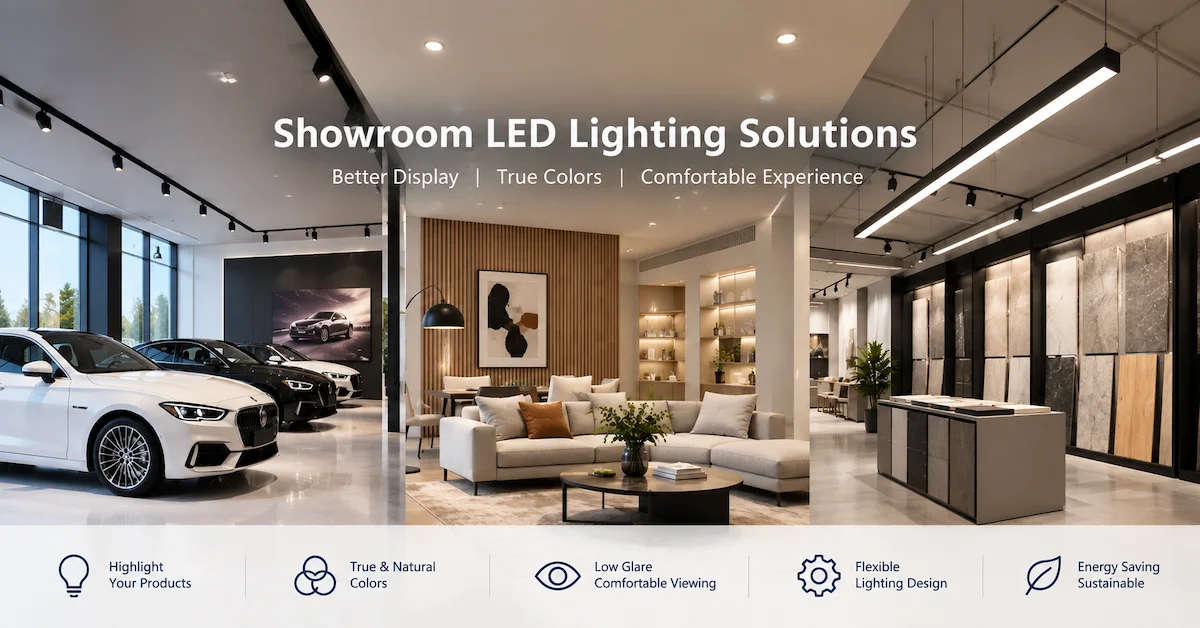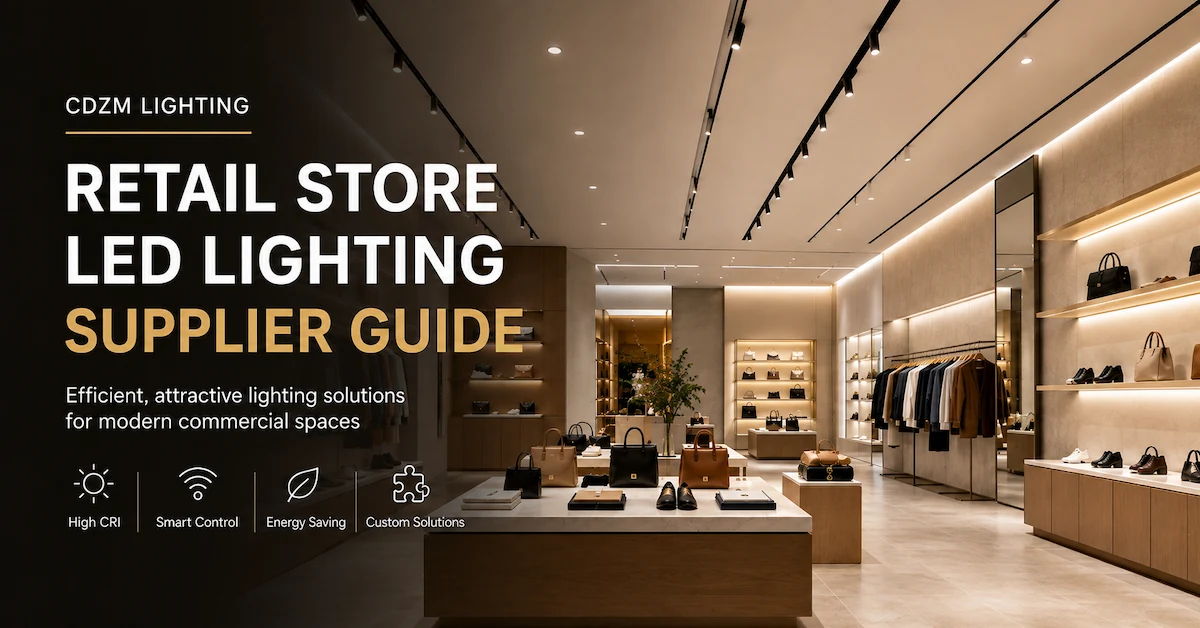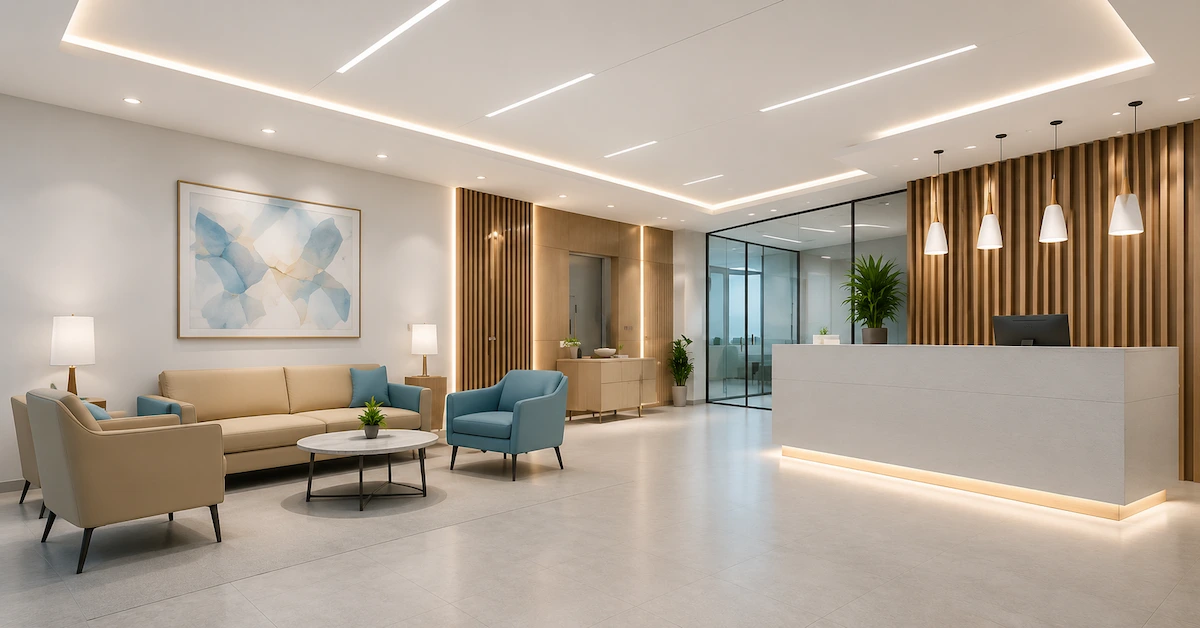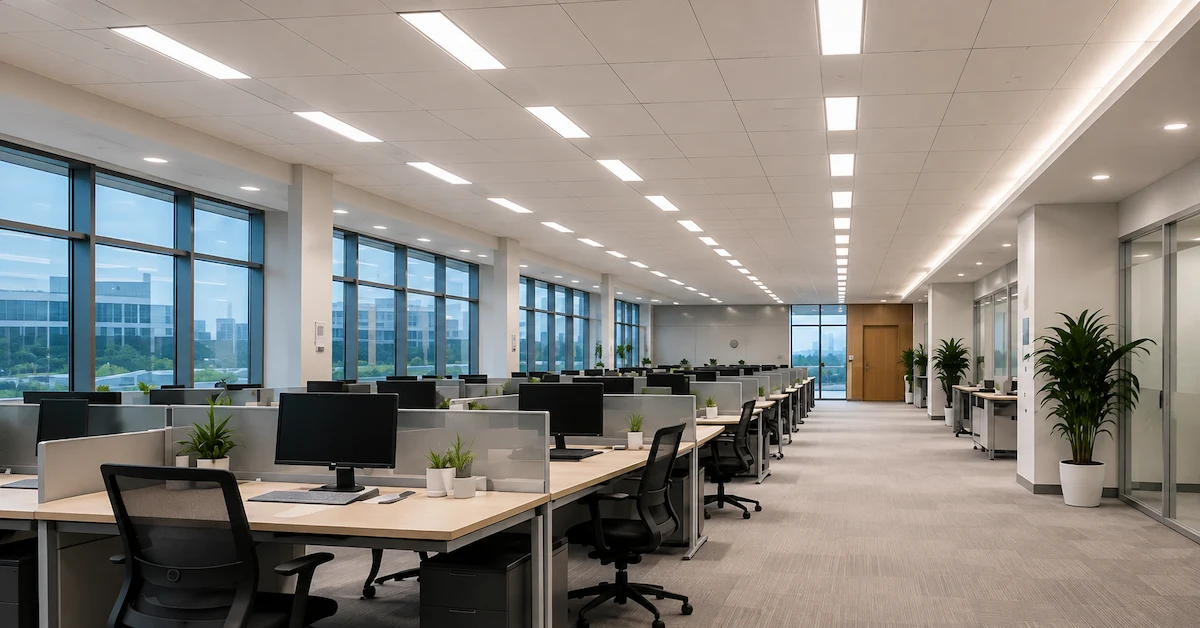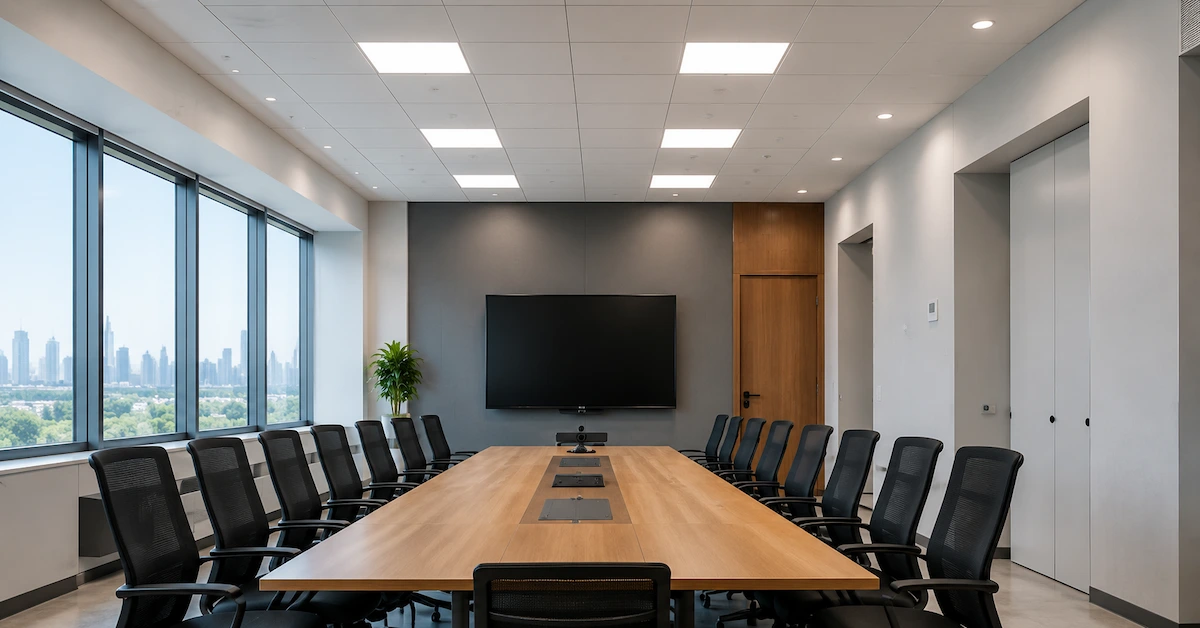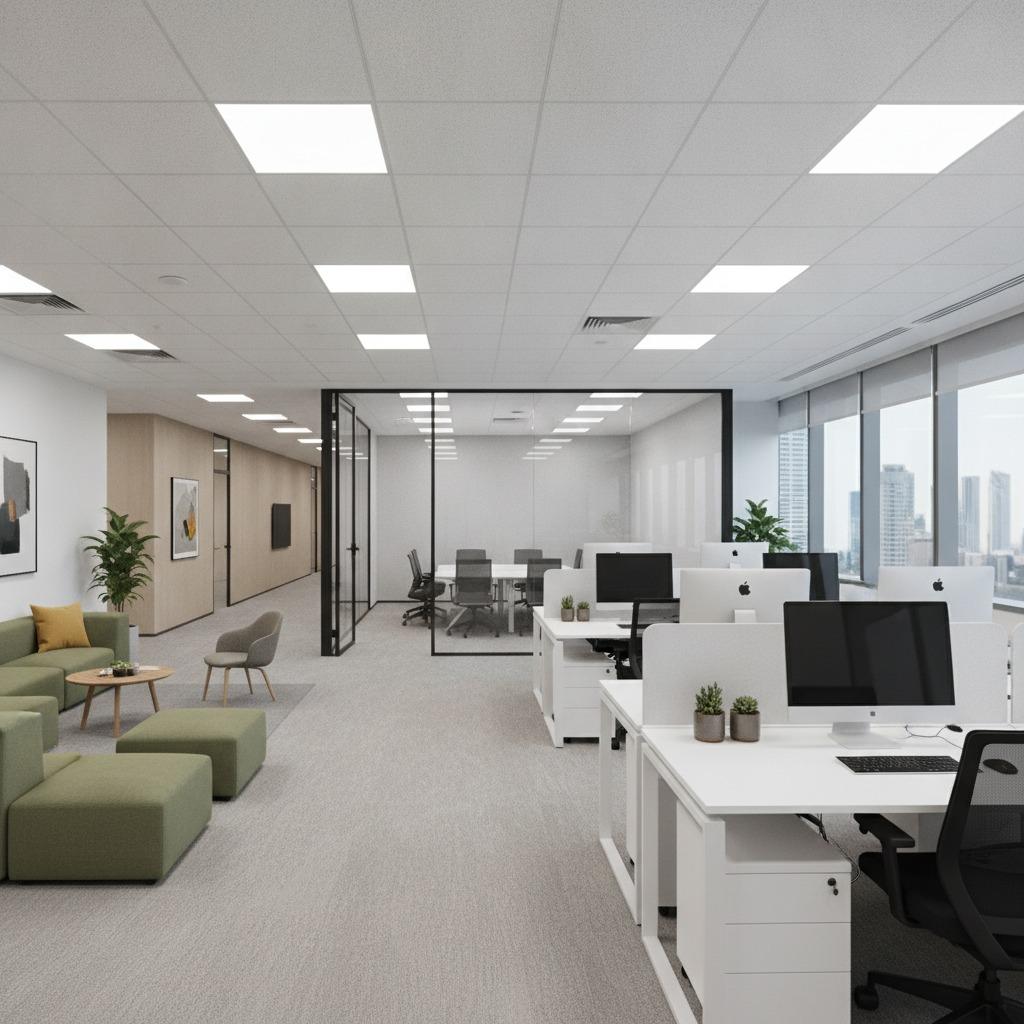

What Should Buyers Look for in Office LED Lighting?
Good office LED lighting is not defined by wattage alone. A commercial lighting specification has to deliver the required light on work surfaces, control glare around computer screens, render colors accurately, fit the ceiling system, support appropriate controls, and remain practical to operate and maintain.
For most office projects, buyers should review at least these eight factors before requesting a quotation:
- Required illuminance at the workplane
- Light distribution and uniformity
- Glare performance
- Luminous efficacy in lm/W
- CRI and color quality
- CCT and visual atmosphere
- Fixture dimensions and ceiling compatibility
- Dimming, occupancy sensing, daylight control, and building integration
The U.S. Department of Energy also recommends evaluating LED lighting as a complete luminaire system rather than focusing only on the LED source. Fixture efficiency, power supply performance, optics, dimmability, and control compatibility all influence the final result.
For buyers planning office, retail, or mixed commercial projects, CDZM Commercial Lighting Solutions currently lists panel and troffer lighting as part of its commercial solution offering, alongside DALI and 0–10V control options.
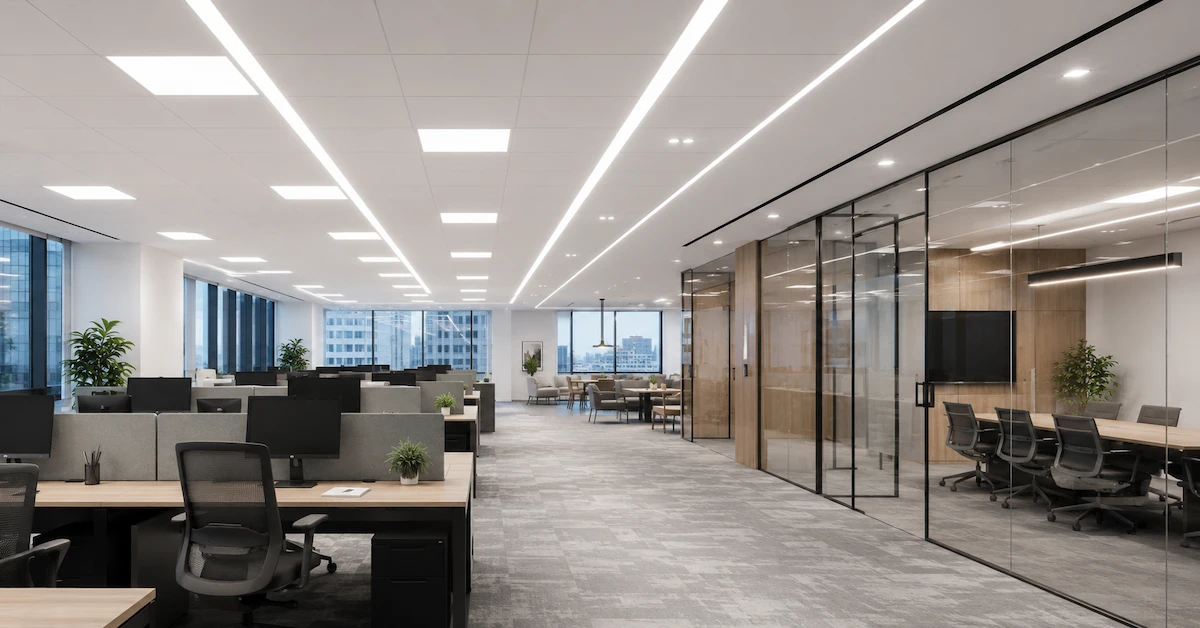
Office Lighting Should Be Designed Around the Task, Not Just the Fixture
A common procurement mistake is to begin with a product question:
“Do you have a 36W LED panel?”
The better first question is:
“What lighting conditions does this office need to achieve?”
A 36W panel may work well in one room and perform poorly in another because office lighting depends on ceiling height, workstation layout, room dimensions, wall and ceiling reflectance, daylight availability, furniture positions, luminaire spacing, and the optical distribution of the fixture.
A U.S. Department of Energy office-lighting study modeled workstations around an IES-recommended horizontal illuminance reference of 300 lux and showed that workstation position, luminaire placement, daylight, and view direction materially affect lighting conditions across the same office.
That is why commercial buyers should provide project information before a supplier recommends fixture quantity or wattage.
Useful Information to Include in an Office Lighting RFQ
| Project Information | Why It Matters |
|---|---|
| Room length and width | Determines total lighting area |
| Ceiling height | Affects fixture output and spacing |
| Workplane height | Needed for illuminance calculations |
| Office type | Open office, private office, conference room, reception, showroom |
| Ceiling system | Determines panel, troffer, suspended, or surface mounting |
| Target illuminance | Defines required usable light |
| CCT preference | Influences visual atmosphere |
| CRI requirement | Important for color appearance |
| Control requirement | DALI, 0–10V, sensor, daylight control |
| Local voltage | Required for driver selection |
| Project location | Relevant to standards and electrical requirements |
| Quantity | Affects production and commercial planning |
For larger projects, a lighting calculation should ideally be completed before final fixture selection.
CDZM states that its engineering team supports DIALux lighting simulation, structural design, rapid prototyping, lux calculations, 3D visual rendering, energy-saving analysis, and cost optimization for project applications.
How Much Light Does an Office Actually Need?
Illuminance is measured in lux and describes how much luminous flux reaches a surface.
This is different from lumens.
Lumens measure how much light a luminaire produces.
Lux measures how much of that light reaches the desk, floor, wall, or other target surface.
Two fixtures with the same lumen output can therefore produce very different office lighting results if their optics, installation height, spacing, or room geometry are different.
The DOE office study referenced above used a 300-lux IES office reference at horizontal workstation calculation points. However, buyers should not treat one number as a universal specification. The appropriate level should be selected according to the visual task, local regulations, daylight conditions, room function, and project design.
Different Office Areas May Need Different Lighting Strategies
Open-Plan Workstations
Priorities usually include:
- Uniform general illumination
- Good screen comfort
- Low visible glare
- Efficient fixture spacing
- Occupancy zoning
- Daylight-responsive dimming near windows
Private Offices
These spaces may combine general overhead lighting with task lighting or local dimming.
Meeting Rooms
Meeting rooms often benefit from zoned controls because presentations, video conferences, writing tasks, and face-to-face meetings require different lighting conditions.
Reception Areas
Reception lighting may place greater emphasis on architectural appearance and vertical illumination than a standard workstation zone.
Showrooms and Customer-Facing Offices
Color quality and accent lighting may be more important here than in back-office areas.
This is one reason buyers should avoid specifying the entire building using one wattage, one lumen output, and one control setting.
Why Glare Control Matters in Office LED Lighting
Glare is especially important in offices because employees frequently work with computer displays and other visual tasks for long periods.
The Illuminating Engineering Society defines Unified Glare Rating, or UGR, as a measure of discomfort produced by a lighting system. It is therefore a system-level lighting consideration, not simply a marketing number printed on a fixture box. IES explains the UGR metric here.
CDZM's commercial solution page lists panel and troffer lighting with UGR<19 as an available office and retail lighting characteristic.
However, buyers should use UGR carefully.
IES specifically supports guidance explaining both the proper use and common misuse of UGR. Actual glare conditions depend on the lighting system, room background, luminaire position, viewing direction, and installation geometry.
Therefore, a specification should not stop at:
“UGR<19 required.”
Ask the supplier for photometric data and evaluate the fixture inside the intended room layout whenever the project is sensitive to visual comfort.
What Else Should Be Checked for Glare?
- Diffuser or optical lens design
- Luminance of the visible light-emitting surface
- Position relative to computer monitors
- Fixture spacing
- Ceiling height
- Direct versus indirect light distribution
- Room reflectance
- Workstation orientation
For important projects, a DIALux simulation or physical mock-up can reveal problems that cannot be identified from wattage and catalog photographs alone.
Luminous Efficacy: Why lm/W Matters More Than Wattage
Luminous efficacy shows how efficiently a luminaire converts electrical input into visible light and is expressed in lumens per watt (lm/W).
For example:
- Fixture A: 40W × 100 lm/W = approximately 4,000 lumens
- Fixture B: 30W × 135 lm/W = approximately 4,050 lumens
Fixture B can theoretically provide similar total light output while using less power.
The DOE Federal Energy Management Program uses luminous efficacy as a major purchasing metric for commercial LED luminaires. Its published efficiency guidance includes different thresholds for linear ambient luminaires and different troffer formats, illustrating why buyers should compare like-for-like fixture categories rather than using wattage as the main benchmark. DOE commercial LED luminaire purchasing guidance.
CDZM's commercial lighting solution currently describes its office panel and troffer fixtures as offering more than 130 lm/W. Buyers should still confirm the exact efficacy, lumen output, test report, driver configuration, and product model being quoted for a specific project.
CRI and Color Quality for Office Environments
CRI, or Color Rendering Index, describes how faithfully a light source renders colors compared with a reference.
The U.S. Department of Energy recommends CRI 80 as a general minimum for interior lighting, while CRI 90 or above represents higher color fidelity. DOE also notes that CRI is not a complete description of color performance and that IES TM-30 provides additional information about fidelity and gamut.
For general offices, CRI 80 may be suitable for many projects.
Higher color rendering can be valuable for:
- Design studios
- Material selection areas
- Fashion offices
- Architectural studios
- Printing and graphics businesses
- Premium reception spaces
- Product showrooms
The important purchasing question is not simply:
“Is higher CRI better?”
It is:
“Does this application justify the potential cost or efficacy trade-off of higher color fidelity?”
DOE notes that increasing color fidelity can involve efficiency and cost trade-offs, which makes application-based specification important.
What CCT Should You Choose for Office LED Lighting?
CCT, or correlated color temperature, describes the apparent color of white light and is expressed in kelvin.
Common office options include:
- 3000K: warmer visual atmosphere
- 3500K: balanced warm-neutral appearance
- 4000K: neutral white commonly specified for commercial environments
- 5000K and above: cooler appearance
There is no single CCT that is automatically correct for every office.
A law firm reception, technology workspace, creative studio, luxury showroom, and back-office administration area may all have different visual objectives.
CCT should therefore be coordinated with:
- Interior materials
- Daylight
- Brand atmosphere
- Employee tasks
- Furniture colors
- Customer-facing requirements
DOE identifies CCT and color fidelity as two distinct aspects of LED light quality, which is why buyers should evaluate both rather than using CCT as a substitute for CRI.
LED Panel Lights vs Troffers vs Linear Lighting
Different ceiling systems require different fixture formats.
| Fixture Type | Main Advantages | Potential Limitations | Typical Applications |
| LED Panel Light | Slim, clean appearance, uniform luminous surface | Must match ceiling and glare requirements | Offices, meeting rooms, retail |
| LED Troffer | Familiar modular ceiling format, strong commercial compatibility | Appearance is more functional | Offices, schools, institutional projects |
| Linear Ambient Light | Flexible layouts and modern architectural appearance | Layout and suspension require more design work | Open offices, creative spaces, modern commercial interiors |
| Suspended Direct/Indirect Light | Can improve ceiling brightness and visual balance | Higher installation complexity | Premium offices, collaborative areas |
| Downlight | Useful for circulation and accent zones | Not ideal as the only workstation lighting in many layouts | Corridors, reception, breakout areas |
The DOE's commercial luminaire guidance separately classifies linear ambient luminaires and multiple troffer sizes, reinforcing that these products should be evaluated according to their intended application rather than compared only by efficiency numbers.
CDZM's commercial lighting page currently lists 600 × 600 mm and 300 × 1200 mm panel/troffer formats for office and retail applications.
Why Smart Controls Should Be Part of the Specification
One major advantage of LED technology is controllability.
DOE explains that LEDs can be integrated with:
- Occupancy sensing
- Daylight harvesting
- Local light-level control
- Dimming
- Programming
These strategies can reduce unnecessary operating time and improve the flexibility of commercial lighting systems.
For an office project, control strategies can be divided by zone.
Window Zones
Use daylight-responsive dimming where natural light is available.
Meeting Rooms
Combine occupancy sensing with manual scene control.
Private Offices
Local dimming can allow individual adjustment.
Corridors and Support Areas
Occupancy-based reduction can be useful where traffic is intermittent.
Large Open Offices
Zoning avoids treating hundreds of workstations as one lighting circuit.
CDZM lists optional DALI and 0–10V dimming in its commercial office and retail lighting solution.
When comparing suppliers, buyers should verify driver compatibility rather than assuming that every luminaire supports every control protocol.
What Commercial Buyers Should Compare Before Ordering
For a B2B office-lighting project, a useful comparison sheet should look more like this:
| Specification | Supplier A | Supplier B | Supplier C |
| Luminaire type | |||
| Power | |||
| Delivered lumens | |||
| Efficacy | |||
| CCT | |||
| CRI | |||
| Glare data | |||
| Photometric file | |||
| Driver brand/model | |||
| Dimming protocol | |||
| Power factor | |||
| THD | |||
| Fixture size | |||
| Mounting | |||
| Certifications | |||
| Warranty | |||
| MOQ | |||
| Sample lead time | |||
| Production lead time | |||
| OEM/ODM support |
Do not make the final decision from unit price alone.
The lower-priced fixture may become more expensive over the project lifecycle if it requires more fixtures, consumes more power, uses a lower-quality driver, has poor dimming compatibility, creates glare complaints, or requires earlier replacement.
DOE purchasing guidance likewise recommends considering life-cycle cost rather than acquisition price alone when evaluating commercial luminaires.
Common Office LED Lighting Procurement Mistakes
Choosing Wattage Before Calculating the Room
Wattage is electrical consumption, not a guarantee of task illumination.
Comparing lm/W Across Completely Different Fixtures
A recessed troffer and suspended direct/indirect luminaire may solve different lighting problems even if one has higher efficacy.
DOE specifically advises comparing efficacy between similar product types because optical distribution and application requirements matter.
Treating UGR as a Fixture-Only Number
UGR describes discomfort glare in a lighting system. Room layout and observer position matter.
Ignoring the Driver
The driver affects dimming, flicker behavior, control compatibility, electrical performance, and long-term system reliability.
Using One CCT Everywhere
Reception areas, workstations, conference rooms, customer spaces, and circulation zones may have different visual requirements.
Forgetting Daylight
Perimeter workstations can receive significantly different daylight contributions depending on window position and viewing direction. DOE office simulations demonstrate substantial workstation-to-workstation variation even within the same building.
Buying Before Reviewing Photometric Data
IES files and lighting simulations are far more useful for engineering decisions than product photographs alone.
When Does OEM or Project Customization Make Sense?
Standard office luminaires are suitable when the project matches common ceiling dimensions and electrical requirements.
Customization becomes more valuable when buyers require:
- Special fixture dimensions
- Different wattage or lumen packages
- Specific CCT
- Higher CRI
- Customized diffuser or optics
- DALI or 0–10V drivers
- Sensor integration
- Custom housing color
- Private-label branding
- Customized packaging
- Project-specific electrical configurations
CDZM states that it provides OEM/ODM design services and engineering support as part of its broader LED lighting manufacturing capabilities.
For distributors and brands, this can help adapt a commercial lighting range to local market specifications rather than selling the same configuration in every country.
How to Evaluate an Office LED Lighting Supplier
A supplier should be able to answer technical questions, not only provide a quotation.
Before shortlisting a manufacturer, ask for:
- Product datasheet
- Photometric file
- Relevant test reports
- Driver specification
- Efficacy and lumen data
- CRI and CCT options
- Dimming compatibility
- Certification details for the requested market
- Sample availability
- Production and QC process
- OEM/ODM capability
- Project lighting support
According to its About Us page, CDZM operates a 50,000 m² facility, specializes in commercial, industrial, and outdoor lighting, and reports more than 30 internal tests before product release plus 100% testing of essential safety and performance parameters during mass production. Its listed test capabilities include integrating-sphere, electrical safety, high-temperature aging, waterproof, impact, and environmental stress testing.
For project buyers, CDZM also publishes engineering support including DIALux and 3D lighting simulation.
One important procurement note: CDZM's public commercial lighting solution page describes office panels and troffers, while the main product catalog currently places stronger emphasis on outdoor and solar products. Buyers should therefore confirm current office-lighting model availability, photometric files, certifications, MOQ, and lead time directly before specifying a project.
What Information Should You Send for an Office Lighting Quotation?
A clear RFQ reduces back-and-forth communication and makes supplier proposals easier to compare.
Send:
- Project country
- Office type
- Floor plan
- Room dimensions
- Ceiling height
- Ceiling grid size
- Required illuminance
- Required quantity
- CCT
- CRI
- Input voltage
- Dimming requirement
- Sensor requirement
- Required certifications
- Branding or OEM requirements
- Target delivery schedule
For a project that requires lighting calculations, include CAD drawings when available.
Buyers who need product matching, project advice, or lighting design support can use the CDZM Contact Us page to request a quotation or lighting-design discussion. The company states that its team supports product inquiries, quotations, and lighting design services.
You can also review CDZM engineering cases to understand the company's broader experience with project-based lighting installations.
FAQ About Office LED Lighting
1. What is the best LED lighting for an office?
There is no single best fixture for every office. The correct solution depends on workplane illuminance, room dimensions, ceiling type, glare requirements, CCT, CRI, controls, daylight, and workstation arrangement. Panel lights and troffers are common solutions for modular office ceilings, while linear or suspended systems can suit more architectural environments.
2. How many lux should an office have?
The target should follow the applicable project standard and visual task. A DOE office-lighting study used an IES office reference of 300 lux at horizontal workstation calculation points, but designers should confirm the appropriate requirement for the project, task, and jurisdiction.
3. Is UGR<19 necessary for office lighting?
UGR<19 is commonly requested for visual-comfort-oriented office applications, and CDZM lists it as an option for its commercial office/retail solution. However, UGR is a lighting-system metric, so the final result also depends on room geometry, luminaire placement, background luminance, and observer position.
4. Is 4000K good for office lighting?
4000K is a common neutral-white commercial choice, but it is not universally required. The appropriate CCT should be coordinated with daylight, interior finishes, brand atmosphere, visual tasks, and user requirements.
5. What CRI is recommended for office lighting?
DOE recommends a minimum CRI of 80 for general interior lighting. Projects that require more accurate color rendering may specify CRI 90 or higher.
6. Are LED panel lights better than fluorescent troffers?
LED systems can provide high efficacy, long useful life, optical control, and easier integration with dimming and sensors. Whether an LED panel or LED troffer is the better format depends on the ceiling, light distribution, glare requirements, appearance, and project layout.
7. Should office LED lights use occupancy sensors?
They can be valuable in rooms or zones that are not continuously occupied. DOE recommends considering occupancy sensing, task tuning, and daylight-responsive dimming where appropriate to reduce unnecessary lighting energy use.
8. What is the difference between DALI and 0–10V lighting control?
Both can be used for dimming, but they use different control architectures. The correct choice depends on the building-control strategy, zoning, commissioning requirements, driver compatibility, and project budget. CDZM lists both DALI and 0–10V options in its commercial office-lighting solution.
9. Can office LED lighting be customized for OEM projects?
Yes, depending on the manufacturer's engineering capability. Typical customization may include wattage, CCT, CRI, drivers, dimming, fixture finish, branding, packaging, and project-specific configurations. CDZM states that it supports OEM/ODM lighting development and engineering services.
10. What should I send to CDZM before requesting an office lighting quote?
For the most useful recommendation, provide the project location, room or floor plan, ceiling height, ceiling system, target illuminance, CCT, CRI, voltage, required controls, quantity, certification requirements, and any OEM specifications. For engineered layouts, drawings can also support lux calculations and fixture planning.
Conclusion
Selecting office LED lighting is ultimately a lighting-design and procurement decision, not a wattage-selection exercise.
Commercial buyers should compare usable light, efficacy, glare performance, CRI, CCT, optics, fixture format, driver quality, controls, photometric data, maintenance requirements, and total project cost before choosing a product.
For standard office spaces, LED panels and troffers can provide an efficient and practical platform. For larger developments, premium workplaces, offices with strong daylight variation, or projects using advanced controls, lighting simulation and zoning become increasingly important.
CDZM currently presents commercial panel and troffer solutions with high-efficacy, glare-control, and DALI/0–10V options and supports DIALux-based project design through its engineering team.
If you are planning a commercial office project, send the floor plan, room dimensions, ceiling height, target light level, control requirements, quantity, and market certification requirements through the CDZM lighting inquiry page. This gives the engineering and sales team enough information to recommend a more appropriate solution instead of relying on wattage alone.