
What Should Buyers Look for in a Retail Store LED Lighting Supplier?
Retail lighting is no longer only about making products visible.
For modern stores, lighting influences customer experience, product presentation, brand image, and operational costs. A carefully designed lighting system can help products appear more attractive, guide customer movement, and create a comfortable shopping environment.
For retailers, distributors, contractors, and commercial developers, choosing the right retail store LED lighting supplier is a long-term business decision rather than a simple product purchase.
A professional supplier should understand more than LED technology.They should understand:
- Retail space planning
- Product display requirements
- Lighting atmosphere
- Energy management
- Installation conditions
- Control systems
- Maintenance requirements
- Project timelines
A reliable supplier should provide complete retail LED lighting solutions instead of only selling individual fixtures.
CDZM provides commercial lighting solutions for professional applications, including retail, office, industrial, and project lighting requirements. The company supports customized lighting configurations, engineering assistance, and commercial project solutions.
CDZM Commercial Lighting Solutions
Why Retail Store LED Lighting Is Important for Commercial Projects
Retail spaces have unique lighting requirements compared with offices or industrial facilities.
A warehouse mainly needs visibility and efficiency.
An office focuses on comfort and productivity.
A retail store needs lighting that supports both products and customers.
The right lighting system helps retailers achieve:
Better Product Presentation
Customers often judge products through visual perception.
Lighting affects:
- Product color accuracy
- Material appearance
- Display attractiveness
- Brand atmosphere
For example:
A fashion store requires lighting that represents clothing colors accurately.
A jewelry store requires precise illumination to highlight details and materials.
A supermarket requires stable lighting to maintain product visibility throughout operating hours.
This means retail lighting selection should consider more than brightness.
Important factors include:
- CRI
- CCT
- Beam angle
- Light distribution
- Glare control
Improved Customer Experience
A successful retail environment creates a comfortable atmosphere.
Lighting can influence:
- Customer browsing time
- Visual focus
- Store navigation
- Brand perception
Different areas require different lighting strategies.
| Retail Area | Lighting Objective |
|---|---|
| Entrance | Create first impression |
| Product display | Highlight merchandise |
| Checkout area | Provide clear visibility |
| Fitting room | Improve color perception |
| Corridor | Guide customer movement |
| Brand wall | Create visual focus |
A professional commercial retail lighting supplier should understand these differences and recommend solutions based on the actual application.
Lower Operating Costs
Retail stores often operate lighting systems for long hours.
Poor lighting selection may increase:
- Electricity consumption
- Maintenance frequency
- Replacement costs
LED technology helps reduce operational costs through:
- Higher efficiency
- Longer service life
- Better control options
However, buyers should evaluate lifecycle value instead of focusing only on initial purchase price.
The U.S.Department of Energy recommends evaluating commercial LED luminaires based on overall performance, including efficiency, controls, and maintenance factors rather than relying on only one specification.
U.S. Department of Energy Commercial LED Lighting Guidance
Types of LED Lighting Used in Retail Stores
A complete retail lighting project usually combines different fixture types.
The correct combination depends on:
- Store size
- Product category
- Ceiling structure
- Display design
- Brand positioning
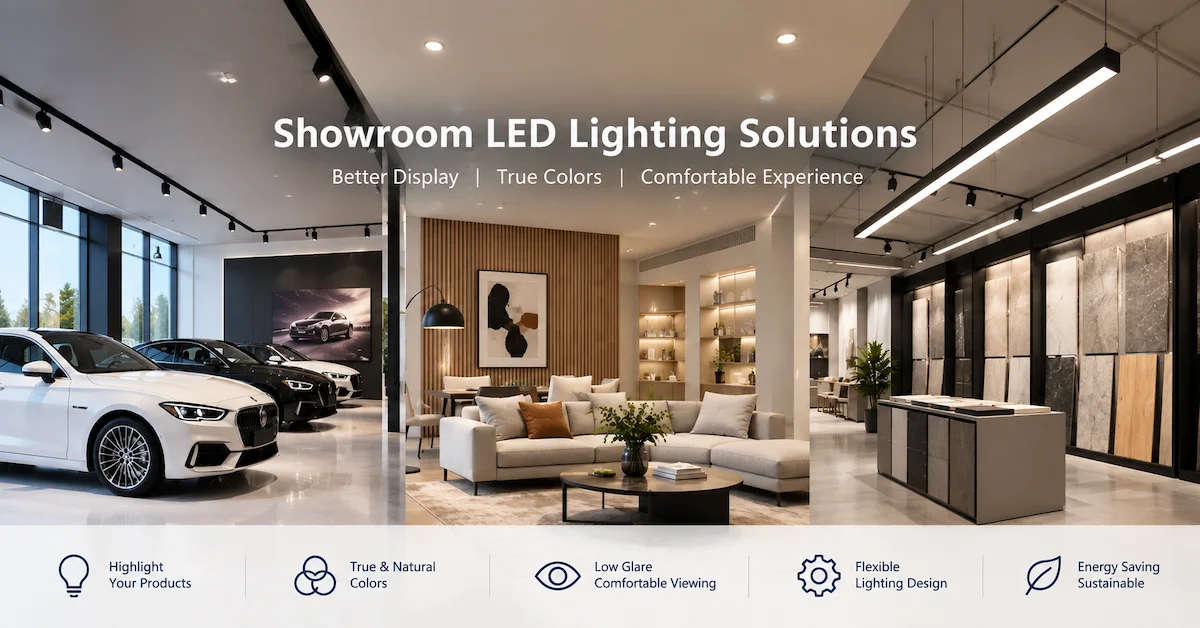
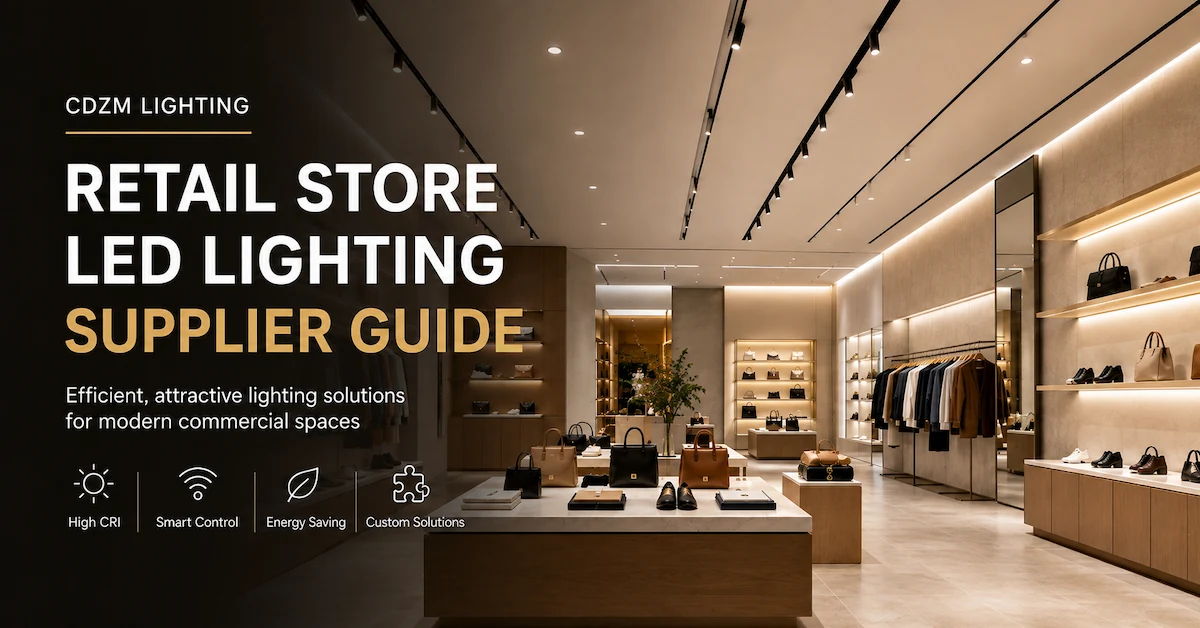
LED Track Lighting for Product Displays
Track lighting is one of the most common solutions for retail environments.
It is widely used in:
- Fashion stores
- Showrooms
- Luxury retail
- Exhibition spaces
Advantages include:
- Adjustable beam direction
- Flexible installation
- Easy repositioning
- Strong accent lighting capability
Track lighting is especially useful when stores frequently change product layouts.
For example:
A clothing retailer may redesign displays every season.
A showroom may change products according to campaigns.
A flexible lighting system reduces future renovation costs.
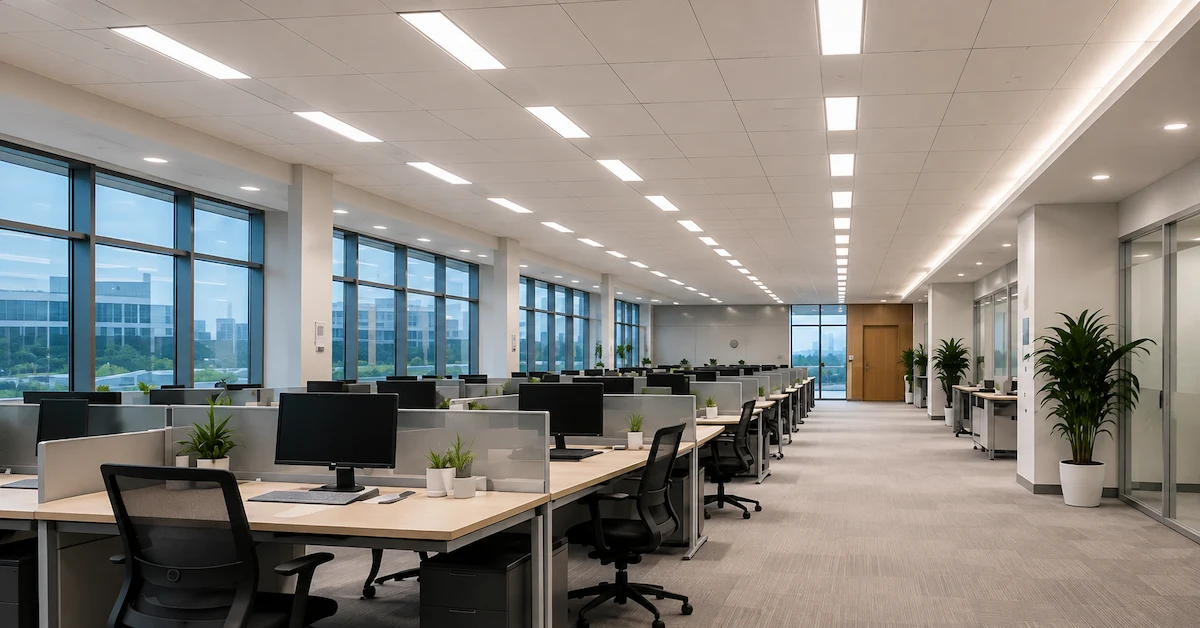
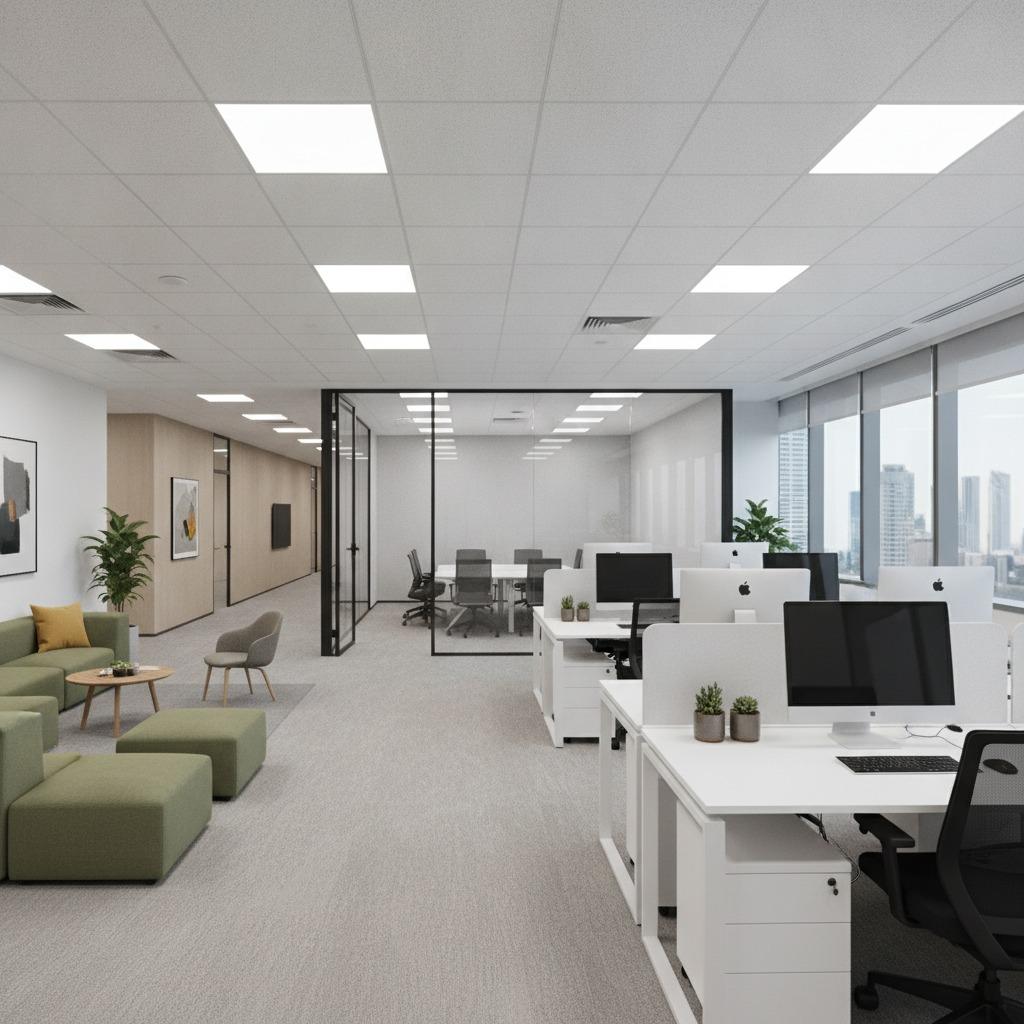
LED Panel Lighting for General Retail Illumination
LED panel lights are commonly used for general lighting.
Typical applications include:
- Supermarkets
- Shopping centers
- Retail offices
- Storage areas
- Back-of-house spaces
Benefits include:
- Uniform illumination
- Clean ceiling appearance
- Energy efficiency
- Comfortable working conditions
For commercial buyers,selecting a panel light supplier requires checking:
- Delivered lumens
- Efficiency
- Driver quality
- Dimming compatibility
- Installation method
- Ceiling compatibility
CDZM commercial lighting content highlights that buyers should evaluate complete luminaires, including optical design, driver performance, glare control, CRI, CCT, and control compatibility.
CDZM LED Panel Light Manufacturer Guide
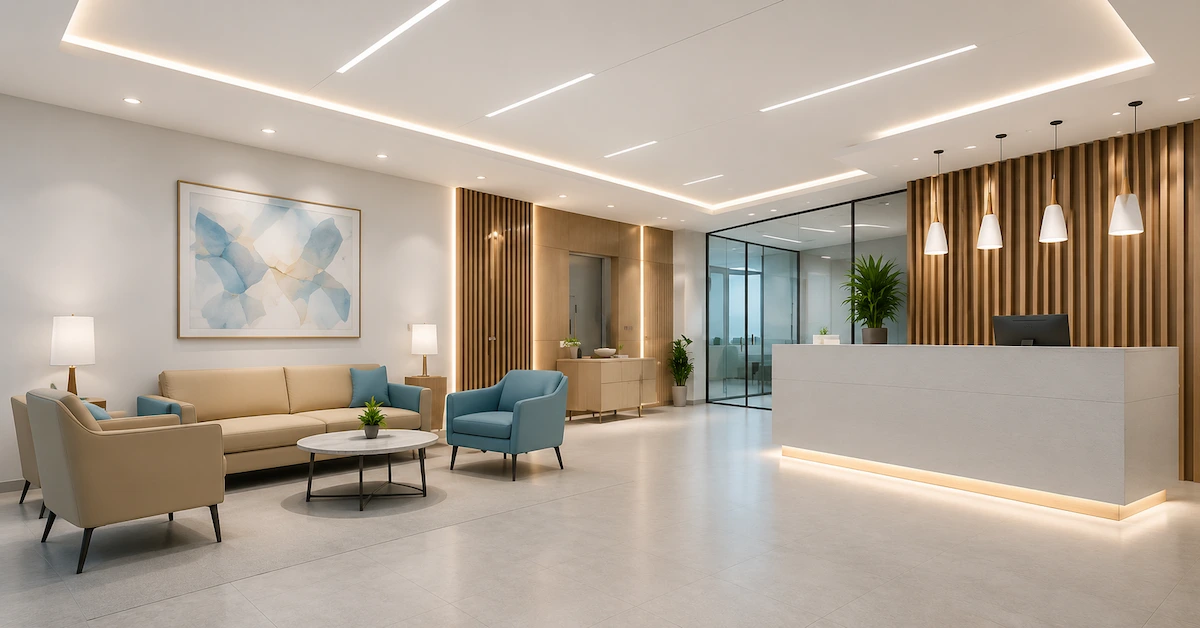
LED Downlights for Retail Accent Lighting
Downlights are often used for:
- Entrance lighting
- Display areas
- Reception counters
- Decorative zones
Important selection factors include:
Beam Angle
A narrow beam can highlight specific products.
A wider beam can create general illumination.
Color Rendering
High CRI lighting is important when customers need to see accurate product colors.
Applications include:
- Fashion
- Cosmetics
- Furniture
- Premium goods
Glare Control
A retail store may have reflective surfaces such as:
- Glass
- Mirrors
- Metal products
- Glossy packaging
Poor glare control can reduce shopping comfort.
Linear LED Lighting Solutions
Linear lighting has become increasingly popular in modern retail design.
Applications include:
- Ceiling features
- Shelving illumination
- Architectural lighting
- Store decoration
Advantages:
- Modern appearance
- Continuous lighting effect
- Flexible design options
For premium retail spaces, linear lighting can become part of the brand identity.
How to Choose the Right Retail LED Lighting Supplier?
Choosing a supplier requires evaluating more than product catalog size.
A strong supplier should provide:
Product Selection Capability
The supplier should understand:
- Store type
- Product category
- Lighting objective
- Installation environment
For example:
A supermarket and a luxury fashion store should not receive the same lighting recommendation.
A professional supplier should recommend based on application instead of pushing one standard product.
Technical Support Capability
Retail lighting projects often require engineering support.
Useful services include:
- Lighting layout
- Lux calculation
- DIALux simulation
- Fixture selection
- Energy analysis
For large retail projects, lighting simulation helps buyers understand:
- Required fixture quantity
- Light distribution
- Installation position
- Expected illumination
CDZM provides lighting engineering support including DIALux simulation, lux calculation, structural design, and project optimization.
CDZM Lighting Engineering Support
Manufacturing Capability
For distributors and project buyers, manufacturing reliability is critical.
Evaluate:
- Production capacity
- Quality control
- Testing process
- Supply stability
- OEM capability
CDZM states that it provides LED lighting manufacturing services, OEM/ODM support, and commercial lighting solutions for global customers.
CDZM About Us
Customization Capability
Different markets often require different lighting specifications.
A capable retail lighting manufacturer should support customization such as:
| Custom Item | Buyer Requirement |
|---|---|
| Wattage | Different store sizes |
| CCT | Market preference |
| CRI | Product display needs |
| Beam angle | Display requirements |
| Driver | Control compatibility |
| Housing | Brand appearance |
| Packaging | Distributor requirements |
| Logo | Private label projects |
OEM and ODM capability is especially valuable for:
- Lighting distributors
- Retail chains
- Brand owners
- Engineering companies
How to Evaluate Retail LED Lighting Product Specifications Before Ordering
For commercial retail projects, product selection should be based on performance data rather than appearance alone.
A professional retail store LED lighting supplier should provide complete technical information before quotation.
Important specifications include:
| Specification | Why Buyers Should Check |
|---|---|
| Lumens | Determines actual light output |
| lm/W efficiency | Evaluates energy performance |
| CRI | Affects product color appearance |
| CCT | Defines store atmosphere |
| Beam angle | Controls product highlighting |
| UGR | Helps evaluate visual comfort |
| Driver quality | Influences stability and lifespan |
| Dimming function | Supports flexible operation |
| Power factor | Indicates electrical performance |
| Thermal design | Improves reliability |
| Installation method | Ensures project compatibility |
| Certification | Supports market requirements |
A common mistake is choosing fixtures only according to wattage.
Two LED fixtures with the same wattage can produce very different results because of differences in:
- LED efficiency
- Optical design
- Driver quality
- Light distribution
- Thermal management
For commercial projects, the complete luminaire performance matters more than one individual specification.
Why CRI and Color Temperature Matter in Retail Lighting
Retail lighting directly affects how customers perceive products.
This makes color quality one of the most important considerations when selecting a retail LED lighting solutions provider.
Color Rendering Index (CRI)
CRI describes how accurately a light source reveals colors.
Higher CRI is especially important for:
- Fashion stores
- Beauty stores
- Jewelry shops
- Furniture showrooms
- Food retailers
Poor color rendering may make products appear different from their actual appearance.
For example:
A clothing store needs customers to see fabric colors accurately.
A cosmetics store needs realistic skin-tone presentation.
A food retailer needs products to look fresh and attractive.
Color Temperature (CCT)
Different retail environments require different lighting atmospheres.
| CCT Range | Common Applications |
|---|---|
| Warm white | Luxury retail,hospitality-style stores |
| Neutral white | General retail environments |
| Cool white | Technology stores and modern commercial spaces |
The best choice depends on:
- Brand positioning
- Product category
- Customer experience goals
- Local market preference
The Importance of Low Glare Commercial Retail Lighting
Modern stores often use reflective materials:
- Glass displays
- Mirrors
- Metal surfaces
- Glossy packaging
Without proper optical design,lighting may create:
- Reflections
- Visual discomfort
- Reduced product visibility
A professional low glare commercial lighting solution should consider:
- Fixture position
- Beam angle
- Optical lens
- Ceiling height
- Display arrangement
- Customer viewing direction
For projects requiring high visual comfort, buyers should request:
- Photometric files
- Lighting simulation
- Glare information
- Installation recommendations
CDZM's commercial lighting content emphasizes evaluating glare performance, optical design,and installation conditions rather than judging lighting only from product images.
CDZM Commercial Lighting Solutions
Smart Lighting Controls for Retail Stores
Retail lighting is becoming more intelligent.
Modern commercial projects may integrate:
- 0-10V dimming
- DALI control
- Occupancy sensors
- Daylight sensors
- Building management systems
Benefits include:
Flexible Lighting Scenes
Retailers can create different lighting modes:
- Opening mode
- Shopping mode
- Promotion mode
- Cleaning mode
- Closing mode
Energy Management
Lighting output can be adjusted according to:
- Store occupancy
- Business hours
- Natural daylight
Better Store Operation
Smart controls help facility teams manage lighting more efficiently.
CDZM currently includes smart control options such as DALI and 0-10V dimming within its commercial lighting solutions.
CDZM Commercial LED Lighting Guide
Retail Lighting Supplier Comparison Checklist
Before selecting a supplier, buyers should compare multiple factors.
| Evaluation Area | Questions |
|---|---|
| Product Range | Does the supplier cover different retail applications? |
| Technical Data | Are complete specifications available? |
| Optical Performance | Are beam angles and photometric files provided? |
| Color Quality | Are CRI and CCT options available? |
| Controls | Does the supplier support required dimming systems? |
| Customization | Can products be modified for specific projects? |
| Manufacturing | Can the supplier support repeat orders? |
| Quality Control | Are products tested before shipment? |
| Delivery | Can production meet project schedules? |
| Support | Is technical assistance available? |
For distributors and contractors, supplier capability is often more important than the lowest product price.
OEM and ODM Retail Lighting Solutions
Retail brands often need customized lighting products because different markets have different requirements.
A professional LED shop lighting supplier may support:
Product Customization
Including:
- Wattage
- Lumens
- CCT
- CRI
- Beam angle
- Driver configuration
- Housing design
Brand Customization
Including:
- Logo
- Packaging
- Product labels
- Marketing materials
Project Customization
Including:
- Store-specific layouts
- Control integration
- Regional electrical requirements
- Special installation methods
OEM and ODM services are especially valuable for:
- Lighting distributors
- Retail chains
- Brand owners
- Engineering contractors
Retail Store LED Lighting Procurement Process
A professional lighting project usually follows several stages.
Step 1: Understand the Store Requirements
The buyer should provide:
- Store type
- Floor area
- Ceiling height
- Product category
- Display requirements
- Lighting goals
Examples:
A fashion boutique may prioritize product appearance.
A supermarket may prioritize efficiency and uniform illumination.
A showroom may prioritize accent lighting.
Step 2: Product Recommendation
The supplier evaluates:
- Fixture type
- Quantity
- Optical requirements
- Color performance
- Control options
Step 3: Lighting Design
For larger projects, suppliers may provide:
- Lighting layout
- Lux calculation
- DIALux simulation
- Energy analysis
This helps reduce risks before installation.
Step 4: Sample Approval
Before mass production,buyers should verify:
- Appearance
- Brightness
- Color
- Installation
- Control performance
Step 5: Production and Quality Control
The supplier completes:
- Material inspection
- Assembly
- Testing
- Packaging
- Shipment
Step 6: After-Sales Support
Professional support may include:
- Installation guidance
- Technical assistance
- Replacement support
- Future product supply
Common Mistakes When Buying Retail LED Lighting
Choosing Only the Lowest Price
The cheapest product may create additional costs through:
- Higher energy consumption
- Frequent replacement
- Poor lighting performance
- Customer complaints
Using the Same Lighting Everywhere
Different retail zones require different lighting strategies.
A checkout area and a product display area should not always use identical fixtures.
Ignoring Future Store Changes
Retail environments frequently change.
Flexible lighting systems make future adjustments easier.
Not Checking Supplier Experience
A supplier experienced in residential lighting may not understand commercial retail requirements.
Retail projects often require:
- Consistent quality
- Large quantities
- Technical support
- Repeat supply capability
How CDZM Supports Retail Lighting Projects
CDZM positions itself as a professional LED lighting manufacturer providing commercial lighting solutions, OEM/ODM services, and project support.CDZM About Us
Its commercial lighting capabilities include:
- Retail lighting solutions
- Office lighting solutions
- Panel lighting
- Troffer lighting
- Smart control options
- Lighting engineering support
CDZM also provides engineering-related support including:
- DIALux simulation
- Lux calculation
- 3D visual rendering
- Energy-saving analysis
- Cost optimization
For distributors, contractors, and retail project buyers, this type of technical support can help reduce uncertainty during product selection.
What Information Should Buyers Include in an RFQ?
A detailed request helps suppliers provide more accurate recommendations.
Include:
Project Information
- Country
- Store type
- Store size
- Ceiling height
- Installation environment
Lighting Requirements
- Required brightness
- CCT
- CRI
- Beam angle
- Glare requirements
Control Requirements
- 0-10V
- DALI
- Sensors
- Smart building integration
Commercial Requirements
- Quantity
- Delivery schedule
- Certification requirements
- OEM requirements
Providing complete project information allows suppliers to recommend a more suitable lighting solution.
FAQ About Retail Store LED Lighting Supplier
1. What is a retail store LED lighting supplier?
A retail store LED lighting supplier provides LED fixtures, technical recommendations, customization, and project support for commercial retail environments.
2. What type of LED lighting is best for retail stores?
The best lighting depends on the store type and application. Common solutions include track lights, panel lights, downlights, linear lighting, and accent lighting.
3. Why is CRI important for retail lighting?
CRI affects how accurately customers see product colors. It is especially important for fashion, food, beauty, and premium retail environments.
4.How do I choose a retail lighting manufacturer?
Evaluate:
- Product quality
- Technical capability
- Manufacturing capacity
- Customization ability
- Delivery reliability
- After-sales support
5. Can retail LED lighting support smart controls?
Yes. Many commercial lighting systems support:
- 0-10V dimming
- DALI
- Sensors
- Building management integration
6. Can a supplier customize retail lighting products?
Yes.OEM/ODM customization may include:
- Product design
- Driver selection
- CCT
- CRI
- Housing
- Branding
- Packaging
7. What information should I provide before requesting a quote?
Provide:
- Store layout
- Ceiling information
- Lighting goals
- Quantity
- Control requirements
- Certification requirements
8.Is low glare lighting necessary for retail stores?
It depends on the application, but low glare lighting is especially valuable in stores with reflective products, long customer viewing times, or premium displays.
9. Does CDZM provide retail lighting solutions?
CDZM provides commercial lighting solutions for professional projects and supports customized lighting requirements.
CDZM Commercial Lighting Solutions
10. How can I request a retail lighting quotation?
Prepare:
- Project drawings
- Store information
- Lighting requirements
- Quantity
- Control requirements
Then contact CDZM for a project evaluation.
Conclusion
Choosing a retail store LED lighting supplier requires evaluating more than product price.
A reliable supplier should provide:
- Suitable lighting products
- Professional technical support
- Stable manufacturing
- Quality control
- Smart control options
- OEM/ODM capability
- Long-term cooperation support
Retail lighting is ultimately about creating the right balance between product visibility, customer experience, energy efficiency, and operational cost.
For retailers, distributors, and commercial contractors, the best supplier is the one that can support the complete process from lighting design to final delivery.
CDZM provides commercial lighting solutions, engineering support, and customized LED lighting services for global B2B customers.