
Why an all in one solar street light is worth a closer look
An all in one solar street light is usually evaluated for one reason: it promises outdoor lighting without the usual trenching, cabling, and utility tie-ins. For engineers, sourcing managers, and project teams, that matters because the lighting decision is rarely just about brightness. It is about site work, installation sequence, maintenance access, and how much of the project budget disappears into infrastructure before a single pole is standing.
The integrated format also changes the buying conversation. Instead of comparing a separate lamp head, panel, battery box, controller, and mounting hardware, you are looking at a self-contained unit designed for autonomous night operation. That can simplify procurement on roadways, campuses, parks, parking areas, residential streets, and pedestrian paths where conventional wiring is awkward or expensive.
What the integrated format actually gives you
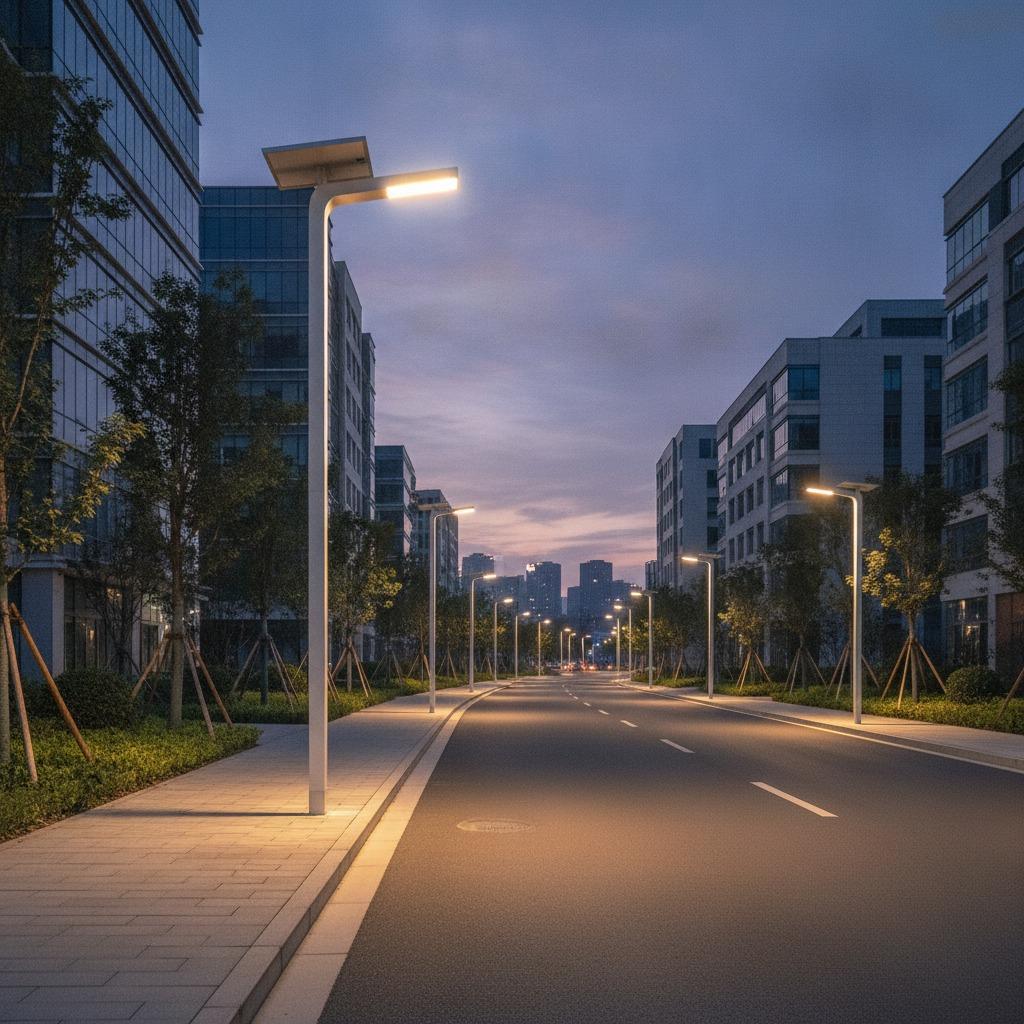
The product style here is straightforward: a long, slim lamp head with a light-colored metal housing mounted to a straight pole, using a compact bracket at the top. The underside shows the LED light source behind a small lens or diffuser area, which suggests directional downward lighting rather than broad spill into the sky. In practical terms, that is the kind of beam pattern buyers usually want for roads and walkways, where light needs to land on the surface, not waste itself in the air.
The solar collection element is not clearly visible from the available information, so it is safer to treat the exact placement as a detail to confirm with the supplier. That is common with integrated solar lighting: the exterior may look simple, but the internal arrangement can vary quite a bit. Battery location, controller access, and panel orientation all affect maintenance and real-world performance, even if the fixture looks neat from the curb.
Where this kind of light fits best
These fixtures make the most sense where pole-based outdoor lighting is needed and grid power is inconvenient. Municipal streets are the obvious case, but the same logic applies to business parks, campus roads, community streets, landscaped boulevards, and long pedestrian routes. If trenching would disturb paved surfaces, delay the schedule, or inflate civil work costs, an integrated solar unit becomes more attractive very quickly.
There is also a visual reason buyers like the format. A clean, integrated fixture presents less clutter on the pole. On new-build sites, that often matters more than people admit. Residents, planners, and property managers tend to respond better to a lighting solution that looks deliberate rather than assembled from several visibly separate boxes.
Quick buyer comparison: what to check before you commit
When comparing an all in one solar street light manufacturer or all in one solar street light supplier, the real questions are not limited to price. You want to know how the product is built, how it is serviced, and what assumptions the design makes about climate and usage.
Ask for clarity on the hidden parts
Start with the battery, controller, and solar charging arrangement. Those are the components that determine whether the light can actually meet the site’s nighttime needs through a full season, not just on a good weather day. Since the visible fixture may hide the panel location or internal layout, drawings or a technical sheet matter more than glossy photos.
Look at housing and finish as a durability issue, not a cosmetic one
The light-colored metal housing suggests an aluminum alloy or painted metal construction, and a matte or semi-matte finish is often preferred for outdoor fixtures because it reduces glare and hides minor weathering better than a shiny surface. Still, buyers should not assume weather resistance from appearance alone. Coastal, humid, or dust-heavy environments deserve a tougher review of enclosure design and surface treatment.
Think in terms of installation and service access
A self-contained unit can reduce installation steps, but it can also concentrate more components in one housing. That is convenient until a repair is needed. If a failure takes the whole fixture offline, replacement strategy becomes important. For some sites, a modular system is easier to maintain; for others, the speed of installation outweighs that concern. There is no universal answer, and that is exactly why the site conditions matter.
Common mistakes buyers make
The most common mistake is treating all integrated solar street lights as interchangeable. They are not. Two fixtures can look similar on a product page and behave very differently once installed. Another mistake is overestimating the usefulness of a neat design while underestimating the site’s actual lighting demand. A path that looks modest on paper can still require reliable runtime, especially during winter or in locations with long cloudy stretches.
A second caution: do not let the absence of grid wiring create a false sense of simplicity. You may save on electrical infrastructure, but you still need to think through mounting height, spacing, sun exposure, cleaning access, and how the unit will be inspected over time. Outdoor lighting is never just a hardware purchase; it is a site system.
Practical questions to ask a supplier
If you are speaking with an all in one solar street light supplier, ask for the installation method, maintenance approach, and the exact layout of the solar and storage components. Request photos or diagrams that show the unit from multiple angles, not just the front view. For project work, it also helps to ask how the lighting is intended to perform on streets versus pedestrian areas, since those use cases can demand different beam distribution.
And if a supplier avoids answering basic questions about battery placement, charging arrangement, or serviceability, treat that as a warning sign. Good outdoor lighting products are designed for the field, not just for catalog pages.
What decision this article should help you make
If you are weighing whether an all in one solar street light is the right fit, the real decision is whether your site values reduced civil work and faster deployment more than the flexibility of a conventional wired system. For roads, campuses, parks, and retrofit projects where cabling is difficult, the integrated approach can be a sensible option. For more demanding sites, it is worth pushing for deeper technical detail before you standardize on a model.
In other words: choose the format for the site, not for the brochure. That is usually where the better projects start.