
Why the all in one solar street light is getting more attention
An all in one solar street light solves a very practical problem: how to light a road, path, or site area without running long electrical lines to every pole. For engineers and sourcing teams, that is not just a sustainability story. It affects trenching work, civil cost, installation time, maintenance access, and how quickly a project can be put into service.
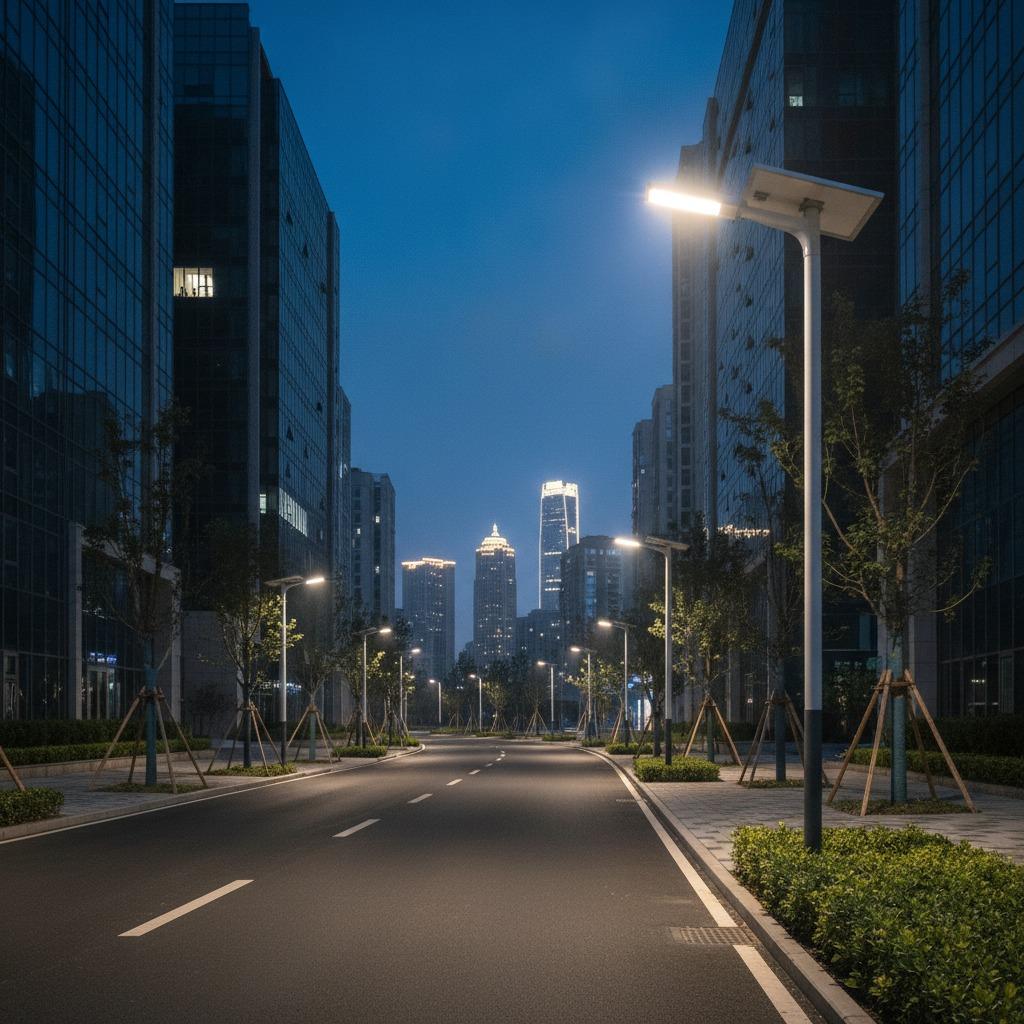
The appeal is easy to see in roadway projects where identical fixtures are installed in a clean row. A self-contained pole-top unit keeps the solar panel, LED light source, and housing together in one fixture, which simplifies planning and reduces the number of separate parts to coordinate. That said, the format is not a universal answer. It fits some sites very well and others only after a closer look at lighting levels, shading, and local weather conditions.
What the integrated design changes on site
Traditional solar lighting often uses a separate panel mounted away from the lamp head. The integrated or all-in-one form folds those functions into one compact unit. Visually, it usually appears as a slim horizontal light head with a flat top module. In the type of fixture described here, the top section combines the solar collection area and the lighting assembly into a single housing, mounted on a tall metal pole with a light gray or white finish.
For buyers, the main change is not aesthetic. It is logistical. Fewer separate components can mean simpler handling during installation and less hardware to align on site. For municipal lanes, pedestrian routes, campus roads, and industrial park drives, that can matter more than it does on a postcard. But compactness also means there is less physical flexibility if a project needs unusual panel orientation or a high degree of customization.
Where this lighting format fits best
The all in one solar street light is commonly considered for streets and avenues, residential community roads, parks, campuses, commercial driveways, and landscaped pedestrian routes. It is especially attractive in areas where grid power is limited, where trenching would be expensive, or where the project team wants to reduce cabling work.
It also suits coordinated roadway lighting. When multiple identical fixtures are installed along a single route, the result is cleaner visually and easier to standardize. That uniformity can be useful for developers and public works teams that need one lighting style repeated over a long run.
What to compare before you buy
Site exposure and shading
Solar street lighting lives or dies on sun exposure. Trees, nearby buildings, sign gantries, and even awkward pole placement can reduce charging performance. A compact integrated unit will not solve a poor site layout. If the route has frequent shadows, the buyer should ask for a realistic discussion of charging conditions rather than assuming the fixture will perform the same way everywhere.
Lighting target and coverage
The visible product information here does not provide wattage, lumen output, battery capacity, or autonomy hours, so those details should be confirmed during sourcing. That is one of the most common mistakes in this category: teams focus on the product format first and only later discover that the lighting target was never properly matched to the application.
Maintenance philosophy
Integrated lights reduce external wiring, but they do not eliminate maintenance. Batteries age, LED modules degrade, and outdoor housings face weather and dust. A buyer should ask how service is handled if one internal component fails, because an integrated form can be easier to install but sometimes less modular to repair.
Materials and finish matter more than they first appear
From the available product information, the pole appears to be metal, likely aluminum or steel, with a powder-coated or painted light finish. The housing appears similarly coated, and the illuminated section uses a translucent diffuser. That sounds ordinary, but it matters in the field. Outdoor lighting lives in a harsh environment: heat, rain, dust, bird droppings, vibration, and the occasional careless impact.
Buyers should pay attention to finish quality, corrosion resistance, and how the housing is sealed and joined. Even a good optical design can become a poor purchase if the enclosure ages badly or discolors quickly. In public-facing projects, appearance is not a minor issue; once a road is lit in a uniform row, mismatched aging becomes obvious.
Choosing between an all in one solar street light manufacturer and supplier
Some buyers search for an all in one solar street light manufacturer because they want product customization, technical documentation, and tighter control over assembly details. Others approach an all in one solar street light supplier when the project is smaller, the specification is standard, or the main need is sourcing and logistics support.
The distinction is useful, but it should not be oversimplified. A manufacturer may offer more direct input on structure and component selection, while a supplier may be better positioned to coordinate mixed project quantities or provide faster quotation support. Either way, the decision should come down to whether the vendor can explain the fixture’s internal configuration, outdoor durability approach, and installation assumptions clearly.
Common buyer mistakes
One frequent error is assuming all integrated solar lights behave similarly. They do not. Panel size, battery arrangement, optical design, and thermal management can all vary widely, even when the fixtures look similar from a distance.
Another mistake is buying only against appearance. The long flat top module may look tidy and modern, but the real question is whether it supports the required lighting schedule at the actual site. A third mistake is ignoring serviceability. If the project is for municipal or commercial use, the cost of later access can erase the benefit of the initial purchase.
Practical buyer advice for project teams
For engineers and sourcing managers, the best next step is to define the application before you define the product. Start with pole spacing, road width, expected night use, and exposure to shade. Then ask the vendor for the fixture configuration that matches that use case. If the supplier cannot explain those basics without drifting into vague marketing language, that is a warning sign.
Also, request enough information to compare apples to apples. Because the visible product data here does not include power ratings or control details, those should be treated as required commercial questions rather than optional extras. On a roadway project, “looks suitable” is not a specification.
FAQ
Is an all in one solar street light good for every road?
No. It is a strong option for many paths and roads, especially where cabling is difficult, but site conditions and lighting requirements still decide whether it is the right fit.
Does the integrated design reduce installation work?
Usually yes, because the system is self-contained and does not need a separate visible panel assembly. But installation savings still depend on pole work, foundations, and the project layout.
What should buyers verify first?
Ask about lighting output, battery configuration, charging performance under local conditions, and how maintenance is handled. Those are the points that affect real project success.
Next step for sourcing teams
If you are evaluating an all in one solar street light for a roadway, campus, or community project, start with the site conditions and the lighting target, then compare vendors on structure, serviceability, and clarity of technical information. The right fixture is rarely the one with the flashiest description. It is the one that matches the project without forcing compromises later.