
What buyers really mean when they search for a solar flood light manufacturer
When engineers, sourcing managers, or facilities teams look for a solar flood light manufacturer, they are usually trying to solve one of three problems: how to light an exterior area without trenching new cable, how to add security lighting where grid power is limited, or how to replace a hard-to-maintain fixture with something simpler to deploy. The product looks straightforward from a distance, but the decision behind it is not. You are not only buying a lamp; you are choosing a small off-grid lighting system with a panel, battery, control electronics, mounting hardware, and enclosure design that has to survive outdoors.
That is why a solar flood light supplier should be evaluated on more than the fixture face. In practice, the details that matter are the quality of the photovoltaic module, how the LED floodlight head is assembled, how the bracket holds position, and whether the overall construction suits a warehouse yard, loading dock, façade, or perimeter line.
How the product is built
The solar flood light system in this category usually combines a separate solar panel and an LED floodlight head. The panel charges a battery during the day, and the stored energy powers the light at night. That basic architecture is common, but the physical layout varies a lot.
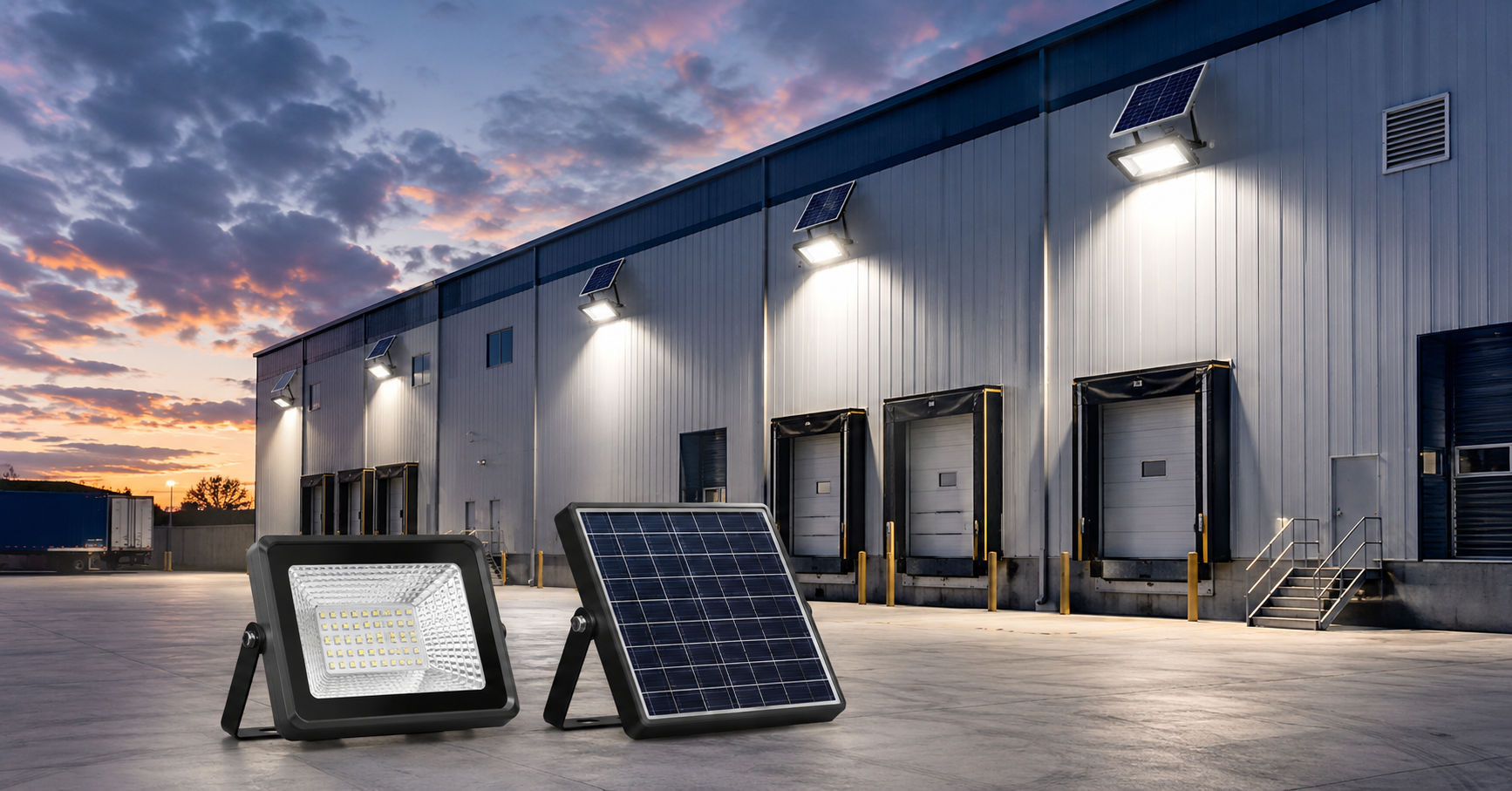
The units described here use rectangular floodlight heads with a clear front lens and a black housing that appears to be metal or coated aluminum. Behind the lens, the LEDs are arranged in a grid, which is a familiar format for wide-area lighting. Adjustable yokes or brackets are visible, which matters more than it sounds; if the mounting angle is awkward, the light may waste output on a fence line or spill into the wrong area.
The solar panels are separate from the light head, mounted on frames or poles, with dark cells under a reflective glass surface and light-colored aluminum frames. That separation is practical for installations where the panel needs a better sun angle than the fixture body can provide.
Where these lights make sense
The strongest use cases are exterior spaces where wiring is expensive, slow, or simply inconvenient. Warehouses, industrial buildings, parking areas, yards, loading docks, façades, and security perimeters are the obvious candidates. A solar flood light factory that understands these applications will usually think in terms of mounting flexibility, weather exposure, and the actual task of lighting a working site after dark.
A buyer should be careful here: solar lighting is not a universal replacement for grid-powered floodlighting. If the area needs very high output, long winter runtime, or consistent light across all seasons, the system has to be reviewed carefully. Solar works best when the load is matched to the site and the installation has enough sun exposure.
Quick comparison points for sourcing teams
Separate panel versus all-in-one design
A separate panel gives more flexibility in placement and angle. That can be a real advantage on façades, poles, or locations with shade near the fixture.
Wall mount versus pole mount
The visible examples show both. That suggests the product family may support different deployment styles, which is useful for retrofits and new builds alike.
Metal housing and clear lens
A coated metal housing usually feels more appropriate for industrial environments than lightweight decorative plastics, while the clear protective lens helps the LED array present a focused flood pattern.
What to ask before you place an order
The obvious specifications are wattage and lumen output, but those are not visible here and should be confirmed directly. The same caution applies to battery chemistry, IP rating, charging time, runtime, beam angle, and any smart controls. A decent-looking sample can still be a weak field performer if the electronics are undersized or the enclosure is not built for weather exposure.
Buyers should also ask for mounting drawings and a clear breakdown of what is included in the kit. Some projects fail not because the light is poor, but because the bracket, pole interface, or solar panel hardware is not suited to the site conditions.
Common mistakes buyers make
The first mistake is treating all solar flood lights as interchangeable. They are not. Panel size, light head geometry, and control logic all influence whether the system will meet a site’s needs.
The second mistake is over-specifying the application based on catalog photos alone. The units here show wall-mounted, pole-mounted, and portable/display use, but that does not tell you how they perform after months outdoors. Ask for documented construction details, not just glossy product images.
The third mistake is ignoring installation conditions. A solar flood light supplier can provide the hardware, but the site still needs usable sunlight and a sensible mounting location.
FAQ: practical buying questions
Is a solar flood light suitable for industrial use?
Yes, for many perimeter and exterior applications. It is especially useful where cabling is difficult or costly.
Why choose a separate solar panel?
Because it gives more freedom in panel orientation and can improve real-world installation options.
What should I verify first with a manufacturer?
Confirm the electrical specs, runtime expectations, enclosure protection, and mounting compatibility. Those details determine whether the product is a fit, not the brochure photo.
Next step for buyers
If you are comparing a solar flood light manufacturer against other options, start with the site conditions rather than the fixture itself. Measure the available sunlight, define the mounting points, and list the lighting tasks the area must support after dark. Then ask for a sample configuration that matches the installation method you plan to use. That approach saves time, and usually saves a few avoidable mistakes too.