
What buyers really mean when they ask for a solar flood light manufacturer
If you are searching for a solar flood light manufacturer, you are probably not just comparing lamps. You are weighing whether the lighting system will cut wiring costs, survive weather exposure, and provide enough reliable nighttime coverage for a yard, dock, facade, or remote site. That is a different buying problem from choosing a decorative outdoor fixture. It is closer to specifying equipment.
The solar flood light category usually sits somewhere between standard LED area lighting and off-grid power equipment. The solar panel, battery, controller, LED head, and mounting hardware all have to work as one system. Miss one part of that chain and the installation becomes a maintenance headache. That is why many sourcing teams look beyond catalog images and ask how the product is built, how it is mounted, and what kind of site conditions it is meant to handle.
Quick reference: what to compare before you send an RFQ
Buyers often get pulled toward wattage or lumen claims first, but that is rarely the full story. For a solar flood light supplier, the more useful questions are practical ones: Can the unit be mounted on a pole, wall, or bracket? Is the solar panel separate from the light head, or integrated? Does the system suit a warehouse exterior, parking lot edge, or a remote service road? These details determine whether the product fits the job.
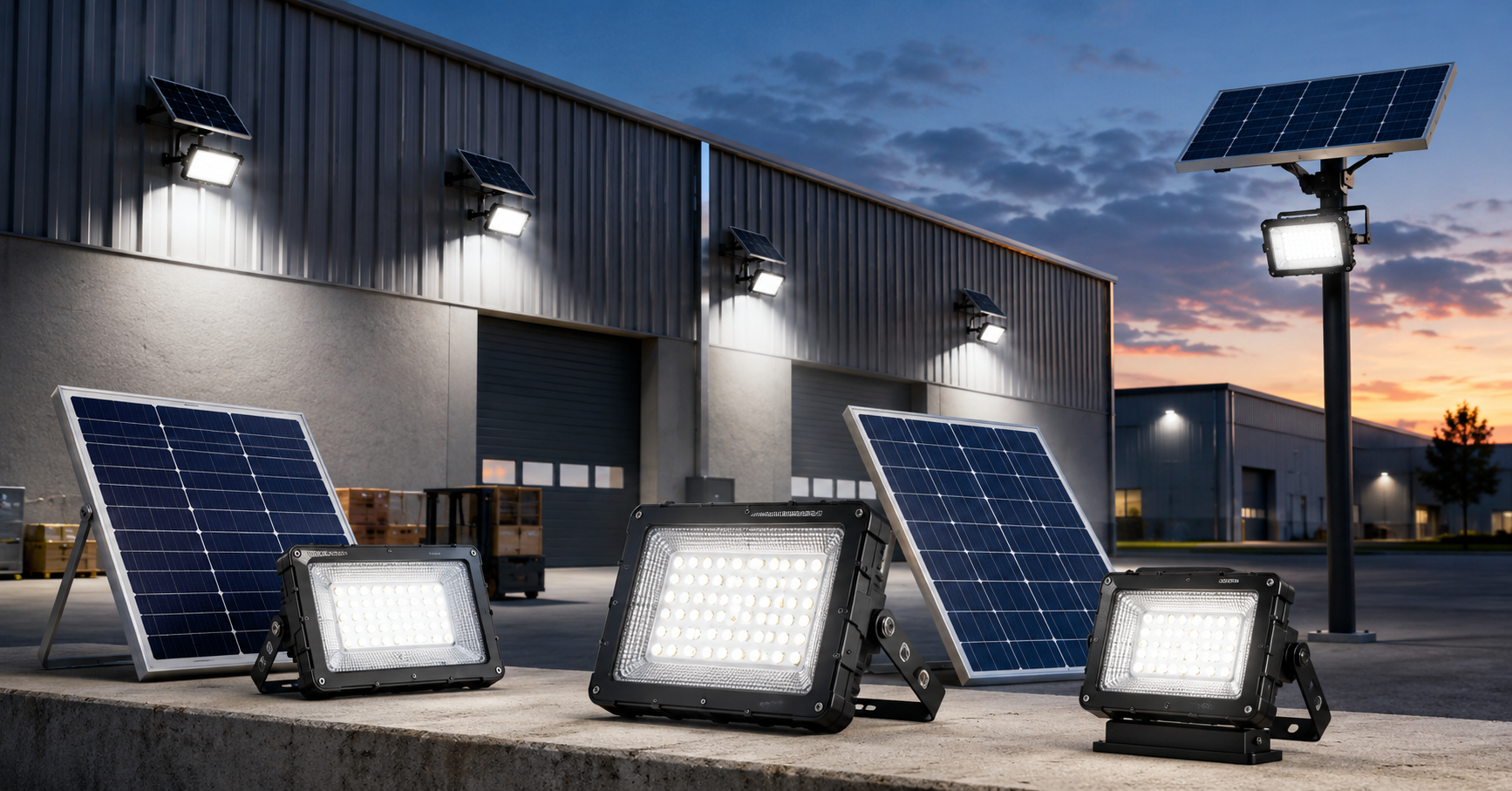
In the product range shown here, the lights appear in multiple sizes and mounting styles, including compact heads, larger floodlight housings, and a pole-mounted arrangement. That matters because a single format does not suit every site. A loading dock wall and a perimeter fence line usually call for different bracket geometry, panel orientation, and installation spacing.
How this product category is typically built
Light head and housing
The visible floodlight heads use a rectangular housing with an array of LED emitters behind a clear front lens or diffuser. The enclosure appears to be black metal, likely aluminum or painted metal, with sealed edges and a weather-exposed form factor. That is a common approach in outdoor lighting because heat management and enclosure durability matter just as much as optical output.
Solar panel and support hardware
Each system includes a separate solar panel mounted on an adjustable bracket or pole. The panels show blue photovoltaic cells under glass with a silver frame. Separate-panel designs are often preferred when the light head needs to be aimed one way and the panel another, especially on facades or poles where sun exposure and beam direction are not aligned.
From a buyer’s perspective, adjustable mounting is not a small detail. It affects installation time, seasonal solar capture, and whether the light can be aimed to avoid glare or dark spots. A supplier that understands those tradeoffs is usually more useful than one that only sells a catalog configuration.
Where solar flood lighting makes sense
The obvious use cases are warehouse exteriors, factory yards, parking lots, building facades, loading docks, and remote sites without easy grid access. In these places, the goal is not just illumination. It is also reducing trenching, cabling, and electrical coordination. That can simplify a project considerably, though buyers should not treat solar as a cure-all. If the site has weak sunlight exposure, long winter darkness, or heavy security requirements, the system design needs closer review.
For industrial facilities, solar flood lights can be a useful complement to grid-powered lighting rather than a total replacement. That hybrid approach often gives operations teams more flexibility. It also reduces the pressure to overbuild one part of the system to compensate for poor site conditions.
Selection criteria that matter in real sourcing work
When evaluating a solar flood light factory, the first thing to confirm is product fit: fixture size, mounting method, and intended application. Then move to the technical questions that are not always obvious from photos. Ask about battery type, control logic, runtime expectations, recharge behavior, and the enclosure’s outdoor suitability. The exact IP rating, wattage, lumen output, and certifications are not visible here, so they should be verified directly before purchase.
It is also smart to ask whether the supplier can support different mounting scenarios. The visible range suggests a mix of bracket-mounted, pole-mounted, and standalone styles. That variety is useful because project teams frequently need one family of products to cover multiple locations. A vendor that can offer related configurations may reduce procurement friction.
Common buyer mistakes
The most common mistake is buying on appearance alone. A black housing and a solar panel may look straightforward, but outdoor performance depends on more than visual robustness. Another frequent issue is ignoring site orientation. A panel that looks fine on paper may underperform if trees, walls, or building overhangs limit sun exposure.
A second mistake is treating all solar flood light suppliers as interchangeable. They are not. Some are closer to assembly-focused manufacturers, while others may simply resell standard configurations. If your project needs repeatable installation across multiple sites, ask how the product is assembled, how the panel and fixture are matched, and whether the mounting parts are consistent from order to order.
FAQ
What should I ask a solar flood light manufacturer first?
Start with the basics: application fit, mounting options, panel placement, battery and control configuration, and what outdoor conditions the unit is designed for. If the supplier cannot answer those clearly, keep looking.
Are separate solar panels better than integrated designs?
Not always, but separate panels give more installation flexibility. They can help when the light needs to face one direction and the panel another. That is often useful on walls, poles, and site perimeters.
Can these lights work for industrial sites?
Yes, especially for exteriors, yards, and remote areas where wiring is expensive or difficult. For critical lighting zones, it is still wise to review sun exposure, nighttime coverage needs, and maintenance access before committing.
What details should I confirm before ordering?
Confirm ratings, output, battery behavior, enclosure protection, and any control features you need. Those are not visible in the product images and should never be assumed.
Next step for buyers
If your project depends on dependable outdoor lighting with reduced wiring, use the product configuration itself as part of your qualification process. A capable solar flood light manufacturer should be able to explain the fixture, the panel, the mounting hardware, and the intended installation environment without drifting into vague claims. That is usually the quickest way to separate a workable offering from a generic one.