
Why rural roads often push buyers toward solar
A solar street light for rural roads is usually chosen for one simple reason: the road needs light, but the grid does not reach it cleanly, or it reaches it at a cost that is hard to justify. For engineers, sourcing managers, and project teams, the real decision is not whether solar lighting looks modern. It is whether the system can deliver dependable nighttime visibility on a long, low-density road without creating a new maintenance burden.
That is where comparison matters. A rural road can be lit with grid-tied poles, an off grid solar road lighting layout, or a mixed approach. Each option solves the same problem in a different way. The right answer depends on access to power, installation effort, road length, and how much maintenance the owner can realistically support over time.
Solar versus grid power: the practical trade-off
Grid-powered street lighting still has a place. If a road already has electrical infrastructure nearby, the operating model can be familiar and easier to standardize. But for remote villages, agricultural access roads, and secondary roads that run far from substations, trenching cable and extending utility service can turn a lighting project into a civil works project. That is often where solar wins on speed and simplicity.
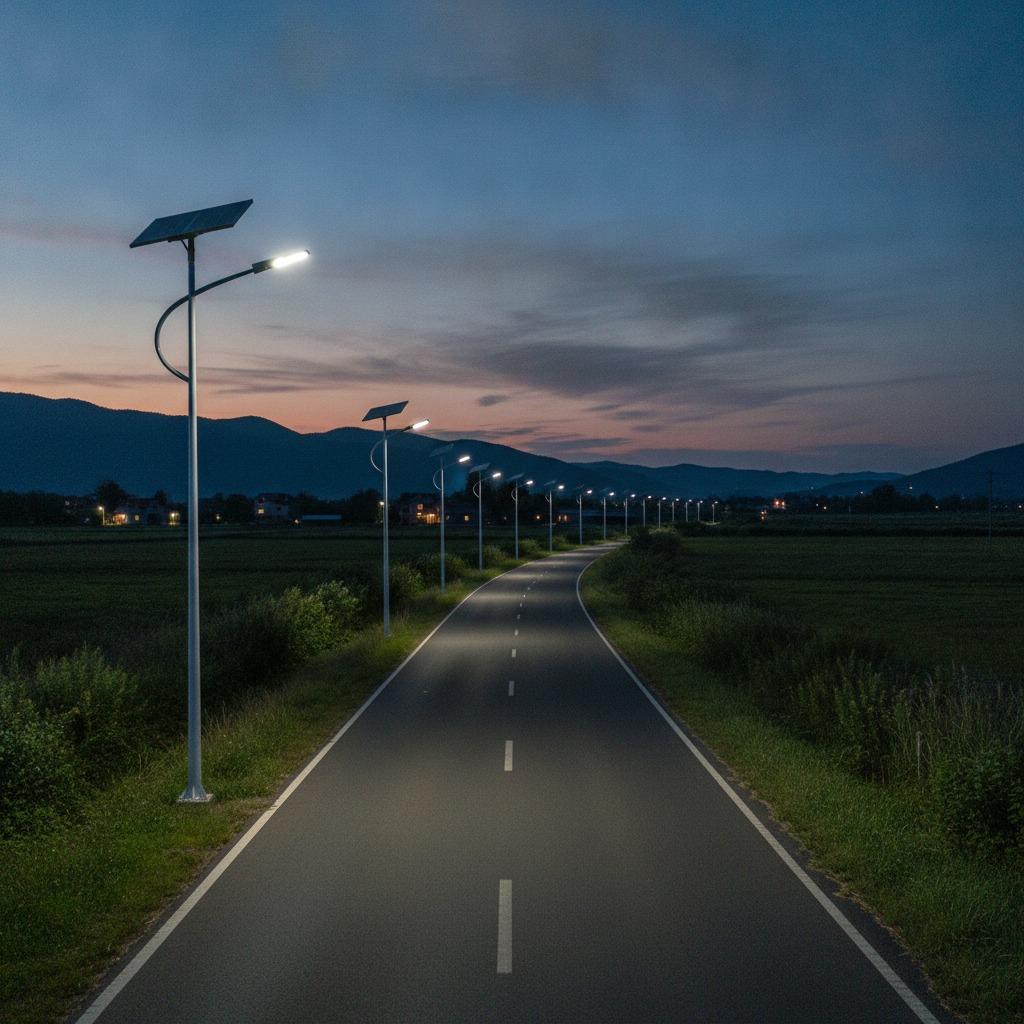
Solar lighting changes the equation by making each pole a self-contained outdoor lighting point. The visible structure is straightforward: a metal pole, a photovoltaic panel mounted at the top, and an LED luminaire on a side arm. On a long stretch of road, that repeatable format is useful because the installation logic is easy to scale. It also avoids the common problem of one failed cable section taking out a whole run of lights.
There is a catch, and it is worth saying plainly. Solar systems are not magic. Performance depends on available sunlight, panel orientation, battery health, and the actual lighting demand during the night. If a buyer assumes a solar street light will behave exactly like a grid-fed pole in every season and every location, disappointment usually follows.
What the roadside installation tells a buyer
The product image suggests a utility-focused roadside system rather than decorative lighting. The poles are tall and straight, with a light-colored metal finish that looks suitable for outdoor infrastructure. The panel is rectangular and tilted for sunlight capture, while the lamp head is a slim LED fixture mounted on a cantilever arm. That combination is common in municipal and rural deployments because it is efficient, visually clear, and easy to maintain from the ground.
For buyers comparing suppliers, that matters. A rural road solar lighting supplier should be able to explain not just the pole and fixture, but how the whole assembly is intended to work in the field. Questions about battery placement, charge control, mounting hardware, and corrosion protection are not secondary details. They determine whether the system is practical in remote conditions, especially where access for repairs may be limited.
Comparison snapshot: where each option makes sense
Grid-powered poles
Best when electrical infrastructure is already close, road geometry is dense, and long-term utility power is stable. The upside is familiarity. The downside is installation complexity and ongoing dependence on the grid.
Solar street lighting
Best when the road is remote, the project needs faster deployment, or cable extension is expensive. It is often the cleaner answer for village streets and community access roads, especially where the road is long and the lighting points are spaced out.
Hybrid or mixed approaches
Useful when part of a route has power access and another part does not. These systems can reduce risk, but they also add planning complexity. In practice, mixed systems work best when the owner has a clear maintenance strategy and a sensible spare-parts plan.
Selection criteria that matter more than brochure language
When reviewing off grid solar road lighting options, the first filter should be the site itself. How much sun does the location get through the year? Is the road shaded by trees or structures? Are there dust, humidity, or wind conditions that will affect the panel and pole over time? These questions sound basic, but they shape the life of the installation more than marketing claims do.
Second, look at the road use pattern. A quiet village lane does not need the same lighting density as a busier access road or highway-side segment. The goal is not to flood the area with light. It is to provide enough visibility for vehicles and pedestrians to move safely without overbuilding the system.
Third, consider service access. If a battery or controller fails, how quickly can the site be reached? Rural lighting projects are often judged not by day-one performance, but by how gracefully they hold up after the first rainy season, the first dust cycle, and the first round of wear on mounting hardware. That is where well-designed metal poles and straightforward fixture geometry tend to outperform complicated-looking assemblies.
Common mistakes buyers make
The most common mistake is treating all solar lights as interchangeable. They are not. Another frequent error is ignoring the road’s actual operating hours. If lights are expected to run through long nights, cloudy periods, or peak-season traffic, the system needs to be specified conservatively. Under-sizing is a classic problem, and it is usually more expensive to fix after installation than before.
Buyers also sometimes focus on the lamp head and forget the support system. The pole, arm, panel mount, and foundation all have to work together. On rural roads, where maintenance crews may not visit often, a mechanically simple design is usually a safer choice than a visually flashy one.
FAQ for project teams and procurement staff
Is solar lighting always cheaper?
Not always on first purchase. The comparison depends on trenching distance, local labor, grid extension cost, and maintenance expectations. Solar often becomes attractive because it reduces civil work and avoids utility dependency.
Can solar lighting work on long roads?
Yes, provided the system is planned as a repeating roadside installation and the lighting demand is matched to site conditions. Long roads are exactly where consistent, modular deployment can make solar practical.
What should a buyer ask a supplier?
Ask how the system is configured for the site, how the panel and lamp are mounted, what maintenance access looks like, and what is included in the supply package. If a supplier cannot speak clearly about those points, the project may be harder to manage than it first appears.
What good procurement looks like
A sensible buying decision starts with the road, not the catalog. Compare solar street lights against grid-powered options based on access, operating cost, installation effort, and maintenance reality. Then narrow the field to suppliers who understand rural conditions, not just product dimensions. A rural road solar lighting supplier should be able to discuss the site as a working environment, not a showroom.
For teams planning a remote project, the best next step is usually a site-based lighting review: road length, pole spacing, sunlight exposure, and service access. From there, it becomes much easier to decide whether a solar street light for rural roads is the right fit, or whether a hybrid approach makes more sense for the first phase.