
Solar Street Lights for Rural Roads: What They Solve, and What They Don’t
A solar street light for rural roads is usually chosen for one simple reason: the road needs visible, reliable night lighting, but the grid is too far away, too expensive to extend, or too disruptive to trench through. That is the practical heart of the decision. For village lanes, farm access roads, perimeter roads, and other low-infrastructure corridors, the comparison is not really solar versus “better” lighting. It is solar versus the cost, delay, and civil work that come with conventional power.
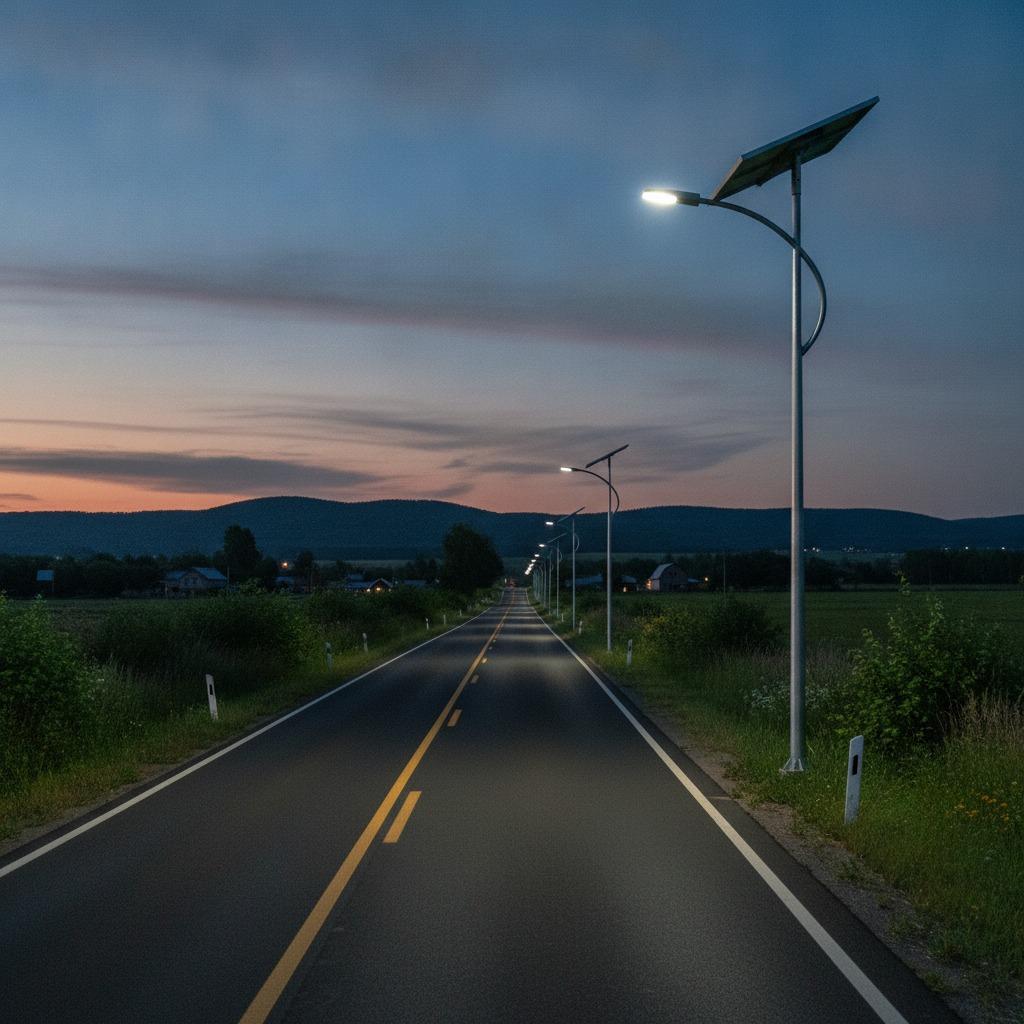
The installation pictured here reflects that logic. You can see a tall pole, a top-mounted photovoltaic panel, and a directional LED luminaire aimed at the roadway, repeated in a line along a rural stretch. No overhead wiring is visible. That matters more than it might seem, because the absence of trenching and cable runs can reshape both the project budget and the construction schedule.
Grid-Connected Road Lighting vs. Off-Grid Solar: The Real Tradeoff
The easiest way to evaluate off grid solar road lighting is to compare it with a conventional grid-fed system under the same site conditions.
Grid power can be attractive when the road is already built up, the electrical infrastructure is nearby, and future maintenance crews can reach the site quickly. In that case, a wired system may offer simpler energy management and, in some projects, easier integration with centralized controls. But once the road is remote, or once trenching crosses hard ground, long distances, drainage channels, or private land, the economics start to move in solar’s favor.
Solar systems bring a different kind of simplicity. Each pole is more self-contained. There is less dependence on utility connection timing, and the lighting project can often move forward even when the road itself is still being improved in stages. For rural road authorities and contractors, that can be the difference between a stalled plan and a completed one.
Of course, self-contained does not mean maintenance-free. Panels need to stay clean, poles must be mounted correctly, and the system has to be sized for local weather and traffic expectations. A buyer should not assume that every solar street light for rural roads behaves the same just because the hardware looks similar from a distance.
What the Visible Hardware Suggests
The product shown uses a straightforward roadway layout: a straight pole, a side arm, a slim LED head, and a rectangular solar panel mounted at the top. That is a common format for outdoor street lighting because it keeps the optical task clear. The luminaire throws light down onto the carriageway, while the panel sits high enough to catch daylight without being shadowed by the road edge or nearby vegetation.
The light poles appear to have a smooth, light-colored finish, likely painted or powder-coated metal. That type of finish is common in roadside work because it looks clean and is easier to specify across a multi-pole installation. Still, finish alone does not tell you how long the structure will hold up. Wind exposure, foundation design, corrosion conditions, and local installation practice all matter. A rural road in a sheltered village corridor is not the same as an exposed farm road across open land.
This is where a rural road solar lighting supplier should be able to speak plainly about the project context, not just the fixture. The right question is not only “What lamp are you selling?” but also “How does this package behave as a roadside system?”
Where Solar Wins, and Where It Needs Careful Review
Situations where solar is often the stronger option
Solar usually makes sense when the road is remote, when electrical extension would be expensive, or when the project needs quick deployment with limited civil work. It is also useful where trenching would disturb farmland, drainage, or finished road surfaces. For community pathways and rural access roads, the reduced wiring burden can simplify procurement and installation.
Situations that deserve more scrutiny
Shaded locations, heavy dust, long cloudy seasons, and roads with very high night-time demand can complicate the picture. In those cases, buyers need to pay attention to system sizing and operating assumptions. A panel and battery package that looks adequate on paper may not hold up if the road is in a low-sun corridor or if the lighting schedule is more demanding than expected.
That is one reason comparisons between solar and grid solutions should include site conditions, not just equipment price. A lower upfront cost is useful only if the lamp actually meets the road user’s needs through the dark season, not just the first week after installation.
Selection Criteria Buyers Should Use
When evaluating a rural road solar lighting system, buyers should start with the application rather than the catalog image. Road width, mounting height, spacing, local daylight, and the expected number of operating hours all affect whether the system is suitable. If the road is used by both vehicles and pedestrians, beam spread and glare control matter as much as brightness.
It is also wise to ask how the system is configured: whether the battery and controller are integrated into the pole or arranged as a split-type setup, whether the LED head can be serviced without removing the panel, and how the installation is handled in the field. Those details are not decorative. They decide whether maintenance is a routine visit or a small construction job.
For procurement teams, a practical shortlist often includes these questions:
Can the lighting meet the road’s safety requirements without grid connection?
How will the system perform during cloudy periods or seasonal variation?
What maintenance access is needed for cleaning, inspection, and replacement?
How are poles, arms, and fixtures standardized across the project so spares remain manageable?
Common Buyer Mistakes
The most common mistake is treating all solar lighting as if it were interchangeable. It is not. A pole that works for a park path may be a poor fit for a rural carriageway where vehicles move faster and the light must cover a wider area.
Another mistake is focusing on the panel and ignoring the mounting structure. The image shows a neat, repeated roadside installation, but the quality of the project is often decided by what is less visible: foundation work, alignment, wiring protection, and resistance to weather. A road light that looks good on day one but shifts or degrades after the first storm is not a bargain.
Some teams also under-specify the maintenance plan. Off grid solar road lighting can be a good choice precisely because it avoids utility dependence, but the system still needs periodic inspection. Dust, leaves, bird droppings, and damaged connectors can quietly reduce performance if no one is assigned to check them.
FAQ for Project Teams
Is solar street lighting only for small villages?
Not necessarily. It is used on village roads, farm roads, perimeter roads, and other low-infrastructure corridors. The key question is whether the site supports the system’s energy needs.
Does a solar road light always mean lower cost?
Not always on the first purchase order. The real savings often come from reduced trenching, faster installation, and less dependence on utility extension.
Can these systems be used in a phased project?
Yes, and that is one of their better features. Multi-unit roadside installations can be expanded section by section as budgets or road work progress.
What a Good Next Step Looks Like
If you are comparing options for a rural road project, start by mapping the site conditions before you compare fixtures. Measure the road length, note the sun exposure, identify likely shade sources, and decide how much maintenance access the installation team will have. Then ask a supplier to match the lighting layout to the road rather than pushing a standard package everywhere.
That is usually the most useful way to work with a rural road solar lighting supplier: not as a catalog source, but as part of the project planning process. When the road is remote and the margin for error is small, the best lighting choice is the one that fits the site, the budget, and the maintenance reality—not just the brochure photo.