
How to Evaluate an Outdoor Lighting OEM for Commercial Projects

Choosing an outdoor lighting OEM is not simply a matter of selecting attractive fixtures from a catalogue. A commercial development may need roadway poles, pedestrian bollards, linear step lighting, landscape spotlights, and entrance downlights to work as one coordinated system. The supplier must therefore be assessed on product fit, technical documentation, customization capability, and project communication—not appearance alone. This article explains what buyers should verify before requesting samples, quotations, or production drawings.
Why the OEM Decision Matters
Outdoor lighting operates in a demanding environment. Fixtures are exposed to rain, dust, temperature changes, cleaning operations, accidental impact, and, in some locations, corrosive air or road contaminants. A product that looks suitable in a dusk-time project image may still be wrong for the installation if its optical distribution, mounting arrangement, electrical configuration, or environmental protection does not match the site.
The decision is especially important when several fixture families are required. Roadway lights must support functional illumination, while bollards and landscape fixtures need to control glare around pedestrians and planting. Recessed linear lights must fit tightly into steps or planter edges. Entrance downlights may need to coordinate with the building soffit and architectural details. A capable supplier should be able to discuss these differences rather than treating every product as a standard decorative item.
Quick Comparison: OEM, ODM, and Standard Supply
| Supply approach | Typical buyer need | What to verify |
|---|---|---|
| OEM | A buyer has defined requirements, branding, dimensions, or project specifications. | Drawing control, customization limits, tooling responsibility, samples, and production inspection. |
| ODM | A buyer wants to adapt an existing product platform or use a supplier-developed design. | Design ownership, modification scope, exclusivity, technical files, and available configurations. |
| Standard catalogue supply | The project can accept an existing fixture with limited changes. | Photometric files, installation details, electrical data, environmental ratings, and availability. |
The boundary between outdoor lighting OEM and outdoor lighting ODM is not always presented consistently by suppliers. Ask for a written description of what is actually made in-house, what is adapted from an existing design, and what is sourced from another manufacturer. This is a practical point, not a legal technicality. It affects documentation, replacement parts, quality control, and responsibility when the project changes.
Fixture Types to Review as a System
Roadway poles and luminaires
Double-arm roadway poles are commonly used for internal roads, access routes, or larger landscaped developments. The visible configuration may include a tall dark shaft, a Y-shaped or curved twin-arm structure, and compact rectangular luminaire heads. Buyers should request pole drawings, foundation requirements, arm geometry, luminaire mounting details, and the applicable structural design basis. Wind-load performance and corrosion protection must be confirmed for the actual project location; they should not be assumed from a photograph or a dark painted finish.
Optical performance is equally important. A roadway luminaire selected only by wattage can produce uneven illumination, excessive glare, or poor coverage between poles. Request photometric files and an application-specific lighting calculation when the supplier is expected to support the design.
Bollards and pedestrian lighting
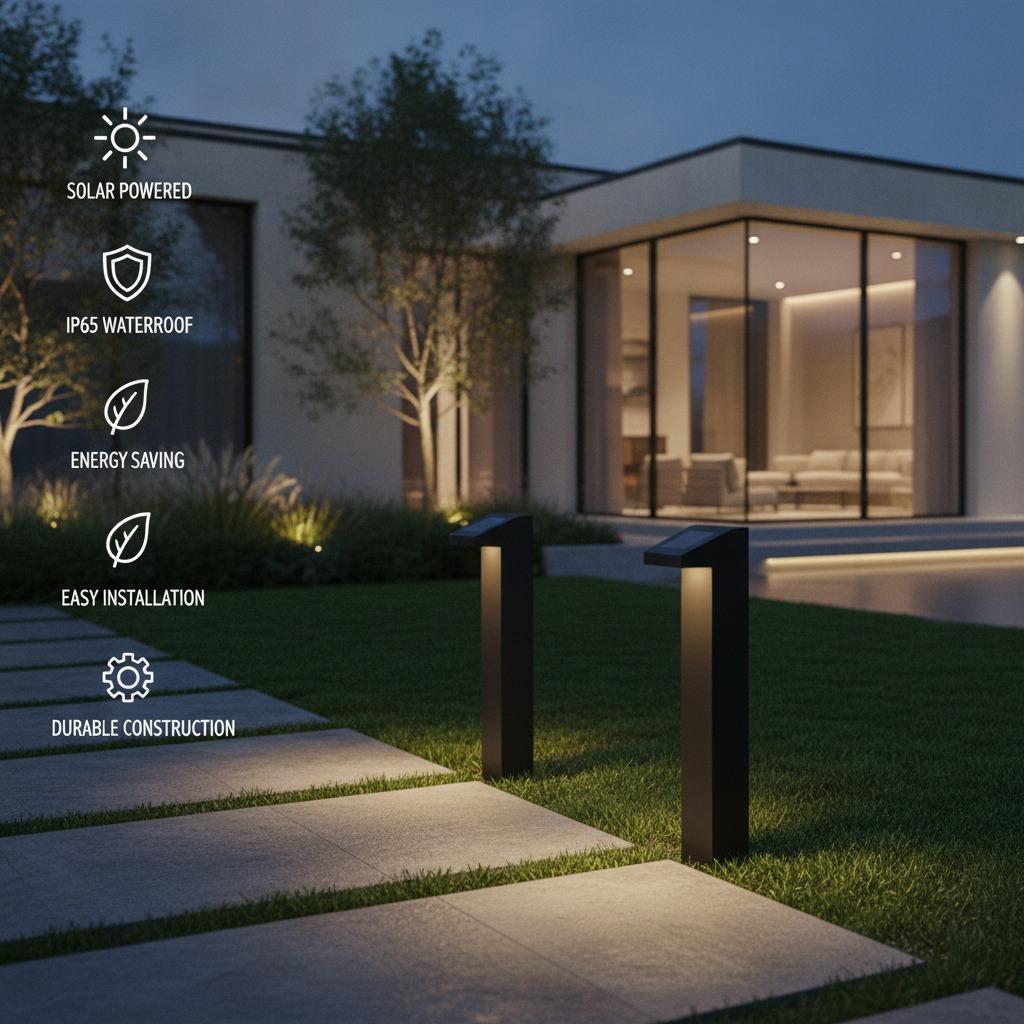
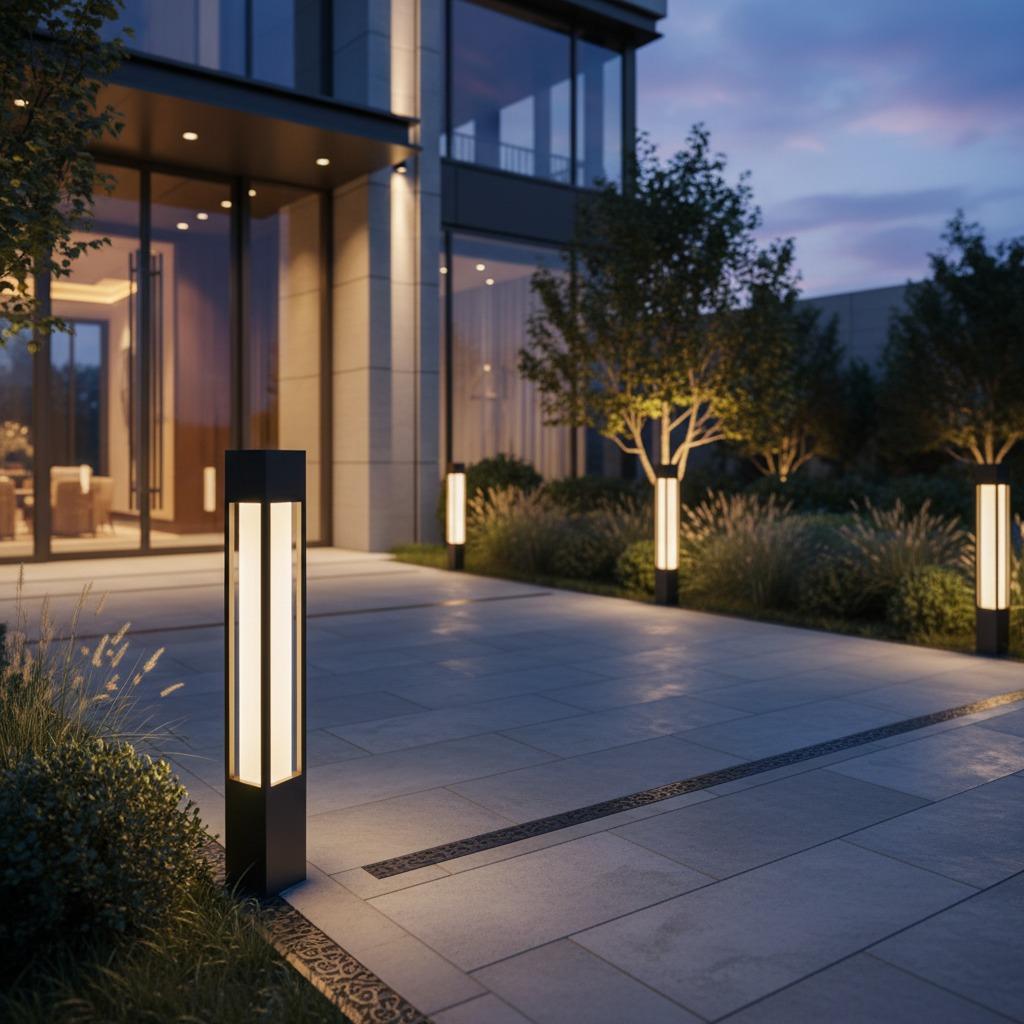
Short bollard lights suit paths, planters, entrances, and courtyard approaches. The visible products may have cylindrical or rectangular dark bodies with vertical diffusing panels. Their main selection issue is not just brightness. The light should guide movement without creating uncomfortable glare for pedestrians, drivers, or nearby residents.
Confirm the mounting method, access for maintenance, cable entry, drainage provisions, and the relationship between the diffuser and the surrounding landscape. A bollard placed beside a path may need a different distribution from one installed around a planting bed.
Linear, spot, and recessed architectural lighting
Ground-level linear lights can be concealed or semi-recessed along planter borders, steps, and pavement interfaces. These products require careful coordination with paving thickness, drainage, expansion joints, and access for replacement. A narrow fitting that cannot be serviced after installation may create a maintenance problem several years later.
Small landscape spotlights or uplights can highlight trees and shrubs, while recessed canopy or soffit downlights provide a more controlled entrance treatment. Confirm beam angles, aiming adjustment, glare control, cable arrangements, and the intended color appearance. The supplied project view suggests warm-white light in many landscape areas and cooler white light from roadway fixtures, but the exact color temperatures are not provided and must be specified in the technical schedule.
Documents to Request Before Approval
A serious supplier evaluation should move quickly from images to controlled information. Request a product data sheet for every fixture family, including dimensions, materials, finish, power, voltage, driver details, optical data, operating conditions, and installation instructions where available. Ask for the relevant ingress and impact ratings, electrical certifications, warranty terms, and service-life information rather than accepting general statements.
For poles, request fabrication drawings, base-plate and anchor details, structural calculations or design criteria, coating information, and packing dimensions. For luminaires, request wiring diagrams, driver replacement information, photometric files, and a clear explanation of any dimming, sensor, or control functions. None of these specifications should be inferred from product photographs.
Common Buying Mistakes
- Approving a coordinated appearance without checking photometric performance.
- Assuming all dark finishes provide the same corrosion resistance.
- Using one specification for roadway, pedestrian, and landscape applications.
- Failing to confirm whether the quoted supplier manufactures every fixture type shown.
- Leaving control protocols, cable entry, mounting details, and maintenance access until after purchase.
- Requesting a low price before the technical scope is stable, then comparing incomplete quotations.
Another frequent problem is unclear ownership of drawings and revisions. If the buyer supplies a custom pole, bollard, or linear profile, both parties should identify which dimensions are fixed, which can change, and who approves the final production file. Small dimensional changes can affect foundations, paving cuts, or the relationship between a fixture and a building façade.
Practical Advice for Sourcing Teams
Prepare a project schedule that separates performance requirements from aesthetic preferences. Include site conditions, mounting locations, target light appearance, control expectations, quantity by fixture type, and any local electrical or structural requirements. Then ask the supplier to mark each item as standard, modified, or newly developed.
Use a sample or prototype review to check finish, proportions, diffuser appearance, cable exits, mounting hardware, and service access. A sample is useful, but it does not replace production documentation or inspection planning. If the project includes several product categories, also review how the supplier manages consistency across finishes, color appearance, packaging, spare parts, and replacement units.
When comparing an outdoor lighting factory, look beyond the word “factory.” Ask which processes are performed internally, including assembly, coating, wiring, testing, and final inspection. The supplier may be a manufacturer for some products and a project integrator for others. That arrangement can be workable, provided it is transparent and the quality responsibilities are documented.
FAQ
Is a project image enough to select a supplier?
No. An image can show the general fixture language and installation context, but it cannot verify wattage, lumen output, beam angle, ingress protection, structural performance, certifications, or control capability.
Should all fixtures use the same color temperature?
Not necessarily. Roadways, pedestrian paths, landscaping, and entrances may have different visual and functional requirements. Establish a coordinated lighting concept and confirm the exact color temperatures with the supplier.
When is ODM more suitable than OEM?
ODM can be practical when an existing supplier design is close to the project requirement and only moderate adaptation is needed. OEM is generally more suitable when the buyer has controlled dimensions, branding, performance requirements, or a defined design package.
Next Step: Build a Verification Checklist
Before requesting a final quotation, organize the project by fixture type and require a matching technical response for each one. Include drawings, photometric data, environmental ratings, materials, finish, mounting, controls, testing, packaging, and after-sales support. This approach makes supplier comparisons more reliable and exposes missing information early—before a pole foundation is poured or a recessed light is trapped beneath finished paving.