
Why Infrastructure Projects Need a Professional LED Lighting Supplier
Infrastructure lighting projects require reliable performance, consistent quality, and long-term operational stability. Unlike small commercial installations, infrastructure projects often involve highways, bridges, public areas, industrial zones, transportation facilities, and large outdoor environments where lighting failure can increase maintenance costs and affect safety.
A professional LED lighting supplier for infrastructure projects should provide more than standard products. The supplier should support project planning, lighting calculations, product customization, quality inspection, documentation, production capacity, and after-sales service.
For large-scale projects, buyers usually evaluate:
- Lighting performance and energy efficiency
- Product reliability in outdoor environments
- Compliance with regional requirements
- Engineering support capability
- Manufacturing capacity
- Delivery reliability
- Long-term cooperation potential
CDZM Lighting provides outdoor and commercial lighting solutions with engineering support, including DIALux lighting simulation, lux calculations, structural design, and project-based customization. CDZM Lighting Solutions
What Types of Infrastructure Projects Use LED Lighting?
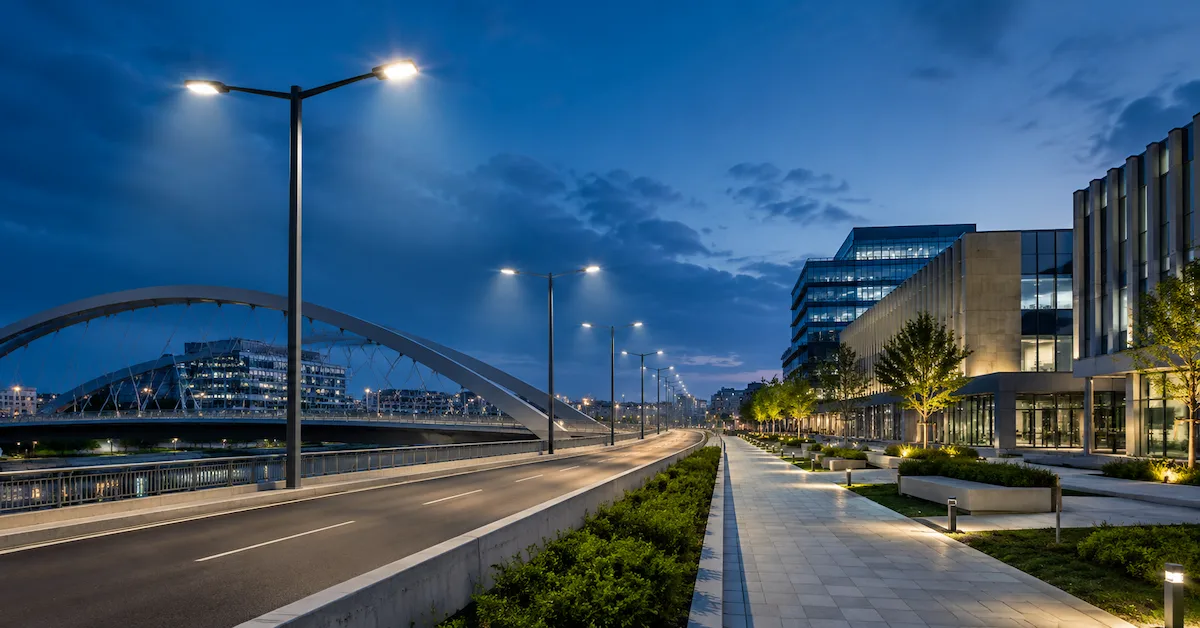
Infrastructure lighting covers a wide range of applications. Each project has different lighting requirements based on safety, environment, installation conditions, and operating hours.
Highway and Road Lighting
Road lighting is one of the largest infrastructure lighting applications.
Buyers typically focus on:
- Road illumination levels
- Light distribution
- Pole spacing
- Mounting height
- Weather resistance
- Energy consumption
- Maintenance requirements
LED street lighting solutions help reduce energy usage compared with traditional lighting technologies while providing better control options and longer service life.
For remote roads or areas without stable grid access, solar lighting solutions can provide an alternative approach. CDZM also provides solar lighting solutions for outdoor applications. CDZM Solar Lighting Solutions
Bridge and Transportation Lighting
Bridge lighting projects often require:
- High corrosion resistance
- Stable outdoor performance
- Long operating hours
- Precise light distribution
- Low maintenance frequency
Because bridges are exposed to humidity, rain, wind, and temperature changes, material selection and waterproof design are critical.
Municipal and Public Lighting Projects
Municipal projects may include:
- City roads
- Parks
- Public squares
- Pedestrian areas
- Community infrastructure
- Government facilities
These projects usually require suppliers that can provide technical documents, product consistency, and stable production capacity.
Industrial Infrastructure
Industrial parks, factories, logistics centers, and warehouses often require:
- High illumination efficiency
- Large coverage areas
- Durable fixtures
- Easy maintenance
- Intelligent control systems
How to Evaluate an LED Lighting Supplier for Infrastructure Projects
Selecting an infrastructure lighting supplier requires a structured evaluation process.
1. Check Manufacturing Capability
Large projects require suppliers that can handle:
- Stable raw material supply
- Consistent production quality
- Large-volume orders
- Flexible customization
- Reliable delivery schedules
A supplier should be able to provide information about:
- Factory capability
- Production process
- Quality management
- Testing procedures
- Previous project experience
According to its About Us page, CDZM operates a manufacturing facility and highlights product testing, engineering support, and production quality management as part of its lighting manufacturing capability. CDZM About Us
2. Evaluate Technical Lighting Expertise
Infrastructure projects cannot rely only on product catalogs.
A capable supplier should understand:
- Lumen requirements
- Beam angle selection
- Light distribution
- Uniformity
- Glare control
- Installation height
- Pole spacing
- Energy-saving calculations
Professional suppliers should be able to support lighting simulation and technical recommendations before production.
CDZM provides DIALux-based lighting simulation and project lighting support for commercial and outdoor applications. CDZM Lighting
3. Review Product Materials and Reliability
Infrastructure lighting products are exposed to outdoor conditions for years.
Important factors include:
| Component | Why It Matters |
|---|---|
| Die-cast aluminum housing | Improves durability and heat dissipation |
| Tempered glass or PC cover | Protects optical components |
| Waterproof structure | Prevents moisture damage |
| Quality LED modules | Ensures stable output |
| Reliable driver | Supports long-term operation |
| Thermal management | Extends product lifetime |
For outdoor infrastructure projects, IP protection, corrosion resistance, and heat dissipation should be verified before purchasing.
Key Specifications Buyers Should Compare
Infrastructure buyers should compare complete technical specifications rather than only power ratings.
| Specification | Why It Matters |
|---|---|
| Power consumption | Determines energy usage |
| Lumens | Shows actual light output |
| lm/W efficiency | Measures energy performance |
| Beam distribution | Controls coverage area |
| CCT | Defines visual appearance |
| CRI | Influences color rendering |
| IP rating | Shows outdoor protection |
| Operating temperature | Indicates environmental suitability |
| Driver quality | Affects reliability |
| Control compatibility | Enables smart management |
A 100W fixture from one supplier may not provide the same lighting performance as another supplier’s 100W product. Optical design, LED efficiency, driver performance, and thermal structure all influence the final result.
Why Lighting Design Support Matters for Infrastructure Projects
Large projects often fail because lighting products are selected without proper calculations.
A professional supplier should help answer:
- How many fixtures are required?
- What installation height is suitable?
- What spacing should be used?
- What light distribution is needed?
- How can energy consumption be reduced?
Lighting simulation helps project teams visualize expected performance before installation.
Benefits include:
- Reduced design mistakes
- Better illumination uniformity
- Lower installation risks
- More accurate budget planning
- Improved energy efficiency
Quality Control Requirements for Infrastructure Lighting
Infrastructure projects usually require higher reliability than standard commercial purchases.
A reliable LED lighting supplier should have a clear QC process.
Typical inspection stages include:
Incoming Material Inspection
Checking:
- LED components
- Drivers
- Aluminum materials
- Optical parts
- Electronic components
Production Inspection
Monitoring:
- Assembly quality
- Electrical connections
- Waterproof structure
- Mechanical consistency
Performance Testing
Common tests include:
- Electrical safety testing
- Aging testing
- Waterproof testing
- Thermal testing
- Optical performance testing
CDZM states that it performs multiple internal tests before product release and conducts testing of key safety and performance parameters during production. CDZM Quality Information
OEM and Custom LED Lighting Solutions for Infrastructure Projects
Infrastructure projects often have special requirements.
Examples include:
- Customized power ratings
- Different mounting structures
- Specific beam angles
- Brand labeling
- Customized packaging
- Regional certification requirements
- Special control systems
OEM and ODM capabilities allow project companies and lighting brands to adapt products to different markets.
Typical customization process:
- Project requirement analysis
- Technical discussion
- Product selection
- Engineering review
- Sample development
- Testing and approval
- Mass production
- Final inspection
This approach is especially useful for:
- Government projects
- Engineering contractors
- Lighting distributors
- Private-label brands
Infrastructure LED Lighting Supplier Comparison Checklist
Before selecting a supplier, buyers can evaluate:
| Evaluation Area | Questions |
|---|---|
| Product | Does the supplier offer suitable models? |
| Engineering | Can they provide lighting calculations? |
| Quality | Are testing procedures available? |
| Customization | Can products be modified? |
| Production | Can they support project quantities? |
| Delivery | Are lead times reliable? |
| Support | Is technical assistance available? |
| Experience | Do they have relevant cases? |
A supplier with strong engineering and manufacturing capability can reduce project risks compared with a supplier focused only on product trading.
Common Mistakes When Choosing an Infrastructure Lighting Supplier
Choosing Only Based on Price
The lowest initial price may result in:
- Higher maintenance costs
- Shorter lifespan
- Poor lighting performance
- Replacement risks
Ignoring Lighting Calculations
A product that looks powerful in a catalog may not perform correctly in a real installation.
Not Checking Environmental Requirements
Different locations require different protection levels.
For example:
- Coastal areas require stronger corrosion resistance
- Cold regions require wider operating temperature ranges
- Humid regions require better sealing protection
Selecting a Supplier Without Project Support
Infrastructure projects often require technical communication throughout design, production, installation, and maintenance stages.
FAQ About LED Lighting Supplier for Infrastructure Projects
1. What should I look for in an LED lighting supplier for infrastructure projects?
Look for manufacturing capability, engineering support, product reliability, customization ability, quality control systems, and experience with similar projects.
2. Can LED lighting suppliers provide project design support?
Many professional suppliers provide lighting calculations, product recommendations, and simulation support. CDZM offers DIALux lighting simulation and project lighting support.
3. What LED lights are commonly used for infrastructure projects?
Common solutions include LED street lights, flood lights, high bay lights, landscape lighting, and solar lighting systems.
4. How do I choose the right LED lighting power for a project?
Power selection depends on application conditions, required illumination, installation height, spacing, optical design, and project standards.
5. Are solar LED lights suitable for infrastructure projects?
Solar lighting can be suitable for roads, parks, rural areas, and locations where grid connection is difficult.
6. What certifications should infrastructure lighting suppliers provide?
Certification requirements depend on the destination market and project requirements. Buyers should confirm applicable standards before ordering.
7. Can LED lighting manufacturers provide OEM services?
Yes. Many manufacturers support customized designs, branding, packaging, and technical modifications for project customers.
8. How long does infrastructure lighting production take?
Lead time depends on product type, customization level, quantity, testing requirements, and production schedule.
9. Why is IP rating important for outdoor infrastructure lighting?
IP protection helps prevent water and dust damage, improving reliability in outdoor environments.
10. How can I request an infrastructure lighting quotation?
Provide project location, application, drawings, quantity, required specifications, and certification requirements. Suppliers can then recommend suitable solutions.
Conclusion
Choosing the right LED lighting supplier for infrastructure projects is a long-term investment decision. The best supplier should provide not only reliable LED products but also engineering expertise, quality assurance, customization capability, and project support.
For infrastructure contractors, municipalities, developers, and lighting brands, evaluating supplier capability before purchasing can reduce project risks and improve long-term operating performance.
CDZM provides outdoor and commercial lighting solutions with manufacturing experience, engineering support, OEM/ODM capability, and project-oriented services. You can explore more about the company through its products page, project cases, or contact the team through the contact page for infrastructure lighting requirements.