
What Should Buyers Expect From an LED Panel Light Manufacturer?
An LED panel light manufacturer should provide more than a flat ceiling fixture. For B2B buyers, the real value lies in matching the panel's light output, optical design, glare performance, dimensions, driver, controls, and installation method to the intended commercial environment.
LED panel lights are commonly selected for offices, schools, healthcare facilities, retail areas, meeting rooms, and other spaces using modular ceilings because they can provide broad, uniform ambient illumination in a slim format.
For commercial procurement, buyers should evaluate:
- Panel construction
- Delivered lumens
- Luminaire efficacy
- Glare performance
- CRI and CCT
- Driver quality
- Flicker performance
- Dimming compatibility
- Ceiling dimensions
- Installation method
- Product testing
- Warranty and supplier support
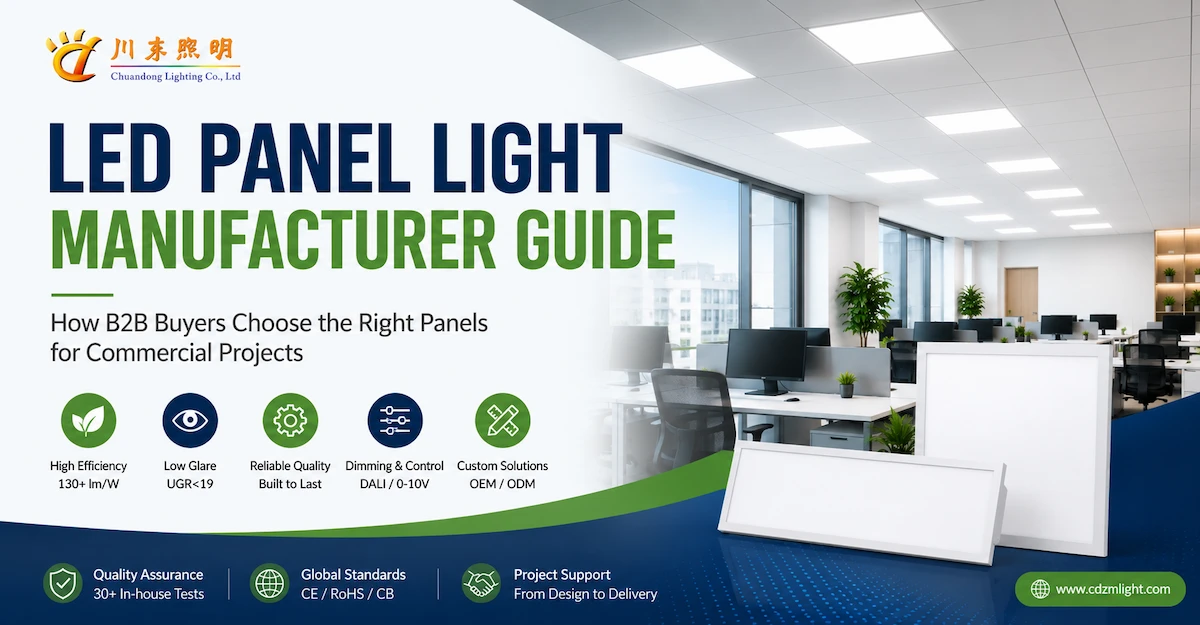
CDZM's Commercial Lighting Solutions currently describe panel and troffer lighting for office and retail projects in common 600 × 600 mm and 300 × 1200 mm formats, with options including high efficacy, UGR<19 configurations, and DALI or 0–10V dimming.
What Is an LED Panel Light?
An LED panel light is a flat luminaire designed to distribute light across a comparatively large surface.
Unlike traditional fluorescent ceiling fixtures, LEDs act as the light source, while optical components spread and diffuse the light to create a broad illuminated surface.
A typical panel may include:
- LED modules or LED strips
- Aluminum frame or housing
- Diffuser
- Optical plate or lens structure
- Reflective material
- LED driver
- Mounting hardware
The exact construction depends on whether the fixture is edge-lit, back-lit, direct-lit, recessed, surface-mounted, suspended, or designed for another installation method.
For commercial projects, the buyer should evaluate the complete luminaire, not only the LED chip.
The U.S. Department of Energy similarly evaluates commercial luminaires by delivered light and whole-luminaire efficacy rather than relying on the performance of the light source alone.
How Does an LED Panel Light Work?
The driver converts the incoming electrical supply into the regulated electrical output required by the LEDs.
The LED modules then produce light, which passes through or interacts with the fixture's optical system.
Depending on the panel design, light may travel through:
- A light guide plate
- Diffusion materials
- Reflective layers
- Direct optical lenses
The purpose is to transform many small LED sources into a visually uniform luminous surface.
The quality of this process affects:
- Uniformity
- Glare
- Efficiency
- Visual comfort
- Fixture thickness
A panel that appears similar from the outside can therefore perform very differently depending on its LEDs, optics, driver, thermal design, and assembly quality.
Why Are LED Panel Lights Used in Commercial Buildings?
Energy Efficiency
Commercial buildings may operate their lighting for many hours each day. Efficiency therefore has a direct effect on operating cost.
Luminaire efficacy is measured in lumens per watt (lm/W).
Higher efficacy means the fixture delivers more light for each watt of electrical input.
DOE's current FEMP guidance uses luminous efficacy as an important procurement metric for commercial LED luminaires and lists different efficiency requirements for different troffer sizes and linear ambient products.
CDZM's commercial lighting solution page describes its panel/troffer offering as exceeding 130 lm/W; buyers should confirm the exact performance of the specific model being quoted.
Uniform Ambient Lighting
A well-designed panel creates broad illumination across the fixture surface.
This can help reduce:
- Harsh point-source brightness
- Strong shadows
- Uneven ceiling appearance
Uniformity is particularly useful in offices, classrooms, meeting rooms, and other spaces where people perform visual tasks for long periods.
Slim Fixture Design
LED panels can integrate cleanly with modern ceilings.
Depending on the project, they may be:
- Recessed into a grid ceiling
- Surface mounted
- Suspended
This gives architects and contractors more flexibility when working with different ceiling conditions.
Lower Maintenance Requirements
LED luminaires generally offer longer service intervals than older fluorescent systems.
For B2B buyers, maintenance value should be evaluated alongside:
- Driver life
- Lumen maintenance
- Operating temperature
- Replaceability
- Warranty
Long nominal LED life alone does not guarantee long fixture life if the driver or thermal design is poor.
What Are the Main Types of LED Panel Lights?
Not every panel uses the same internal structure. Buyers should understand the differences before comparing quotations.
Edge-Lit LED Panel Lights
LEDs are positioned around the perimeter of the fixture.
Light is directed through a light guide plate before exiting through the diffuser.
Advantages
- Very slim profile
- Clean appearance
- Suitable for shallow ceilings
- Good visual uniformity when properly engineered
Buyer Considerations
The quality of the light guide plate and optical materials can affect:
- Brightness
- Long-term uniformity
- Yellowing risk
- Efficiency
Edge-lit panels are frequently considered for offices and premium commercial interiors where slim construction matters.
Back-Lit LED Panel Lights
LED modules are located behind the luminous surface.
Light travels directly toward the diffuser instead of being transmitted from the fixture edges.
Advantages
- Simpler optical path
- Potentially high efficiency
- Fewer optical layers
- Suitable for general commercial lighting
Buyer Considerations
The fixture may require more depth than a very thin edge-lit design.
Buyers should compare:
- Efficacy
- Fixture depth
- Hotspot control
- Diffuser quality
Direct-Lit Panels
Direct-lit designs distribute LED sources across the back of the luminaire.
The LEDs illuminate the diffuser directly.
These products can be suitable for applications where strong general illumination and efficiency are priorities.
Tunable White LED Panels
Tunable panels allow color temperature to be adjusted.
They can be useful in:
- Offices
- Meeting rooms
- Healthcare environments
- Flexible commercial spaces
The supplier should clarify:
- CCT range
- Driver protocol
- Controller compatibility
- Dimming behavior
Emergency LED Panels
Emergency versions incorporate or connect to emergency power equipment so lighting can remain available during power interruptions.
Requirements differ by market, so buyers should specify the destination country's applicable safety and emergency-lighting requirements.
Surface-Mounted LED Panels
Surface-mounted panels are useful where a recessed ceiling is unavailable.
Common applications include:
- Concrete ceilings
- Renovation projects
- Utility areas
- Commercial retrofits
Custom LED Panels
For OEM, ODM, distributor, and project orders, panels may be customized according to:
- Size
- Power
- CCT
- CRI
- Driver
- Dimming protocol
- Frame finish
- Branding
- Packaging
This is one area where working directly with an experienced LED panel light manufacturer can provide greater flexibility than purchasing only standard catalog products.
How Should Buyers Compare LED Panel Light Specifications?
Wattage alone is not enough.
Two 40W panels can have significantly different performance.
| Parameter | What Buyers Should Check | Why It Matters |
|---|---|---|
| Power | Actual luminaire input | Determines energy use |
| Lumens | Delivered fixture output | Indicates usable light |
| Efficacy | lm/W | Helps compare efficiency |
| CCT | Typical fixed or selectable values | Defines white-light appearance |
| CRI | Color rendering performance | Important for visual quality |
| Glare | Optical/glare data | Affects visual comfort |
| Power Factor | Driver performance | Important for commercial systems |
| THD | Electrical quality | Relevant to project specifications |
| Dimming | DALI, 0–10V or other | Determines control compatibility |
| Size | Ceiling module dimensions | Prevents installation mismatch |
| Driver | Type and specification | Influences reliability |
| Warranty | Coverage and conditions | Helps reduce procurement risk |
DOE advises commercial buyers to evaluate efficacy together with other performance factors such as color characteristics, electrical quality, controls, and lumen maintenance rather than choosing a luminaire from one metric alone.
LED Panel Light Sizes and Ceiling Compatibility
One of the easiest ways to create installation problems is ordering panels before confirming the ceiling system.
Common commercial formats can include:
- 600 × 600 mm
- 300 × 1200 mm
- 1 × 4 ft
- 2 × 2 ft
- 2 × 4 ft
Regional construction systems differ.
CDZM's commercial lighting solution currently lists 600 × 600 mm and 300 × 1200 mm panel/troffer formats.
Before requesting a quotation, buyers should provide:
- Ceiling grid dimensions
- Ceiling type
- Recessed or surface installation
- Required fixture depth
- Electrical voltage
- Project country
A “standard panel” in one country may not match the ceiling module commonly used in another.
Where Are LED Panel Lights Commonly Used?
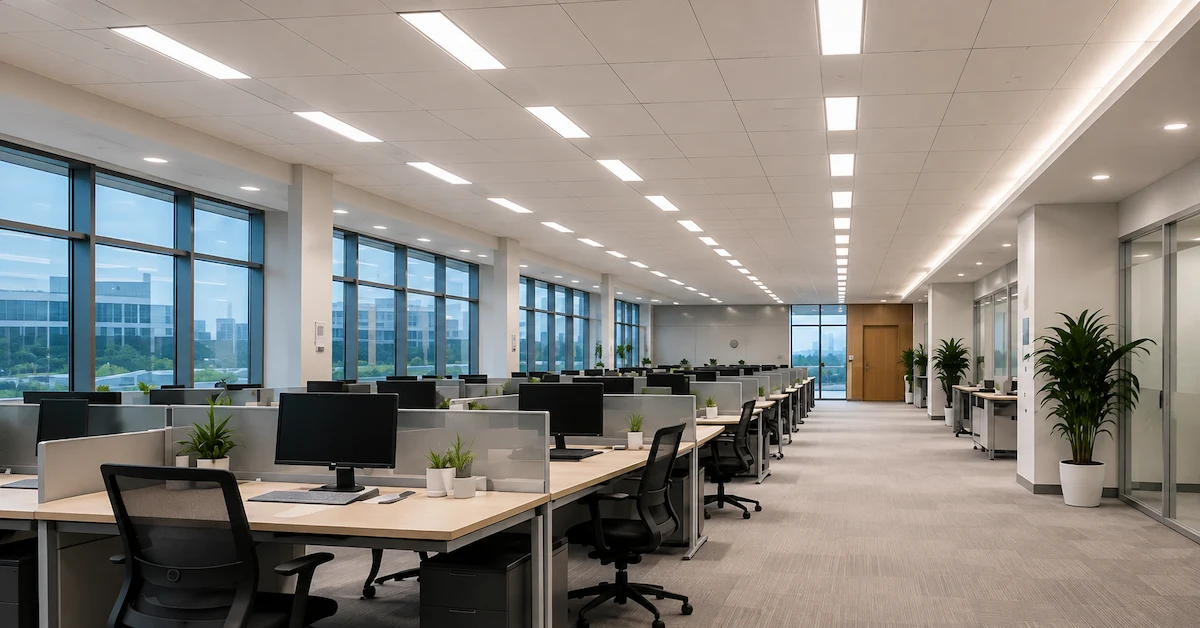
Offices
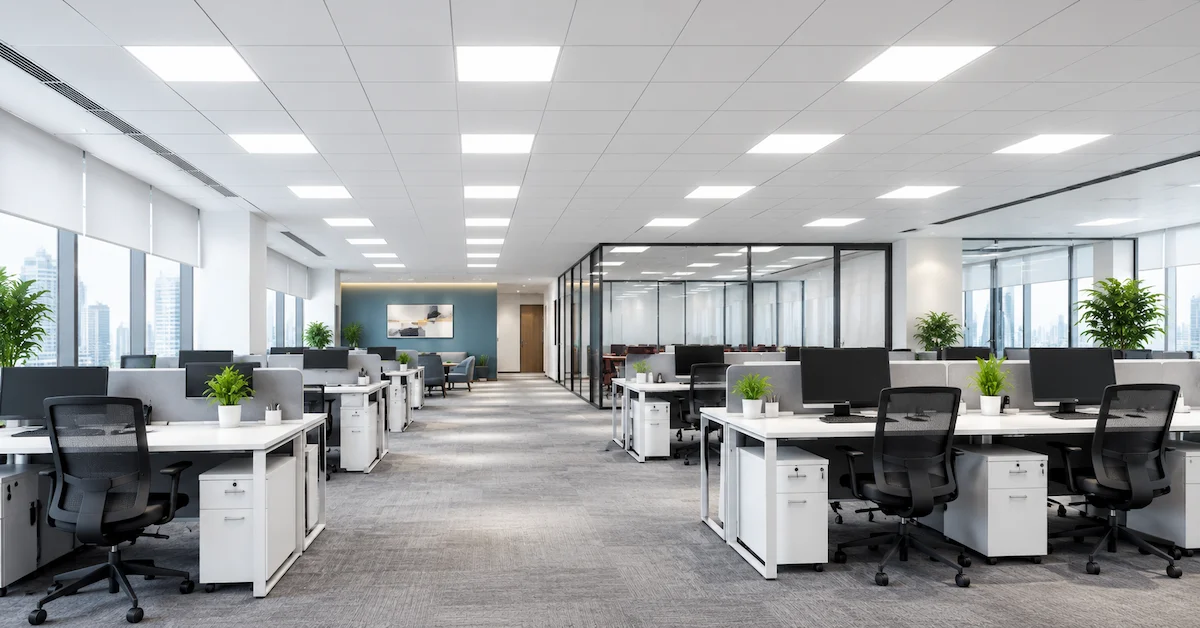
Office lighting requires more than brightness.
Buyers should consider:
- Workplane illumination
- Screen glare
- Uniformity
- CCT
- CRI
- Dimming
- Daylight availability
Low-glare panels can be useful for open offices, meeting rooms, private offices, and administrative areas.
CDZM's commercial lighting page lists UGR<19 panel/troffer configurations for office and retail applications.
Schools and Training Facilities
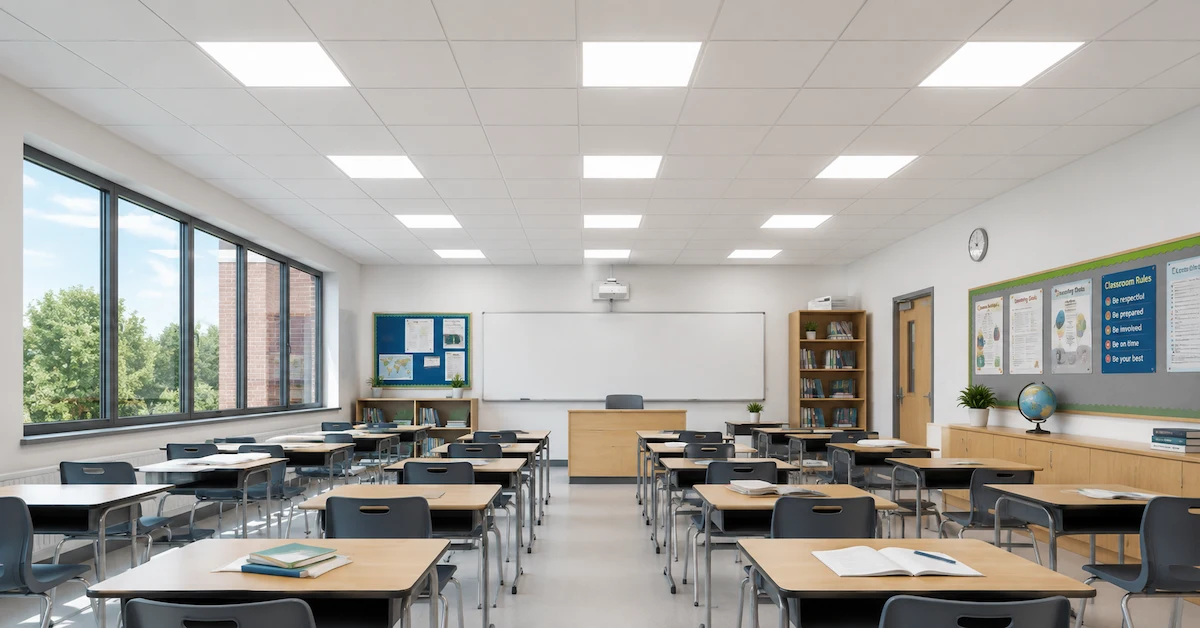
Classrooms often require:
- Uniform general illumination
- Controlled glare
- Stable light output
- Appropriate color quality
- Flexible control
Daylight-responsive controls can also help reduce unnecessary energy use in rooms with significant natural light.
Healthcare Spaces
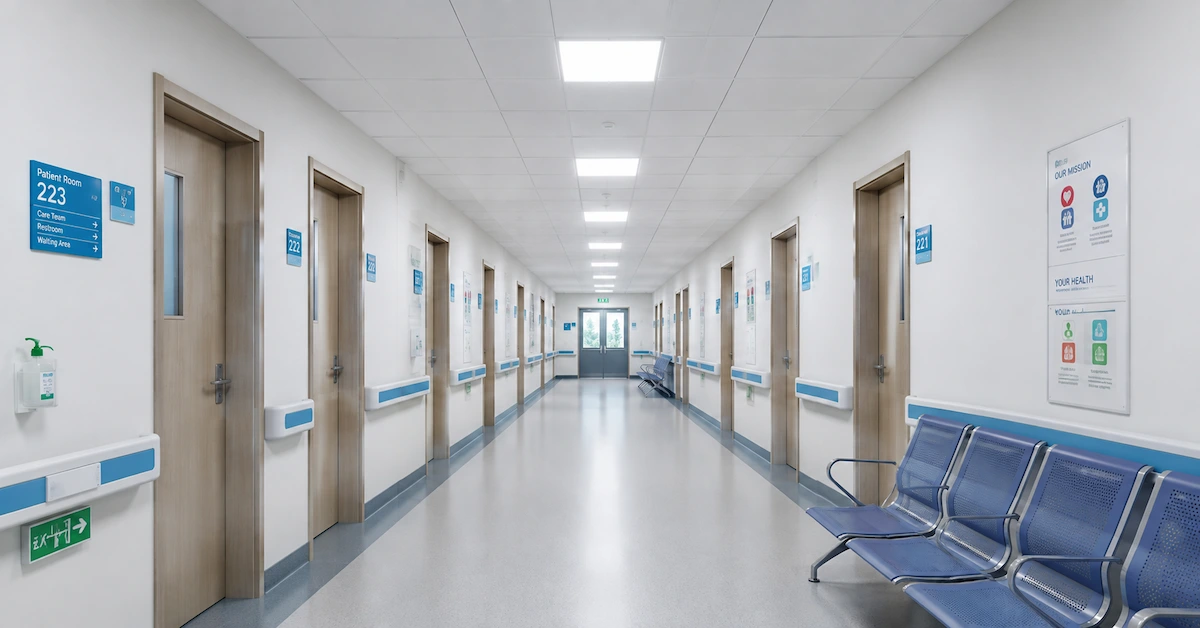
Healthcare projects may place greater emphasis on:
- Color rendering
- Visual comfort
- Cleaning requirements
- Stable light output
Different areas within a healthcare building have different requirements, so buyers should not assume one panel specification is suitable for consultation rooms, wards, laboratories, corridors, and treatment spaces.
Retail Stores
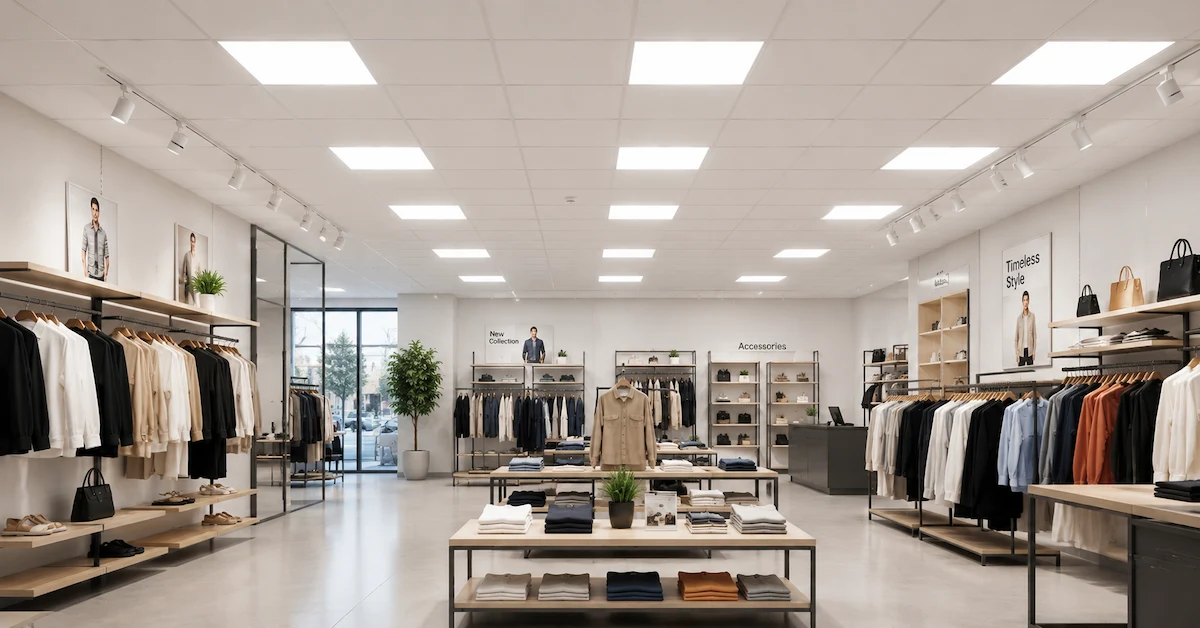
Panels can provide general illumination in:
- Supermarkets
- Convenience stores
- Showrooms
- Shopping areas
Retail projects may require higher color quality when products, materials, or packaging need to appear natural and attractive.
Commercial Corridors and Common Areas
Panels may also be suitable for:
- Corridors
- Reception support areas
- Shared spaces
- Office back-of-house zones
Occupancy control can be particularly useful in intermittently occupied areas.
Edge-Lit vs Back-Lit LED Panel Lights
| Factor | Edge-Lit | Back-Lit |
| Fixture profile | Very slim | Usually deeper |
| Optical path | Side light + guide plate | Direct from rear LEDs |
| Construction | More optical layers | Simpler optical path |
| Typical priority | Slim aesthetics | Efficiency/value |
| Key quality risk | Light guide quality | Hotspot/diffusion control |
| Best fit | Premium/shallow ceiling applications | General commercial projects |
Neither structure is automatically better.
The right choice depends on:
- Ceiling depth
- Efficiency target
- Budget
- Optical requirements
- Project design
A sample installation or project mock-up can be valuable when visual appearance and glare are critical.
What CCT Should Buyers Choose?
Common commercial options may include:
- 3000K
- 3500K
- 4000K
- 5000K
- Selectable or tunable CCT
Warmer CCTs can create a softer atmosphere.
Neutral or cooler white may be preferred for task-oriented environments depending on regional preferences and project requirements.
Rather than asking “Which CCT is best?”, buyers should ask:
Which CCT is appropriate for the people, tasks, materials, daylight, and desired atmosphere in this specific space?
Why Glare Matters in Offices and Classrooms
A panel can deliver sufficient lumens while still creating uncomfortable visual conditions.
Glare is influenced by:
- Fixture luminance
- Optical design
- Installation position
- Viewing direction
- Room geometry
- Ceiling height
This is why project buyers should not evaluate glare only from product photographs.
For projects with strict visual-comfort requirements, request:
- Photometric files
- Glare data
- Lighting calculations
- DIALux simulation where appropriate
CDZM describes UGR<19 configurations for its commercial panel/troffer solution.
Why Controls Matter in Modern LED Panel Lighting
LED panels can be integrated with controls to reduce energy use and improve flexibility.
Options may include:
- On/off control
- 0–10V dimming
- DALI
- Occupancy sensors
- Daylight harvesting
- Central building controls
DOE specifically identifies occupancy sensors, task tuning, and dimming as strategies that can deliver additional savings when used with commercial LED luminaires.
For B2B procurement, confirm the driver and controller combination before placing an order.
“Dimmable” does not automatically mean compatibility with every building-control system.
How to Evaluate an LED Panel Light Manufacturer
Manufacturing Capability
Ask whether the supplier controls:
- Product engineering
- Assembly
- Driver integration
- Quality testing
- Final inspection
CDZM states that its 50,000 m² facility supports commercial, industrial, and outdoor LED lighting manufacturing and serves customers in more than 50 countries.
Quality Testing
A manufacturer should be able to explain what is actually tested.
Relevant checks can include:
- Integrating sphere testing
- Electrical safety
- Aging
- Driver operation
- Color consistency
- Product appearance
- Final functionality
CDZM reports more than 30 internal tests before a product goes to market and 100% testing of essential safety and performance parameters during mass production.
OEM and ODM Capability
For distributors and private-label buyers, useful customization may include:
- Wattage
- Lumens
- CCT
- CRI
- Driver
- Control system
- Dimensions
- Frame finish
- Logo
- Packaging
- Manuals
Customization should be discussed before sampling because optical, thermal, and electrical changes can affect final performance.
Engineering Support
A professional supplier should be able to help answer:
- How many panels are required?
- Which lumen package is suitable?
- Which size fits the ceiling?
- What fixture spacing should be used?
- Is dimming required?
- Which optical solution is appropriate?
CDZM provides commercial lighting project support and presents panel/troffer products as part of its broader commercial solution offering.
What Should You Include in an LED Panel Light RFQ?
A detailed RFQ helps manufacturers provide a more accurate recommendation and quotation.
Include:
- Project country
- Application
- Required quantity
- Panel dimensions
- Wattage or target lumens
- CCT
- CRI
- Voltage
- Dimming requirements
- Glare requirements
- Installation method
- Required certifications
- Branding requirements
- Packaging requirements
- Target delivery date
For project orders, also send:
- Floor plan
- Ceiling height
- Ceiling grid dimensions
- Target illuminance
This allows the supplier to move beyond a simple product quote toward a more useful project recommendation.
Common LED Panel Light Procurement Mistakes
Comparing Only Wattage
Wattage tells you how much power the fixture consumes, not how effectively it lights the space.
Compare:
- Lumens
- Efficacy
- Distribution
- Glare
- Fixture efficiency
Buying Before Confirming Ceiling Dimensions
A small difference in dimensions can create major installation problems across hundreds of fixtures.
Ignoring Driver Quality
The driver affects:
- Reliability
- Dimming
- Flicker
- Electrical performance
Using One Specification for Every Space
An office, classroom, healthcare room, retail shop, and corridor may require different lighting specifications.
Selecting a Supplier Only by Unit Price
The lowest quotation can become expensive if it results in:
- Higher energy use
- Poor installation compatibility
- Premature failures
- More maintenance
- Project delays
FAQ About LED Panel Light Manufacturers
1. What is an LED panel light?
An LED panel light is a flat luminaire that uses LEDs and an optical system to produce broad, uniform illumination for commercial and institutional spaces.
2. What is the difference between edge-lit and back-lit LED panels?
Edge-lit panels place LEDs along the fixture edges and use a light guide plate. Back-lit panels place LEDs behind the diffuser. Edge-lit designs can be thinner, while back-lit designs may offer a simpler optical structure.
3. What sizes of LED panel lights are commonly available?
Common formats vary by market and can include 600 × 600 mm, 300 × 1200 mm, 1 × 4 ft, 2 × 2 ft, and 2 × 4 ft.
4. What is a good efficacy for a commercial LED panel?
There is no universal number for every application. Buyers should compare similar fixture categories and confirm delivered lumens and whole-luminaire wattage. DOE publishes application-specific efficacy requirements for commercial luminaires.
5. Are LED panel lights suitable for offices?
Yes. They are widely used for office ambient lighting because they can provide uniform ceiling illumination in a compact format. Glare, CCT, CRI, controls, and layout should still be evaluated.
6. Can LED panel lights be dimmed?
Yes, when the luminaire uses a compatible dimmable driver. Options may include 0–10V and DALI, depending on the model and project.
7. Can an LED panel light manufacturer provide OEM products?
Yes. Depending on manufacturing capability, OEM/ODM options can include wattage, dimensions, CCT, CRI, drivers, control protocols, branding, and packaging.
8. What information should I request from a panel-light supplier?
Ask for technical datasheets, photometric files, driver information, test reports, certification details, warranty terms, sample lead time, production lead time, and customization options.
9. Does CDZM manufacture LED panel lighting?
CDZM publicly lists commercial panel and troffer lighting within its commercial-lighting solution portfolio. Its current main product catalog, however, is more heavily focused on outdoor and solar lighting, so buyers should confirm available panel models, specifications, certifications, MOQ, and lead time for the intended project before ordering.
10. How can I request an LED panel light quotation from CDZM?
Send the project application, quantity, panel size, target lumens, CCT, CRI, voltage, control requirements, certifications, and delivery schedule through the CDZM Contact Us page.
Conclusion
Selecting an LED panel light manufacturer requires more than finding a supplier with a familiar panel size and competitive unit price.
Commercial buyers should evaluate:
- Panel structure
- Delivered lumens
- Efficacy
- Glare
- CRI
- CCT
- Driver quality
- Dimming
- Installation compatibility
- Quality testing
- Customization
- Project support
Edge-lit, back-lit, tunable, emergency, and surface-mounted panels can all serve useful roles when matched to the correct application.
For offices and commercial projects, CDZM currently presents panel and troffer lighting as part of its Commercial Lighting Solutions, supported by manufacturing, testing, and project capabilities described on its About Us page.
For a more accurate quotation, provide your ceiling dimensions, project application, required quantity, lighting targets, control requirements, and destination market through the CDZM Contact Us page.