
How to Evaluate an Outdoor Lighting OEM Partner for a Project-Ready Product Range
Choosing an outdoor lighting OEM partner is not simply a matter of comparing fixture prices. For a commercial site, campus, hotel ground, residential compound, or landscaped development, the supplier must help coordinate several lighting functions at once: road illumination, pedestrian guidance, tree and shrub accent lighting, planter details, entrances, and covered walkways. This article explains what buyers should assess before requesting samples or approving a production program, and where an OEM arrangement may be more suitable than a standard catalog purchase.
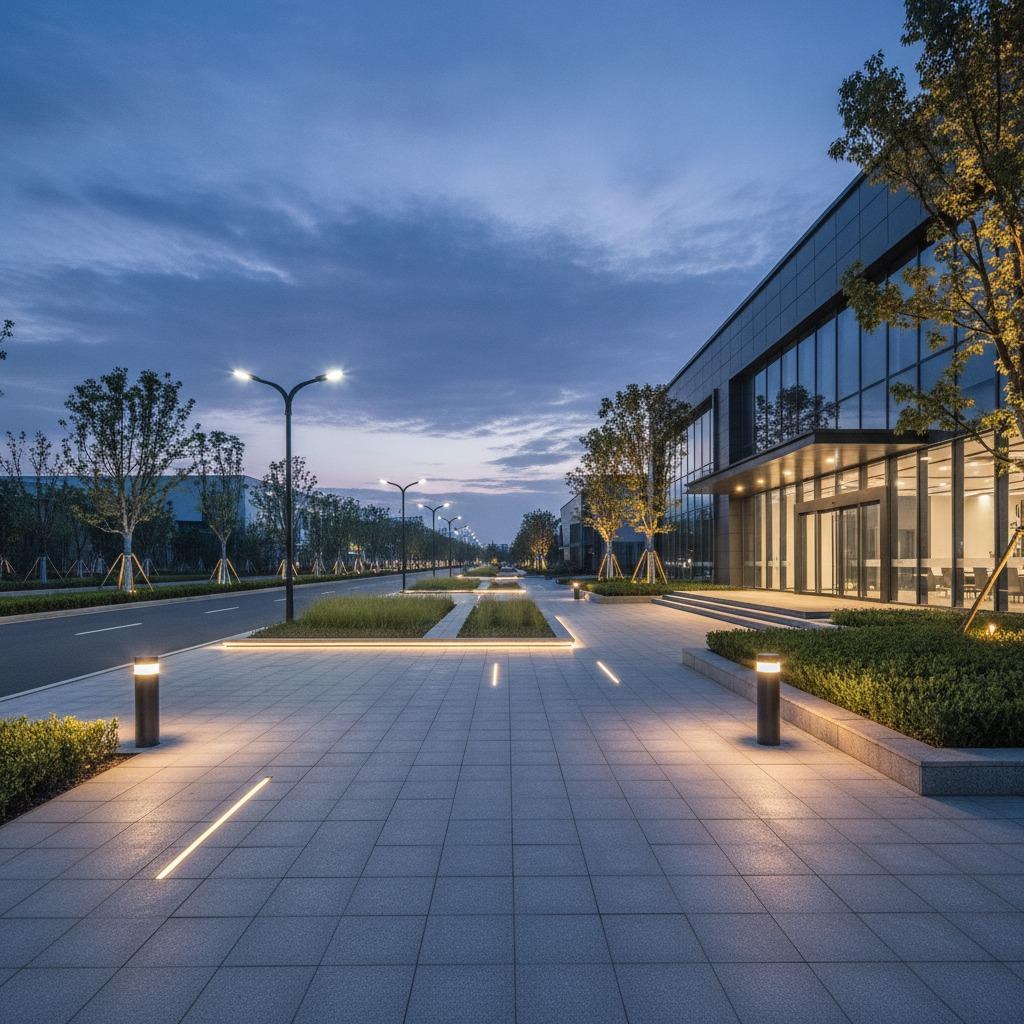
The supplied project view shows a coordinated outdoor installation rather than a single product. It includes double-arm roadway or pedestrian streetlights, short bollards, in-ground or low-mounted uplights, recessed linear lights, and downlights beneath a building canopy. That mix is important. A supplier may produce a good individual luminaire yet still be a poor fit for a project that requires consistent appearance, different optical functions, and dependable documentation across a complete range.
What the Project Appears to Require
| Lighting element | Typical project role | OEM discussion points |
|---|---|---|
| Double-arm streetlights | Roads, internal drives, and pedestrian routes | Pole geometry, mounting, optics, electrical configuration, and finish |
| Bollard lights | Sidewalks, planting beds, and building entrances | Body construction, illuminated panel, glare control, and installation method |
| Landscape uplights | Trees, shrubs, and architectural features | Beam distribution, concealed housing, aiming, and environmental protection |
| Linear or recessed lights | Planters, steps, paving edges, and architectural details | Module length, recess dimensions, diffusion, joints, and service access |
| Canopy downlights | Covered entrances and walkways | Ceiling integration, light distribution, finish, and maintenance access |
These fixtures do not necessarily need identical construction. They do need a deliberately coordinated visual language. In the image, the poles and bollards appear dark black or charcoal, likely using a painted or powder-coated metal finish, although the exact material cannot be identified from the image. Roadway lighting appears cooler white, while building-adjacent and landscape lighting appears warmer. That may reflect application-specific specification, but it does not by itself confirm adjustable products or a standardized color-temperature platform.
OEM or ODM: Which Route Fits the Buyer?
Outdoor lighting OEM usually means the buyer defines the product requirements, branding, packaging, or design inputs while the manufacturer supplies some combination of engineering, tooling, production, and assembly. This route can work well for a lighting brand or project contractor that already has a product concept but needs manufacturing support.
Outdoor lighting ODM generally involves a supplier offering an existing design platform that can be adapted through dimensions, finishes, optical components, labeling, or selected electrical options. ODM can shorten the development path, but buyers should confirm exactly what is proprietary, what can be changed, and whether the same housing is sold to other customers.
The distinction is not always clean in practice. A supplier may use an existing housing, modify the mounting arrangement, and still describe the program as OEM. Ask for a written scope covering design ownership, tooling ownership, revision control, sample approval, packaging, and permitted future changes. The filename associated with the supplied image references an outdoor lighting OEM ODM factory, but the image alone does not verify factory ownership, location, production capability, or whether the pictured products were made by that supplier.
Manufacturing Questions Worth Asking
Housing and structure
For streetlights and bollards, ask how the metal body, pole, arms, and mounting parts are formed and joined. Possible processes may include metal forming and welding, aluminum die casting, extrusion, machining, and powder coating, but these processes should be confirmed rather than assumed. Request section drawings or controlled product drawings showing key interfaces, especially where poles, arms, base plates, anchor systems, and luminaires meet.
Optics and electrical assembly
Do not approve a luminaire from a daytime photograph alone. Request the relevant photometric information, LED and driver details, input requirements, dimming or control options, and the intended application. The visible image cannot establish wattage, lumen output, efficacy, beam angle, CRI, lifetime, driver brand, or color temperature.
For linear and recessed products, examine connector arrangements, cut or module lengths, diffuser construction, cable routing, drainage, and replacement access. A narrow fixture that looks clean in a planter edge can become difficult to service if the driver or connection is buried without a practical access plan.
Finish and environmental exposure
Outdoor products face moisture, dirt, temperature changes, impact, ultraviolet exposure, and, in some locations, coastal or industrial corrosion. Ask the supplier to identify the housing material, coating system, lens material, environmental ratings, operating conditions, and applicable test or compliance documentation. Do not accept a general statement such as “weatherproof” as a substitute for product-specific evidence.
Common Sourcing Mistakes
One frequent mistake is treating a coordinated visual installation as proof of a coordinated product platform. The site may contain products from different design families or suppliers. Another is requesting a quotation before providing mounting conditions, target applications, finish expectations, control requirements, and the distinction between roadway, pedestrian, accent, and architectural light.
Buyers also sometimes compare fixtures only by nominal power. That can be misleading. Distribution, mounting height, spacing, glare control, maintenance access, and the surrounding surface all affect whether a product performs well. For a project range, compare the complete specification and installation requirement, not just the wattage printed on a preliminary sheet.
A Practical Buyer Checklist
- Separate the project into roadway, pedestrian, landscape, linear, recessed, and canopy applications.
- Define the desired visual relationship between poles, bollards, housings, finishes, and light colors.
- Provide drawings or photographs of mounting locations, recesses, paving edges, and service constraints.
- Ask whether the offer is OEM, ODM, private label, or a standard catalog product.
- Request controlled drawings, samples, photometric information, electrical data, and environmental documentation.
- Clarify design ownership, tooling responsibility, revision approval, packaging, and labeling before development begins.
- Confirm which product attributes are fixed and which can be customized.
Because no company information or verified factory data was supplied here, buyers should treat supplier capability as an open question. Production capacity, minimum order quantity, lead time, warranty, pricing, certifications, and test results require direct confirmation from the manufacturer. The same caution applies to the products shown: their exact materials, ratings, dimensions, and electrical performance cannot be reliably measured from the project image.
FAQ
Can one supplier provide all of these outdoor fixtures?
Possibly, but the buyer should verify the supplier’s actual range and engineering capability. Streetlights, bollards, uplights, linear systems, and canopy fixtures involve different housing, optical, installation, and service requirements.
Is a dark finish suitable for every outdoor environment?
Not automatically. Suitability depends on the material, coating system, exposure, maintenance conditions, and the supplier’s documented environmental performance. The visible charcoal finish in the supplied image should be treated as a design reference, not a confirmed specification.
What should happen before an OEM quotation?
Prepare an application schedule and define the required mounting conditions, appearance, electrical inputs, lighting zones, customization scope, documentation, and approval process. This gives the supplier a usable brief and makes competing quotations easier to compare.
Next Step for Project and Brand Buyers
Start with a fixture schedule, not a product photograph. Identify every lighting function in the site, mark which designs are fixed and which are open to adaptation, then ask prospective suppliers to respond against the same technical and commercial checklist. That approach will reveal whether you need true OEM engineering, a faster ODM adaptation, or a standard product family—and it reduces the risk of discovering late in the project that a visually attractive fixture cannot meet the installation or maintenance requirements.