
Why an all in one solar street light keeps showing up in buyer shortlists
An all in one solar street light is usually considered when a project needs outdoor lighting without the trouble of trenching, cabling, or adding load to the local grid. That sounds simple, but in practice it is a decision about installation effort, maintenance access, lighting consistency, and how much infrastructure a site can realistically support. For engineers and sourcing teams, the question is not just whether the light works. It is whether the design fits the site, the operating schedule, and the long-term maintenance plan.
These fixtures are commonly used on roadway edges, campus roads, business parks, residential developments, sidewalks, and landscaped public areas. The visible format is easy to recognize: a slim rectangular light head, a solar panel integrated on top, LED lighting underneath, and a straight pole with a mounting bracket. That self-contained shape is part of the appeal. You get a complete outdoor lighting package in one unit, which can simplify both specification and deployment.
What buyers usually want to know first
The main appeal of an all in one solar street light is convenience, but convenience should not be mistaken for uniformity. Two products can look similar from a distance and perform very differently once installed. The practical buying question is whether the unit can provide enough illumination for the site, hold up outdoors, and remain serviceable when something eventually needs attention. Since the internal battery, controller, and exact solar architecture are not visible from the outside, buyers should treat visual similarity as a starting point, not proof of equivalence.
For many projects, the comparison is between a traditional grid-tied pole light and a solar-integrated unit. Grid-connected lighting can be more predictable in continuous power delivery, while solar-integrated lighting reduces dependency on electrical infrastructure. On sites where trenching is costly or difficult, that can tip the balance quickly. On the other hand, if a project demands strict lighting schedules or unusually high output, the site should be reviewed more carefully before assuming a solar unit is the best fit.
Construction and visible product features
From the product structure, the system appears to combine the main lighting and solar collection elements into one mounted assembly. The pole provides the mechanical support, while the elongated head houses the LED module and the top-mounted photovoltaic panel. That integrated arrangement reduces the number of separate parts on site and can make installation more straightforward than a multi-component setup.
The visible finish is light gray or white, which is common in outdoor lighting because it blends into public and commercial landscapes without looking overly industrial. The housing and pole are likely metal, while the light cover may be glass or polycarbonate. Those materials matter, but not all in the same way. The pole needs structural stability; the lens or cover needs outdoor durability and good light transmission; and the housing needs to protect the internal electronics. Since the exact alloy and lens type are not visible, it is better to ask for material details than to assume them.
Where this type of lighting makes the most sense
Projects that benefit most are usually those with dispersed lighting points and limited access to grid power. Think of internal campus roads, secondary access lanes, parking-adjacent walkways, housing estate roads, or landscaped public paths. In these settings, the value is often less about one dramatic performance number and more about consistency across many poles.
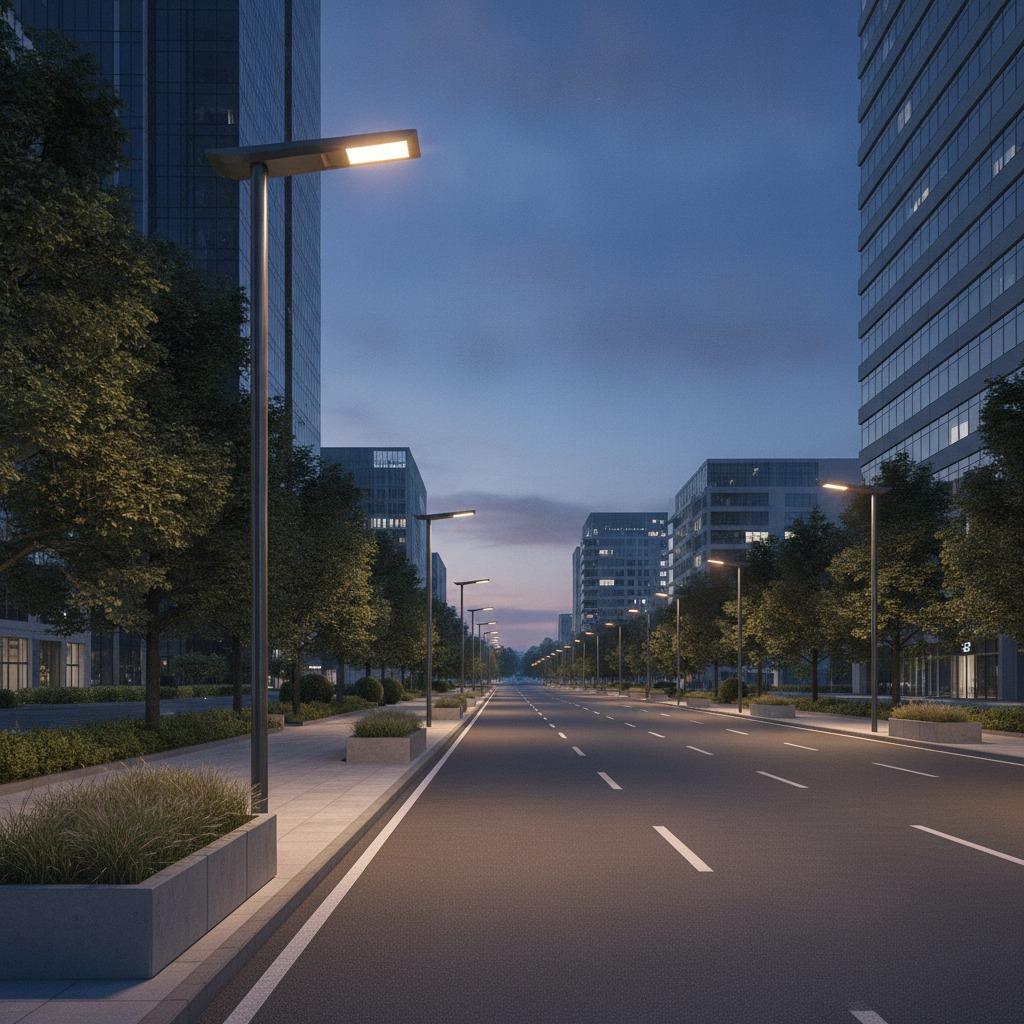
That last point matters. A site might not need the brightest possible fixture, but it does need uniform coverage. Multiple units working as a set can reduce dark patches and help the area feel safer after dusk. The image suggests that these lights are intended for exactly that kind of broad outdoor use.
How to evaluate an all in one solar street light manufacturer or supplier
When sourcing from an all in one solar street light manufacturer or all in one solar street light supplier, ask for the information that determines real-world performance rather than brochure language. The most useful details are the internal configuration, panel size, battery type, charging logic, lighting schedule, and serviceability of the enclosure. If the supplier cannot explain how the unit is assembled or maintained, that is worth noting.
It also helps to ask how replacement parts are handled. Integrated products are convenient, but convenience can turn into a headache if the battery or controller is difficult to access. Some buyers focus too heavily on the pole and light head and forget to ask what happens after a few seasons outdoors. That is usually where the real cost shows up.
Practical selection points
Look at the site first: road width, mounting height, expected operating hours, and whether surrounding trees or buildings will affect solar exposure. Then compare product configuration against that site, not against a generic catalog claim. If the installation area gets partial shade, the fixture may still work, but the design margin becomes more important. If the site is remote, service access matters more than a slightly lower purchase price.
Another quiet issue is visual consistency. In public-facing developments, a mismatched pole light can look improvised even if it works well. Since this style has a clean, straight profile, it usually fits neatly into planned outdoor environments, but the finish and mounting style should still be checked against the rest of the site hardware.
Common mistakes buyers make
One common mistake is assuming all all-in-one units are interchangeable. They are not. Another is treating solar street lighting as a drop-in replacement for every conventional pole light. It can be a strong option, but only when the application matches the system’s energy and maintenance profile.
A second mistake is over-specifying the fixture on paper while under-specifying installation and maintenance. The hardware may be sound, but if the site cannot keep the solar surface clear or the pole accessible, performance will drift. That is a small operational detail that often gets missed during procurement.
What to ask before placing an order
Ask for product drawings, material descriptions, internal component layout, and installation guidance. If the supplier provides a sample or reference image, review it for the pole bracket, head geometry, and finish consistency. For many buyers, a short technical conversation reveals more than a long catalog sheet. A capable supplier should be able to explain how the integrated unit is intended to be used on roads, sidewalks, campuses, and other outdoor spaces without making exaggerated claims.
FAQ
Is this type of light only for roads?
No. It is also used on pathways, business parks, residential developments, and landscaped public areas.
Does the all-in-one design simplify installation?
Usually yes, because the solar panel, LED module, and control components are built into one unit. But site conditions still matter.
Should I choose based on appearance alone?
No. Appearance helps with site fit, but the internal electrical and battery configuration is what determines long-term usefulness.
Next step for buyers and project teams
If you are comparing options for a roadway or campus project, start with the site conditions and then request detailed product data from the all in one solar street light supplier or manufacturer. The right unit is the one that fits the lighting plan, maintenance routine, and outdoor environment without forcing the project to work around the hardware.