
Why buyers keep asking for a different kind of LED flood light
When sourcing teams talk to an LED flood light manufacturer, the conversation is no longer only about brightness. For industrial sites, the real questions are usually more practical: can the light work without trenching, can it be mounted where the cable run would be expensive, and will it keep a yard usable after dark without turning the maintenance team into part-time electricians?
That is why solar-driven outdoor lighting keeps showing up in buyer shortlists. It solves a problem that standard wired floodlights cannot always solve cleanly. Remote gates, loading zones, temporary construction yards, overflow parking, and perimeter points often need light quickly. In those cases, an off-grid setup can be the difference between a project moving forward and a stalled site plan.
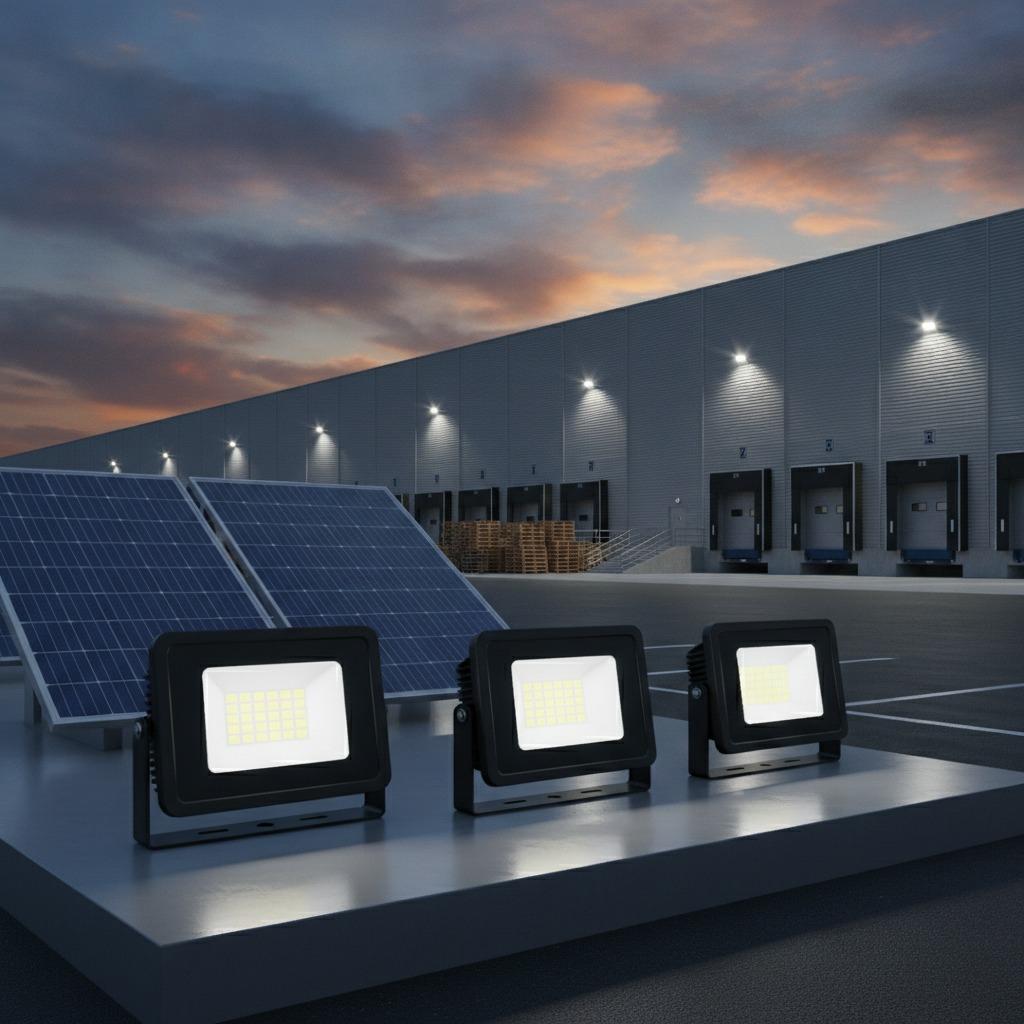
The product concept in front of us is straightforward. You have ground-mounted solar floodlights or spotlights with round black housings, front glass lenses, rear heat-sink fins, and adjustable A-frame brackets. You also have separate solar panels and a taller pole-mounted lamp with a panel above it. It is a familiar industrial solar lighting structure, but one that still needs careful evaluation before a buyer signs off.
What the configuration tells a buyer at a glance
The visible design suggests a complete solar LED lighting system assembled around a few core parts: photovoltaic panel, LED lamp head, control electronics, battery package, and mounting hardware. The exact internal specs are not shown, so a sourcing manager should avoid assuming wattage or runtime just because the unit looks substantial.
That caution matters. Two products can look similar from ten feet away and behave very differently once installed. One may be suited to short-duration task lighting, while another is intended for longer evening coverage. For industrial use, the margin between those two categories is not a minor detail; it affects safety, site operations, and the number of fixtures needed per zone.
The black housings and visible heat-sink fins are worth noting. They suggest the unit is designed to manage thermal load, which is especially important for LED performance over time. The angled brackets also indicate the fixtures are meant to be directed carefully, not just bolted in place and forgotten. That is helpful on real sites, where light spill, glare, and shadowing can be operational issues.
Interview-style question: what should buyers ask the factory first?
If I were sitting across from a LED flood light supplier, I would start with the basic system question: is this being sold as an integrated lighting assembly or as separate components? That sounds simple, but it changes procurement, spare parts planning, and installation scope.
A factory should be able to explain:
- how the panel, battery, controller, and lamp head are integrated
- what mounting options are available for ground, wall, or pole use
- whether the unit is intended for temporary or permanent installation
- what site conditions it is best suited for
Buyers should also ask for application guidance rather than only a spec sheet. For example, a yard light and a perimeter security light may both use solar LED technology, but they are not always interchangeable. The best supplier will talk about site layout, sun exposure, fixture spacing, and maintenance access, not just headline numbers.
Why solar LED floodlights are attractive for industrial sites
The value proposition is usually about installation economics and flexibility. If trenching is difficult, if utility capacity is limited, or if the site changes often, solar can simplify the project. That is especially relevant for logistics yards, construction staging areas, remote facilities, and seasonal operations.
There is also a practical advantage that sometimes gets overlooked: solar systems can reduce the pressure to finish electrical work before lighting is commissioned. In the real world, site schedules slip. A lighting solution that can be positioned with less dependence on grid infrastructure can keep operations moving.
Still, buyers should be careful not to treat solar as a magic substitute for every wired floodlight job. If a site needs all-night high-output illumination in a shaded area, or if the lighting must support very specific compliance requirements, the system has to be evaluated more carefully. Good vendors will not oversell suitability.
Selection criteria that matter more than marketing language
For engineers and sourcing managers, the shortlist should usually come down to four questions.
First, where will the system live? A bright open yard gives a solar panel far better conditions than a shaded warehouse edge or a tree-lined perimeter.
Second, how will the light be mounted? The product shown here includes adjustable angles and a pole-mounted option, which is useful because not every application should be solved with the same bracket.
Third, what is the maintenance strategy? Even a well-made solar light needs a plan for cleaning panels, checking mounts, and replacing aging components when the time comes.
Fourth, what is the buyer actually trying to protect or illuminate? Parking control, worker safety, security visibility, and temporary task lighting all push the spec in different directions.
Common mistakes buyers make
The most common mistake is buying by appearance. A sturdy-looking fixture does not automatically mean it is sized correctly for the site. Another mistake is ignoring panel placement. If the panel is mounted where it receives poor sun, the whole system underperforms no matter how good the lamp head looks.
A more subtle issue is overloading one fixture with too many expectations. A solar floodlight may be excellent for one application and only adequate for another. That is not a defect; it is a matching problem.
What to request before placing an order
Before committing to a vendor, ask for the product structure, installation method, and recommended application scenarios. If possible, request drawings or a system breakdown that shows how the lighting assembly is put together. Buyers should also confirm whether the unit is intended for industrial, commercial, or temporary outdoor use, because that affects the level of engineering support you should expect.
If you are comparing an LED flood light factory against another supplier, this is where the difference often appears. One shop sells hardware. The better one helps you match the hardware to the site.
FAQ: quick buyer answers
Can these lights replace all wired floodlights?
Not always. They are often a strong fit where trenching is hard or expensive, but site conditions decide the final answer.
Are they only for permanent installations?
No. The same solar lighting structure can suit temporary or permanent outdoor use, depending on the mounting and project goals.
What is the safest way to compare suppliers?
Compare system design, application guidance, and installation support—not just the nameplate claim on the lamp.
Next step for buyers
If your project involves parking lots, loading zones, yards, warehouses, or perimeter lighting, start with the site constraints first and the product second. Share the layout, sun exposure, and intended use with the supplier, then ask for a recommended configuration. That approach usually saves more time than chasing a one-size-fits-all quote.