
Why buyers keep asking for solar floodlighting now
When a purchasing team starts comparing options from an LED flood light manufacturer, the discussion usually goes beyond “how bright is it?” The real question is whether the lighting can work where trenching, cabling, and utility coordination are expensive or inconvenient. That is why solar flood lighting has moved from a niche choice to a serious line item for parking lots, yards, perimeter security, and industrial sites.
I sat down with a common buyer concern in mind: what should an engineer or sourcing manager look for before committing to this kind of outdoor lighting? The answer depends on the site, but the logic is consistent. You are balancing illumination, installation effort, maintenance access, and how much dependence you want on the grid. A good LED flood light supplier should be able to explain those tradeoffs clearly, not just push a glossy product sheet.
What the product set suggests at a glance
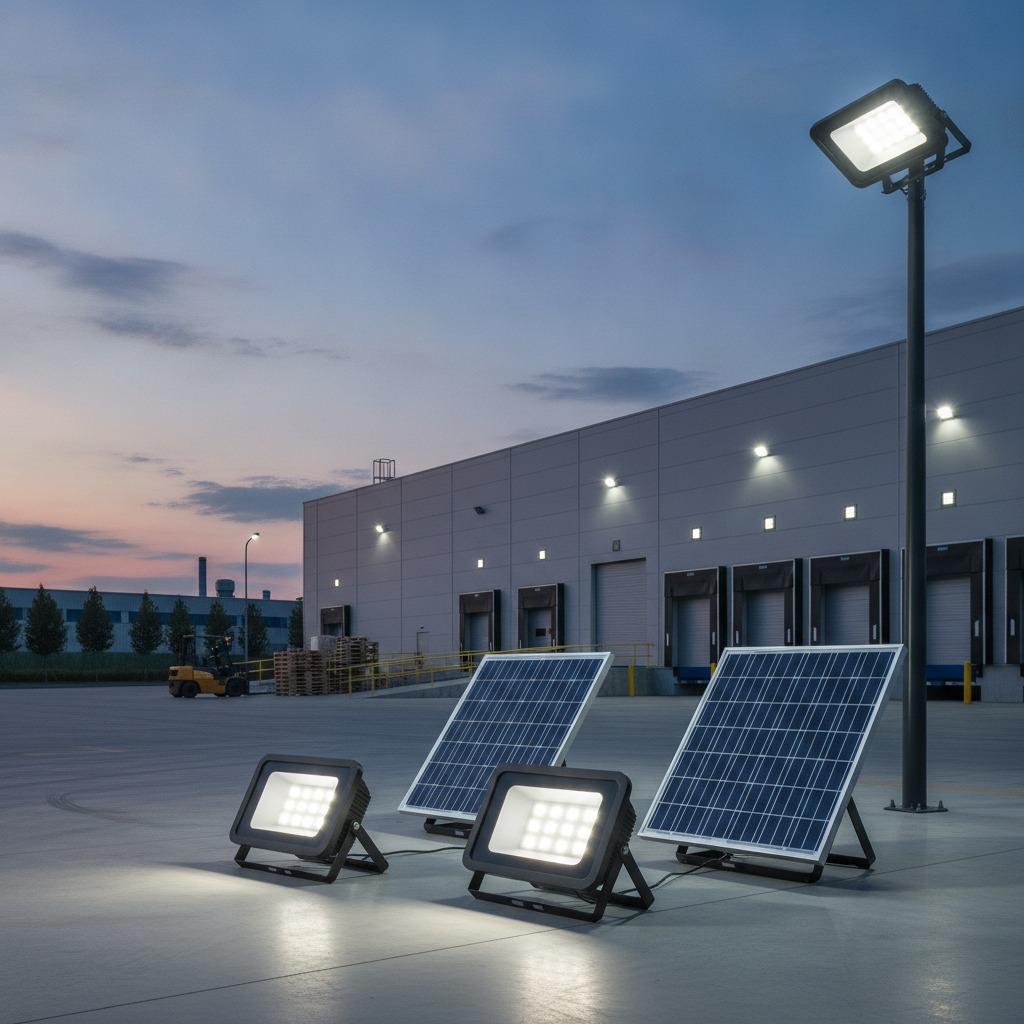
The product information points to a solar-powered outdoor lighting set built around round LED floodlights, separate rectangular solar panels, and a taller pole-mounted unit with the panel and light head integrated. That combination matters.
Separate panels can be useful when the best place for sunlight is not the best place for the light. In practical terms, that gives site planners more freedom: mount the solar module where it gets exposure, and position the floodlight where the beam is needed. The pole-mounted version, by contrast, is a cleaner option when you want a more self-contained area light and have space for a higher installation point.
The visible construction also tells a familiar story. Finned housings suggest heat dissipation, which is important for outdoor LED fixtures. Angled brackets point to adjustable aiming, and the likely metal or metal-look finishes are typical for rugged exterior use. None of that guarantees performance by itself, of course, but it does tell you the manufacturer is working in the right design language for outdoor lighting.
Key decision points before you buy
1. Site layout comes first
A solar floodlight system is not just a lamp. It is a placement decision. If the panel is shaded for half the day, the light may underperform regardless of the fixture quality. That is the first mistake many buyers make: they evaluate the light before evaluating the sun path.
For warehouses, loading areas, and perimeter fencing, sketch the site and identify both illumination zones and solar exposure zones. In some projects, separate panels are a real advantage. In others, a compact integrated unit is easier to manage.
2. Decide whether you need flood coverage or focused security lighting
Floodlights are usually chosen for broad, directional coverage. That makes them useful for driveways, courtyards, access roads, and boundary lines. If the goal is to light a narrow gate or a single doorway, a larger flood pattern may be more than you need. Buyers sometimes overspecify light spread and then end up with spill light where it is not wanted.
3. Think about installation and maintenance, not just hardware
A solar system can reduce wiring work, but it does not eliminate field service. Panels still need cleaning. Brackets still need checking. And any outdoor electrical assembly should be examined for weather resistance, cable routing, and mounting stability. A seasoned LED flood light factory should be able to discuss these basic service realities without sounding defensive.
How buyers typically compare solar floodlight options
There are really three product styles in play here.
First, the separate-panel floodlight system. This is the most flexible when sunlight and lighting position are different. It suits semi-permanent installs and larger outdoor sites.
Second, the integrated pole-mounted unit. This is often simpler to deploy where a single mounting point is acceptable and the light needs to sit at a higher level.
Third, a more conventional wired floodlight. It may still be the better choice if you already have electrical infrastructure and need steady operation with less dependence on daylight. Solar is attractive, but it is not automatically the best answer for every site.
Questions worth asking a manufacturer
If you are speaking with a manufacturer or supplier, ask direct questions:
What site conditions does the system assume?
How are the solar panels mounted and adjusted?
What outdoor environments has the housing been designed for?
Can the fixture be aimed after installation?
What maintenance does the system typically require?
These are practical questions, not procurement theater. A credible manufacturer should answer them plainly, even if some performance details vary by model or configuration.
Common mistakes that lead to disappointment
The biggest one is assuming every solar floodlight behaves the same. They do not. Panel size, battery design, control electronics, and mounting geometry can change the real-world result more than buyers expect.
Another common issue is mixing up decorative exterior lighting with site lighting. Parking lots and industrial edges are not garden paths. The installation needs to be judged on coverage, durability, and service access, not just on the appearance of the fixture.
What a sensible buying decision looks like
If your project is off-grid, temporary, or difficult to trench, a solar LED floodlight system is worth serious attention. If your project is mission-critical and depends on guaranteed runtime every night, you will need to look closely at backup behavior and operating assumptions before you commit.
That is where a good sourcing conversation helps. The right LED flood light manufacturer should help you match the fixture style to the site, not force a one-size-fits-all answer.
FAQ
Is a solar floodlight always lower cost?
Not always. It may reduce wiring and installation work, but hardware and site-specific mounting can offset part of that savings.
Are separate solar panels better than integrated units?
They are better for some sites, especially when the brightest sun exposure is not near the lighting target. For simpler layouts, integrated units can be easier.
What should I verify before placing an order?
Check the mounting arrangement, outdoor exposure requirements, maintenance access, and whether the fixture style actually matches your lighting goal.
Next step
If you are comparing a LED flood light supplier for a solar outdoor project, start with your site sketch, then ask for the fixture configuration that fits it. That single step saves more time than most buyers realize, and it usually separates a workable lighting plan from a costly field correction.