
What buyers are really comparing when they look for a LiFePO4 solar street light supplier
Choosing a LiFePO4 solar street light supplier is rarely just about buying a lamp on a pole. For engineers, sourcing managers, and project teams, the real decision is whether the lighting system can stand up to an outdoor roadway environment without becoming a maintenance problem six months later. That matters because once a solar street light is installed along a municipal street, campus road, or residential route, the costs are not just in the hardware. They show up in access, replacement, downtime, and complaints from users who notice dark spots before anyone in procurement does.
A LiFePO4 battery solar street light usually brings together a pole-mounted LED luminaire, a photovoltaic panel, a charge controller, and a lithium iron phosphate battery package inside the system. The setup is designed to collect energy during the day and provide nighttime lighting without trenching cables. In the field, that simplicity is the appeal. In procurement, the challenge is that the visible product can look straightforward while the hidden parts determine whether the system performs acceptably in real weather, not just on a spec sheet.
Why LiFePO4 keeps showing up in outdoor lighting projects
LiFePO4 battery chemistry has become common in solar lighting because buyers generally value its stability and cycle performance compared with other lithium chemistries. That does not mean every system is equal, and it certainly does not mean every supplier builds the battery pack well. But the chemistry itself is a practical fit for street lighting, where charging and discharging happen repeatedly and the battery lives outdoors or in a semi-enclosed housing.
For roads, parks, and campus paths, the main attraction is dependable night operation with fewer cable runs. If a project is going into a new development or an industrial park where trenching is awkward or expensive, solar lighting can simplify the job. The trade-off is that the system must be sized and integrated properly. A neat-looking pole and lamp head mean very little if the battery is underspecified or the solar module is not matched to local sunlight conditions.
What a buyer should inspect before shortlisting a supplier
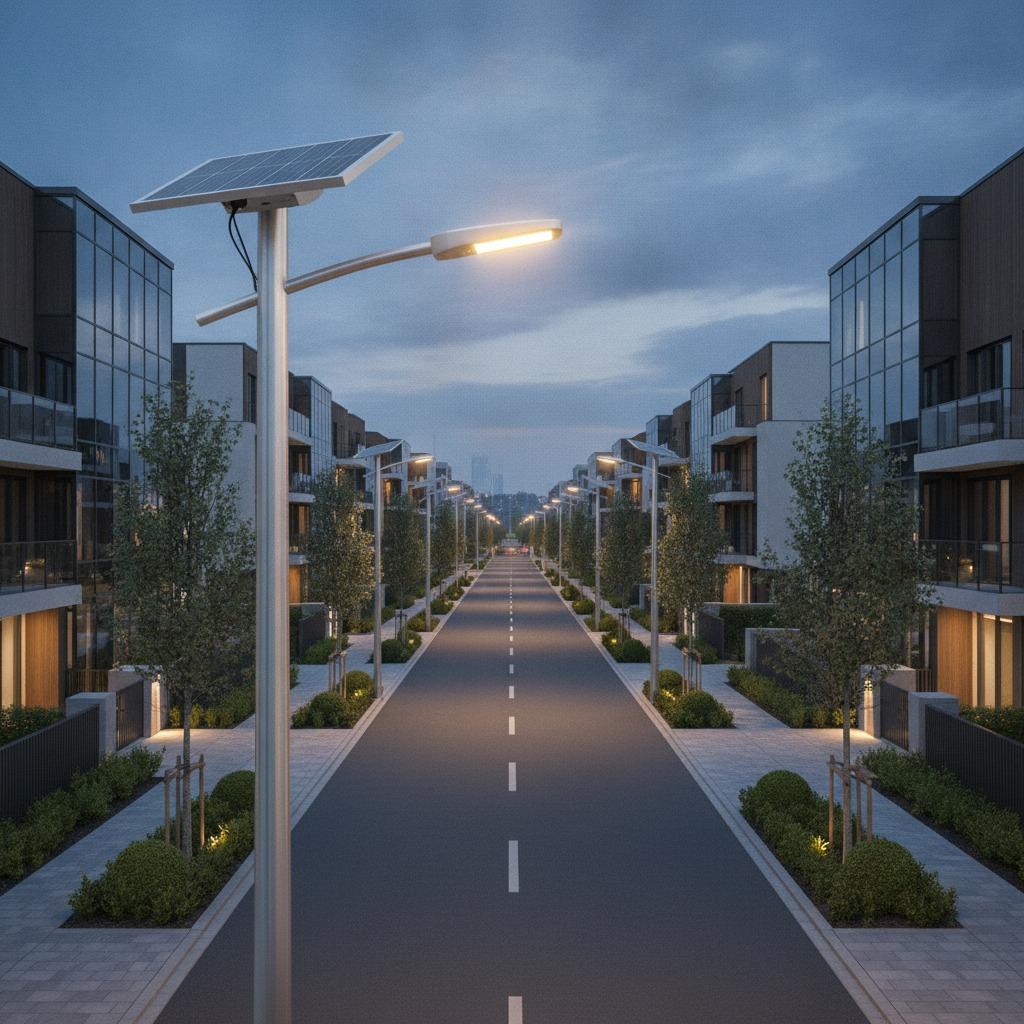
The image and notes describe a familiar roadway lighting layout: tall metal poles, a horizontal arm, a rectangular LED light head, and an angled solar panel mounted above or behind the luminaire. That arrangement is typical of integrated solar street lighting. It also tells you where quality tends to fail first.
Battery integration
If the supplier advertises LiFePO4, ask how the battery is packaged, protected, and serviced. The chemistry is one thing; thermal management, enclosure sealing, and control electronics are another. Buyers should be careful here. A battery hidden inside the pole or housing is convenient, but access for service matters if the project is expected to run for years.
Lighting and optical layout
The LED head should suit roadway use, not just general area lighting. Engineers will want to know how the light is distributed across the pavement and whether the fixture is intended for streets, residential roads, or broader public areas. Since the supplied information does not include lumen output or beam pattern, those details need to be confirmed directly with the supplier.
Solar module and structural fit
The visible panel is a key clue. If the panel area is too small for the load, the whole system can become fragile in poor weather. At the same time, the pole, arm, and mounting hardware must tolerate outdoor wind and vibration. That sounds obvious, but it is where field complaints often begin. A system that looks fine in a yard test can behave differently after repeated seasonal exposure.
Where a LiFePO4 solar street light supplier adds real value
A competent supplier is more than a seller of individual parts. The better ones understand metal fabrication, powder-coated or painted finishes, photovoltaic module integration, and LED luminaire assembly as one system. That matters because the outdoor lighting product fails as a system, not as isolated components.
For buyers, this means looking beyond a single product photo. Ask whether the supplier can support roadway applications such as municipal streets, residential communities, parks, and campus roads. Ask how they handle mounting details, wiring protection, and the interface between the pole, panel, and fixture. If the answer is vague, the project team may be looking at a generic assembly rather than a purpose-built lighting solution.
Common mistakes when sourcing this category
The most common mistake is treating every solar street light as interchangeable. It is not. Pole height, site usage, sunlight availability, and desired lighting hours all affect the final design, even before battery sizing enters the discussion.
Another mistake is focusing on the battery chemistry while ignoring the rest of the package. LiFePO4 is a good sign, but it does not compensate for weak housings, poor sealing, or mismatched electronics. Buyers sometimes ask for the battery first and the system engineering second. That order usually creates trouble later.
A third mistake is skipping the service conversation. If the project is remote, distributed, or expected to scale, replacement strategy matters. The supplier should be able to explain how the system is maintained, not just how it is sold.
A practical buying approach for engineers and sourcing teams
Start with the application: roadway, park, campus, or residential road. Then define the operating conditions: off-grid or grid-assisted, local sunlight, installation environment, and maintenance access. After that, compare how each LiFePO4 solar street light manufacturer presents the system as a whole, not just the headline battery chemistry.
If you are evaluating a LiFePO4 solar street light supplier, ask for the component breakdown, the structural configuration, and the service approach. That will tell you much more than a glossy product image ever will.
Next step
If your project needs solar roadway lighting and you are comparing suppliers, request a full system specification and a component-level explanation before you send out a purchase order. In this category, the details hidden inside the pole are usually the ones that decide whether the lights stay on.