
Why buyers ask for a LiFePO4 solar street light supplier in the first place
A lot of sourcing requests for a LiFePO4 solar street light supplier start with the same problem: a road, campus, park, or industrial lane needs dependable lighting, but running new cable is slow, disruptive, or simply expensive. In those cases, buyers usually want a fixture that can work with limited wiring, reduce trenching, and keep night lighting stable enough for everyday use. That is where the conversation quickly turns from ordinary outdoor lighting to battery-backed solar systems, and more specifically to LiFePO4 battery solar street light solutions.
The battery matters because it is the part that decides whether a system stays useful after a few cloudy days, during seasonal changes, or in places where maintenance visits are infrequent. If the battery is underspecified, the whole project becomes hard to trust. If the battery chemistry is unsuitable for repeated daily cycling, replacement costs creep in earlier than planned. For engineers and sourcing teams, that makes supplier selection more than a price exercise.
What the visible product tells you, and what it does not
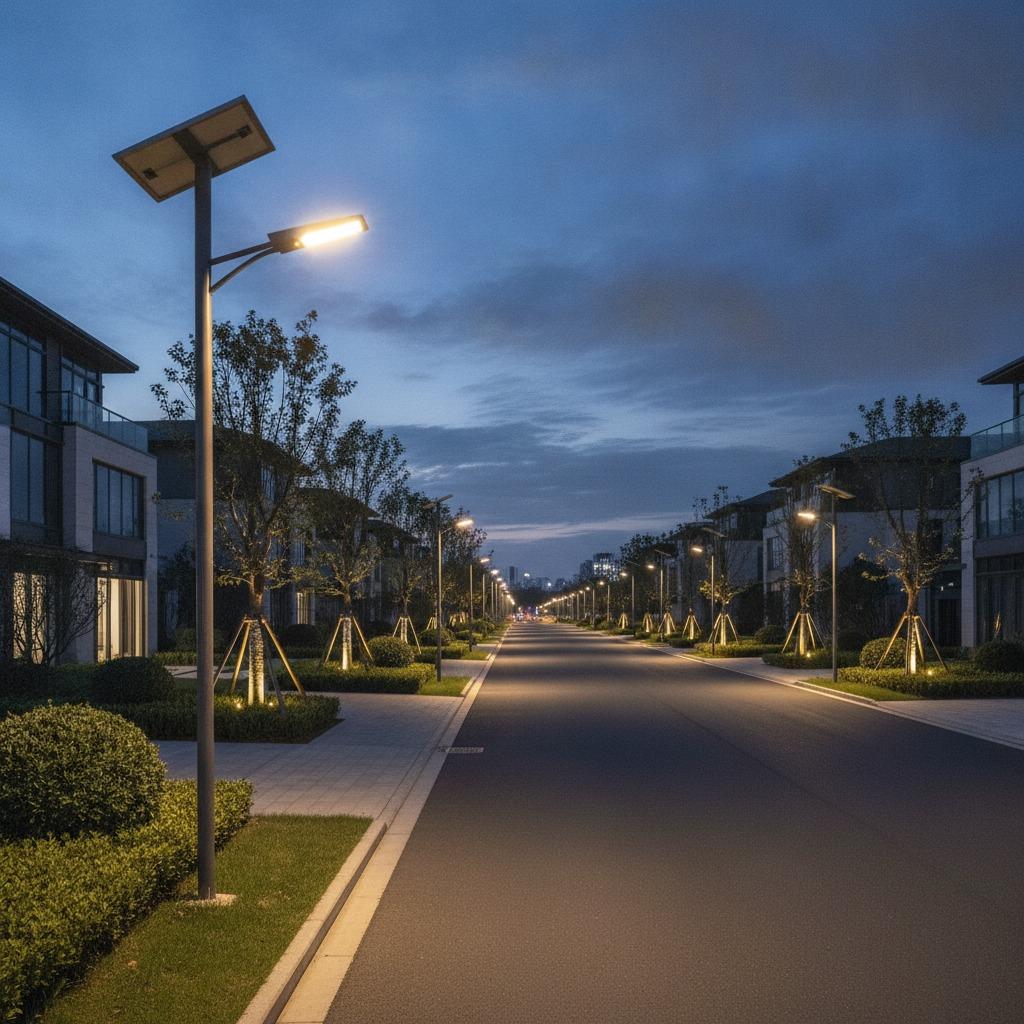
The product category here is straightforward: a solar street light assembly with a tall metal pole, a single side-mounted arm, a rectangular LED light head, and a tilted photovoltaic panel positioned above or behind the luminaire. The structure suggests a common roadway lighting format used on community roads, campus routes, parking zones, parks, and other areas where a neat, repeatable lighting line is more practical than decorative fixtures.
From the image alone, you can confirm a few useful things. The system is clearly solar powered. The units are installed in a line, which signals suitability for route lighting rather than isolated accent use. The fixtures are illuminated at dusk or night, so they are functioning in real conditions rather than only in a showroom.
What you cannot confirm from the image is just as important. Wattage, lumen output, battery capacity, charge time, runtime, IP rating, pole height, and sensor behavior are not visible. The same caution applies to the battery itself: LiFePO4 is suggested by the brief, but not proven by the image. Buyers should treat that as a specification to verify, not an assumption to repeat in a purchase order.
Why LiFePO4 has become the battery chemistry buyers ask for
LiFePO4 is favored in many solar lighting programs because it is generally associated with stable cycling behavior and a long service life in daily charge-discharge use. That matters in street lighting, where the battery is not a backup accessory but the core energy store. A solar lamp can have a tidy pole and a good-looking luminaire, yet still fail if the storage system cannot handle repeated outdoor service.
For procurement teams, the appeal is practical. A LiFePO4 battery solar street light can be easier to justify when the site needs lower maintenance frequency, better consistency across seasons, and less sensitivity to the abuse that comes with outdoor temperature swings. That said, chemistry alone does not guarantee performance. The control electronics, charging strategy, panel size, and installation angle all affect real-world results.
How to evaluate a LiFePO4 solar street light manufacturer before you buy
A serious LiFePO4 solar street light manufacturer should be able to discuss the whole system, not just the lamp head. Ask how the pole, arm, panel bracket, and luminaire housing are fabricated and finished. Outdoor lighting lives or dies on metalwork and coating quality just as much as on electrical components. A dark gray or black powder-coated pole may look ordinary, but finish consistency and corrosion protection are what keep the fixture serviceable.
It also helps to ask how the LED module, solar panel, and battery are integrated. Is the design modular for easier replacement? Can the battery compartment be accessed without disturbing the entire head? Is the system designed for easy field service, or does every repair turn into a full disassembly? These are the unglamorous questions that save money later.
Buyer-facing checks that matter more than brochure language
Look for clarity on these points before comparing suppliers:
Panel orientation and mounting method for local sun conditions
Battery chemistry confirmation in writing, not just in sales copy
Control logic for dusk-to-dawn operation or motion-based dimming, if offered
Pole and bracket construction suitable for wind and outdoor exposure
Spare part availability for the LED module, controller, and battery pack
A small caution here: many solar lighting projects are lost on assumptions. Buyers assume the fixture will behave like a utility-powered street light, but a solar unit is a balance of energy capture, storage, and load management. If one part is oversized or undersized, the whole system feels unreliable.
Common mistakes when sourcing solar roadway lighting
One common mistake is focusing only on the lamp body and ignoring the battery pack. Another is buying by pole height alone, as if taller always means better. In reality, height, spacing, beam distribution, and panel exposure all have to work together.
Another frequent issue is mixing use cases. A fixture that works well on a quiet residential lane may not suit a busy industrial park road with longer operating hours and stricter visibility needs. The application should shape the specification, not the other way around.
What this product type is best suited for
This style of solar street light is a sensible fit for community roads, campuses, parks, industrial parks, business perimeters, and parking areas where off-grid or low-wiring lighting is desirable. It is also useful where construction disruption must be limited. The slim pole, cantilever arm, and integrated solar module make installation more straightforward than a conventional wired lighting run, though “simple” is relative—foundation work and alignment still matter.
How to narrow down a supplier shortlist
If you are choosing a LiFePO4 solar street light supplier, start with technical transparency. A supplier that can explain the complete lighting package, including pole fabrication, coating, photovoltaic integration, and battery architecture, is usually a safer partner than one that only quotes a catalog model number. Ask for product drawings, electrical details, and a clear list of what is included in the assembly.
For engineering teams, it is also worth asking how the fixture will be configured for your site: roadway spacing, expected sun exposure, local weather, and daily operating hours. For sourcing managers, the practical question is simpler: can this supplier deliver a repeatable product that is easy to install, maintain, and verify on arrival?
Next step
If you are comparing suppliers now, build the conversation around the battery, the pole structure, and the control system—not only the visible lamp. That is usually where the difference between a decent quote and a dependable long-term lighting solution becomes clear.