
What buyers really need to know before choosing a solar flood light manufacturer
If you are sourcing a solar flood light manufacturer, the main question is usually not whether the fixture can turn on after dark. It is whether the product will stay reliable on a real site: a warehouse wall, a fence line, a parking lot, or a remote yard where grid power is expensive or awkward to bring in. That is where the decision gets practical fast. A good solar flood light supplier is not just selling a lamp; they are supplying a complete outdoor lighting system with a solar panel, rechargeable battery, LED floodlight head, and the sealing and mounting details that keep it working outside.
For engineers and sourcing teams, the challenge is to separate a decent-looking sample from a product that can handle daily weather exposure, angle adjustment, and uneven charging conditions. The difference is often in the parts you do not notice first: housing construction, battery integration, bracket strength, cable management, and how the panel and light head work together as one system.
Quick buyer takeaways
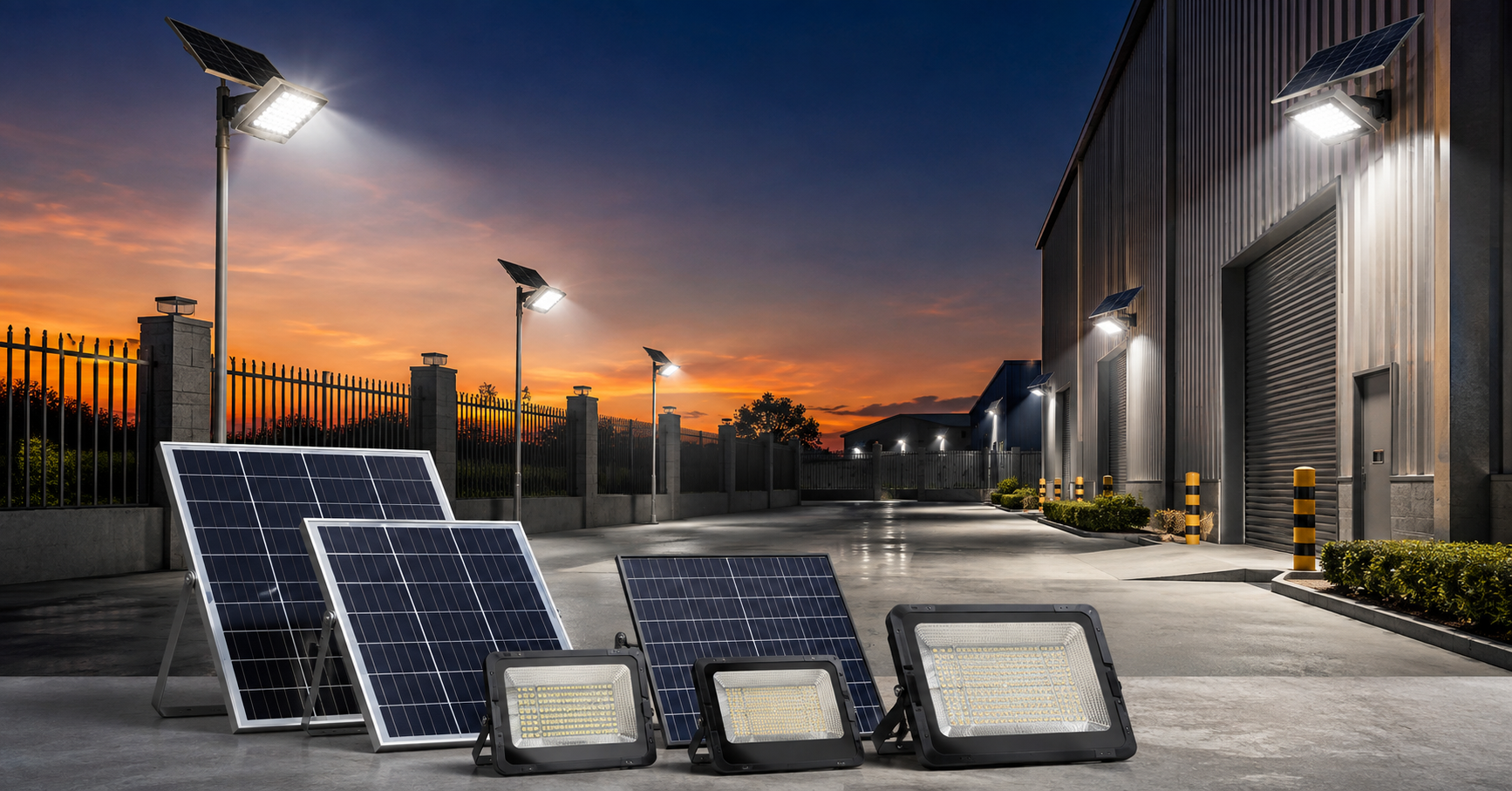
Solar flood lights are generally chosen for security lighting, perimeter coverage, yard illumination, building façades, loading areas, and other outdoor locations where running power lines is undesirable. The separate-panel layout seen in many commercial installations is useful because it lets the panel face better sunlight while the light head is aimed where illumination is needed. That sounds simple, but it matters a lot in the field.
When comparing a solar flood light factory or supplier, focus on four things first: outdoor durability, mounting flexibility, electrical system quality, and consistency across batches. The LED head, bracket, panel frame, and enclosure all need to behave like one product. If one part is underspecified, the whole installation suffers.
How the product is typically built
From a manufacturing point of view, this is an assembled electrical lighting product. The visible structure usually includes a rectangular LED floodlight head with multiple emitters behind a clear lens, a matte black outdoor housing, and an adjustable yoke or mounting bracket for angle positioning. The solar panel is separate, often mounted on a frame or pole, and it uses blue-black photovoltaic cells in an aluminum-looking frame.
That split configuration is common because it gives installers more freedom. The panel can be positioned for better sun exposure while the lamp is aimed at a doorway, wall, lot, or fence line. For buyers, this is one of the clearest advantages of working with an experienced solar flood light manufacturer: the product should make installation easier, not force awkward compromises on site.
What to ask about the internal assembly
Even when the outside looks straightforward, the interior is doing a lot of work. A commercial-grade unit typically combines a PV module, rechargeable battery, LED driver, and outdoor-rated housing. The exact internal construction is not visible in the product image, so buyers should ask how the parts are integrated, how the enclosure is sealed, and whether the design is intended for long-term exterior use. It is also worth checking whether the cable routing and connectors are built to tolerate repeated adjustment and weather exposure.
Selection criteria that matter in real projects
Start with the application. A warehouse exterior has different needs than a fence line or a remote storage yard. Then look at mounting. The bracket needs to hold position after installation, not slowly drift because of vibration, wind, or poor hardware. That may sound like a small detail, but on pole-mounted or wall-mounted systems it becomes obvious very quickly.
Next, review the enclosure and finish. The visible matte black housings and weather-resistant look are encouraging, but appearance alone is not proof of durability. Ask what materials are used, how the front lens is protected, and how the unit is designed to resist outdoor exposure. If the supplier is vague here, treat that as a warning sign.
Finally, look at the system as a whole rather than just the floodlight head. A strong solar flood light factory should be able to explain how panel size, battery storage, and LED demand are balanced. Buyers do not need marketing claims; they need a setup that matches site conditions and realistic night-time use.
Common mistakes buyers make
The most common mistake is comparing only the light fixture and ignoring the panel and battery relationship. Another is underestimating installation conditions. A product that looks fine on a demo wall may perform differently once the panel is mounted farther from the light, or once the angle is constrained by the building layout. Buyers also sometimes overlook support documentation. For commercial projects, installation clarity matters almost as much as product appearance.
There is also a quiet procurement trap: choosing solely on price from a solar flood light supplier without confirming what is actually included in the kit. Separate panel-and-light systems can vary a great deal in hardware completeness, cable lengths, and mounting accessories. That can affect project labor and frustration more than the initial unit cost.
FAQ
What are solar flood lights best used for?
They are commonly used for outdoor security and area lighting, including yards, parking areas, entrances, fences, warehouse exteriors, and remote locations where grid power is limited.
Why use a separate panel instead of an all-in-one design?
A separate panel gives more flexibility. It can be placed where sunlight is better while the light head is aimed where illumination is needed. That is often the better choice for commercial sites.
What should I verify before placing an order?
Ask about housing construction, sealing approach, mounting hardware, battery and driver integration, and whether the product is intended for the specific outdoor setting you have in mind. If the supplier cannot answer those questions clearly, move cautiously.
A practical next step for buyers
If you are shortlisting a solar flood light manufacturer, ask for a sample kit and installation details rather than just a brochure. A real evaluation should include how the panel mounts, how the bracket holds position, and how the system behaves as a complete outdoor lighting package. That is the fastest way to tell whether you are dealing with a serious solar flood light factory or just a generic product reseller.